
Category: Lost Worlds. Template: excavation diary, organised by what each phase of digging overturned.
In 1963 a joint survey team from Istanbul and Chicago walked over a low hill in south-eastern Turkey, noted broken limestone slabs and a scatter of flint, and recorded it as a medieval cemetery. They moved on.
They were wrong by about ten thousand years.
1994: what Klaus Schmidt saw
A German archaeologist named Klaus Schmidt read the 1963 survey notes while looking for a site to excavate. One detail stopped him. The report mentioned slabs of worked limestone, and the flint scatter was heavy.
Schmidt went to look. He later said he understood within minutes that he had two choices: leave immediately, or spend the rest of his life there.
He spent the rest of his life there. He died in 2014 with the excavation perhaps five per cent complete.
What came out of the ground
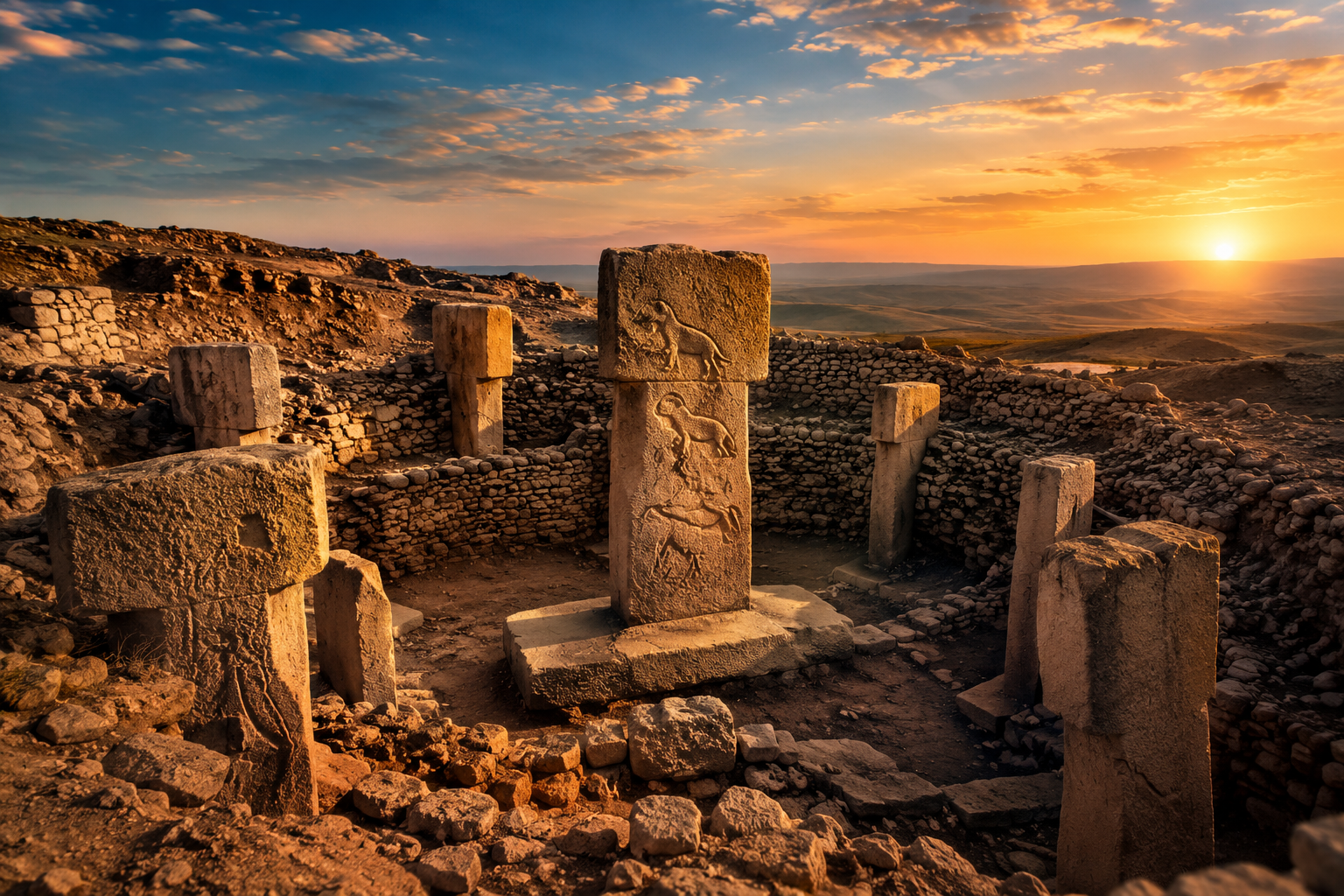
Circular and oval enclosures, walled, with T-shaped limestone pillars set into the walls and two much larger pillars standing free in the centre of each.
The central pillars run up to about five and a half metres and weigh in the region of eight to ten tonnes. They are carved. Foxes, boars, snakes, cranes, scorpions, vultures, aurochs. Some carry arms in low relief down their sides, hands meeting at the front over what looks like a belt, which makes the T-shape a stylised human figure.
Radiocarbon dates from the fill put the earliest enclosures somewhere around 9500 BCE.
That number is the entire problem. It is roughly six thousand years before Stonehenge. It is about five and a half thousand years before the first Egyptian pyramid. It predates pottery, metal, the wheel, writing, and, on the evidence from the site itself, agriculture.
The claim that made it famous, and why it has softened
Schmidt argued that the sequence historians had assumed was backwards. The standard account ran: agriculture produces surplus, surplus produces settlement, settlement produces hierarchy, hierarchy produces monumental religion. Gobekli Tepe appeared to show monumental construction by people who had not yet domesticated anything, which would mean the temple came first and the farm followed.
The site was widely reported as the world’s first temple, built by hunter-gatherers, and that framing is still the one most people have.
Excavation since Schmidt’s death has complicated it considerably, and an honest article has to say so.
Domestic material has been found in the enclosures: grinding stones, hearths, large quantities of animal bone with butchery marks, and cisterns cut into the bedrock. The interpretation now favoured by several of the researchers working there is that these were not purely ceremonial buildings but structures that combined residence, feasting and ritual, which is a distinction that may say more about modern categories than about the neolithic.
The enclosures were also not all standing at once. They were built, used, and deliberately backfilled, sometimes to be replaced.
And Gobekli Tepe turns out not to be unique. Karahan Tepe, about thirty-five kilometres away, has produced comparable architecture including a room with pillars carved as human heads rising from the floor. The wider group of sites, sometimes called the Tas Tepeler, means we are looking at a regional culture rather than a single inexplicable outlier.
None of that undoes the significance. Large-scale coordinated stone construction, in that place, at that date, still requires an explanation, and the explanation still involves a lot of people working together before the conditions that were supposed to make that possible existed.
The burial that was not a burial
One expectation has consistently failed. Schmidt predicted graves under the central pillars and searched for them. None has been found.
What has been found is stranger. Fragments of human skull with deliberate cut marks, drilled holes and applied pigment, in a pattern that has no close parallel and has been described as a previously unknown skull cult. Whether this was veneration of ancestors, treatment of enemies, or something with no modern category is not established.
What to be careful about
The site attracts a great deal of nonsense, and a reader arriving from a search engine will have met some of it.
There is no evidence of lost advanced civilisations, of an antediluvian culture, or of astronomical encoding of a comet impact. The comet claim, based on reading the carvings on one pillar as a star map, was published and then substantially rebutted by the excavation team on the grounds that the animals depicted are the standard repertoire of the site and that the dating does not support the argument.
The honest summary is that Gobekli Tepe is astonishing without any assistance. It does not need to be older than it is, and it does not need visitors.
Questions About Gobekli Tepe
How old is Gobekli Tepe? The earliest enclosures date to around 9500 BCE. That is roughly six thousand years before Stonehenge and about five and a half thousand years before the first Egyptian pyramid.
Who built Gobekli Tepe? Hunter-gatherer communities of the pre-pottery neolithic, working together at a scale that agriculture was assumed to be a precondition for. No evidence of domesticated crops or animals has been found in the earliest phases.
Was Gobekli Tepe really the world’s first temple? That framing came from Klaus Schmidt’s early interpretation and has since been complicated. Excavators have found grinding stones, hearths, butchery waste and cisterns in the enclosures, and now describe them as combining residence, feasting and ritual.
What are the T-shaped pillars? Carved limestone monoliths up to about five and a half metres tall, weighing eight to ten tonnes. Several carry arms in low relief with hands meeting over a belt, which makes the T a stylised human figure.
Is Gobekli Tepe the only site of its kind? No. Karahan Tepe, about thirty-five kilometres away, has comparable architecture, and the wider group of sites indicates a regional culture rather than a single unexplained outlier.
Does Gobekli Tepe show evidence of a lost civilisation? No. There is no evidence of advanced technology, of an antediluvian culture, or of astronomical encoding. The excavation team has published a rebuttal of the comet-impact reading of the carvings.
Sources
Primary: the excavation reports of the Deutsches Archaologisches Institut, published in Neo-Lithics and in the annual reports of the Sanliurfa excavations. Klaus Schmidt, Gobekli Tepe: A Stone Age Sanctuary in South-Eastern Anatolia (2012), which is his own account and is the source for the 1994 rediscovery.
Modern scholarship: Lee Clare and colleagues at the DAI have published the reassessments of the domestic evidence and the response to the comet hypothesis. Oliver Dietrich on the feasting evidence. Julia Gresky, Juliane Haelm and Lee Clare, Modified Human Crania from Gobekli Tepe Provide Evidence for a New Form of Neolithic Skull Cult, Science Advances (2017). On Karahan Tepe and the wider group, the ongoing Tas Tepeler project publications.
Popular caution: Ian Hodder’s work on Catalhoyuk provides the standard comparison for how neolithic ritual and domestic space overlap, and is a useful corrective to the temple framing.