Updated 8 October 2026: corrected claims about Ashoka. See Corrections.
In 1837 a British civil servant named James Prinsep, working in the Calcutta mint, finished cracking a script nobody had been able to read for over a thousand years. The inscriptions it unlocked were carved on rock faces and polished sandstone pillars scattered from Afghanistan to the southern Deccan, and they were all written in the first person by a king who called himself Beloved of the Gods.
For decades nobody could match the voice on the stones to a name in the histories. The identification came from the Sri Lankan Buddhist chronicles, the Dipavamsa and Mahavamsa, which give Ashoka the same title used on the edicts, and it was settled in 1915 when an edict found at Maski, in present-day Karnataka, named him outright.
The king was Ashoka, and what he had done was without precedent. He had used the most durable medium available to him to publish, across an entire subcontinent, an account of a war he had won and regretted.
Start with the object
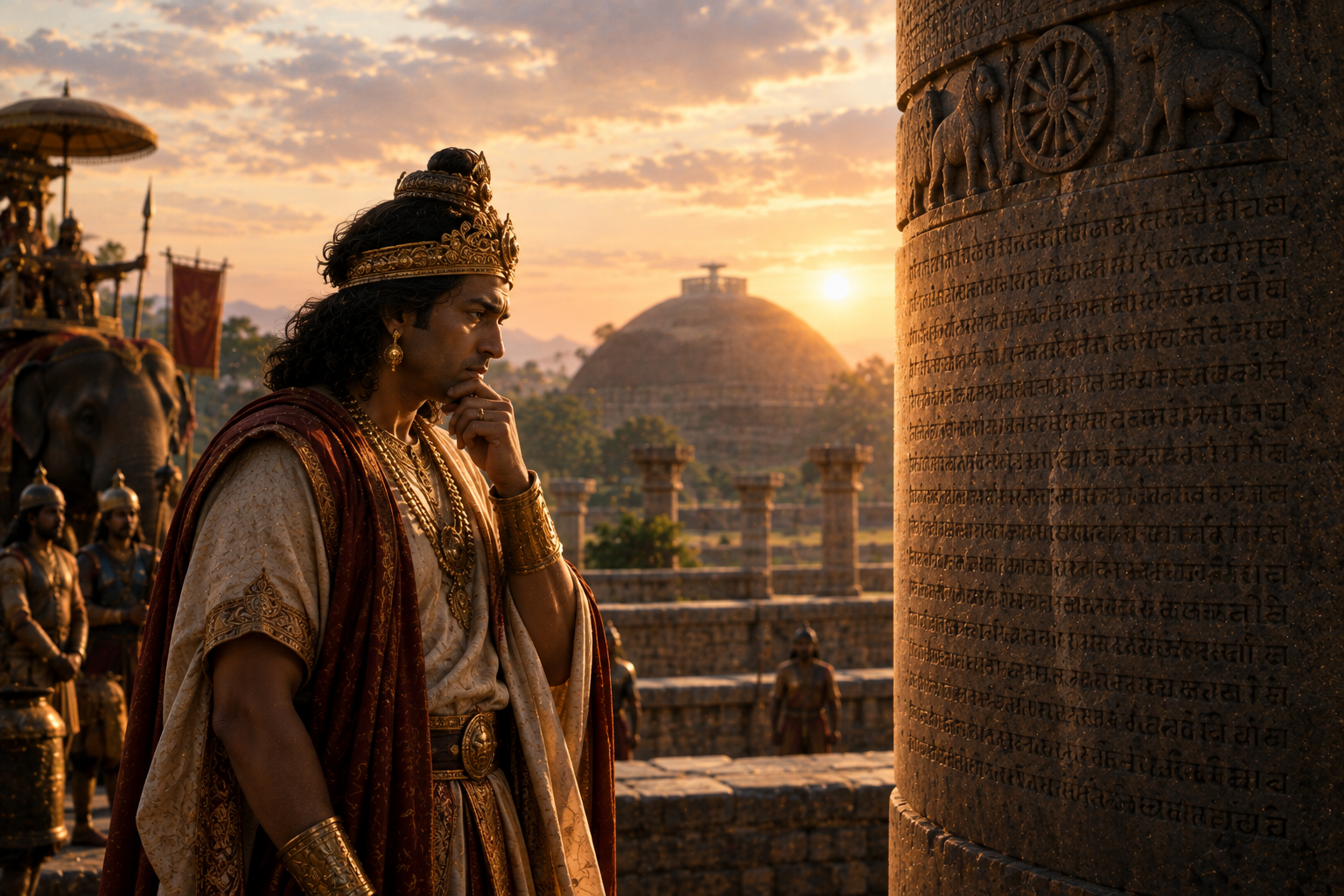
The Thirteenth Major Rock Edict is the one that matters most, and it is worth understanding what it physically is before what it says.
It is carved into rock at several locations, in local scripts and local language variants, positioned near roads and settlements so that people would encounter it. Some versions are in Greek and Aramaic, at Kandahar, because the empire’s north-west spoke those languages. This was a deliberate, engineered, multilingual publication programme.
The text describes the conquest of Kalinga, on the eastern coast, in about the ninth year of the reign. It gives figures: deported, killed, dead afterwards. And then it does something that no other royal inscription from the ancient world does. It says the king felt remorse. It says that when an independent country is conquered, the killing and the carrying away of people is grievous, and that this weighed on him. It states that he now considers conquest by dharma to be the only conquest worth having.
A ruler carved that, at his own instruction, in public, in multiple languages, and left it standing.
What the edicts actually contain
Read as a body, the inscriptions are less a spiritual autobiography than an administrative programme with an ethical justification attached.
They announce restrictions on animal slaughter, including a list of protected species and an end to the royal hunt. They record the planting of banyan trees for shade along roads, the digging of wells, and the establishment of rest houses. They describe medical provision for people and for animals, and the cultivation of medicinal plants. They appoint a new class of officer, the dhamma-mahamatas, charged with welfare and with the fair treatment of prisoners.
They are also insistent, repeatedly, on religious tolerance. One edict states that a person who praises their own sect and disparages another damages their own sect by doing so. That is a striking position for a state document in the third century BCE.
And they are personal in a way official inscriptions almost never are. Ashoka complains that his officers do not always do what he asks. He worries that his message will not last. He instructs that the pillars be maintained so the text survives.
The problem of the two Ashokas
There is a second Ashoka, and he is much better known in South and South-East Asian Buddhist tradition than the one on the stones.
The literary Ashoka comes from texts such as the Ashokavadana and the Sri Lankan chronicles, composed centuries later. In them he is Chandashoka, Ashoka the Cruel, who murders his brothers to take the throne, builds a prison decorated as a paradise where visitors are tortured, and is then converted, dramatically, and becomes Dharmashoka.
The edicts do not support that arc. They mention brothers and sisters who are alive and whose households the king is concerned about. The conversion in the edicts is gradual and follows Kalinga rather than a personal encounter with a monk. The extravagant cruelty appears nowhere.
The two Ashokas serve different purposes. The literary one is a conversion narrative for a monastic audience, and the extremity of the before makes the after more powerful. The one on the stones is a working ruler explaining a change in policy to his own administration and population.
Where they conflict, the edicts are the stronger evidence, because they are contemporary, first-person, and carved on the emperor’s own instruction.
What actually happened afterwards
The honest ending is not triumphant. The Mauryan empire did not last long after him. Within about fifty years of his death the dynasty was gone, and it is genuinely arguable whether his programme was sustainable at that scale.
His memory faded in India so completely that by the medieval period the pillars were unattributed monuments, and one Mughal-era account speculates about who might have raised them. Firuz Shah Tughlaq had two pillars moved to Delhi in the fourteenth century with considerable engineering effort, apparently admiring them without being able to read them. The Moroccan traveller Ibn Battuta had served as a judge in Delhi some years earlier.
The recovery took until Prinsep. And then, in 1947, independent India put the Lion Capital from Sarnath on its state emblem and the wheel from the same monument at the centre of its flag.
An emperor who feared his words would not survive is now on the currency of the country he ruled, and his own account of his worst act is still legible on the rock where he put it.
Frequently asked questions
Who was Ashoka? The third Mauryan emperor, ruling much of the Indian subcontinent from around 268 to 232 BCE, known chiefly from inscriptions he had carved on rocks and pillars across his territory.
What are the Ashokan edicts? A body of inscriptions issued in the emperor’s own voice, in local languages and scripts including Greek and Aramaic, setting out policy on welfare, animal life, religious tolerance and administration.
Did Ashoka really regret the Kalinga war? The Thirteenth Major Rock Edict states his remorse directly and gives casualty and deportation figures. It is a first-person contemporary statement, which makes it unusually strong evidence.
Was Ashoka a Buddhist? The edicts show clear support for the Buddhist community and record his visits to Buddhist sites, while also insisting on respect for other sects. His public dharma is presented in broadly ethical rather than sectarian terms.
Why was Ashoka forgotten? The script his inscriptions used fell out of use, and by the medieval period nobody in India could read them. James Prinsep deciphered Brahmi in 1837, which restored the connection.
Where can Ashokan pillars be seen today? Surviving pillars and rock edicts are spread across India, Nepal, Pakistan and Afghanistan. The Lion Capital from Sarnath is the source of the emblem of the Republic of India.
Sources
Primary: the rock and pillar edicts themselves. English readers are best served by N. A. Nikam and Richard McKeon, The Edicts of Asoka (1959), and by the Ven. S. Dhammika translation, which is freely available. The Thirteenth Major Rock Edict is quoted in this article from those renderings.
Modern scholarship: Romila Thapar, Asoka and the Decline of the Mauryas (third edition, 2012), still the standard historical study. Nayanjot Lahiri, Ashoka in Ancient India (2015), which is the best recent account and is particularly good on the archaeology. Charles Allen, Ashoka: The Search for India’s Lost Emperor (2012), for the Prinsep decipherment story.
On the literary Ashoka: John S. Strong, The Legend of King Asoka (1983), a translation and study of the Ashokavadana.