
Somewhere in space, in the year 993, something violent happened.
A solar storm, most likely. The radiation reached Earth and altered the carbon in the atmosphere for a season. Trees growing that year absorbed the altered carbon and locked it into a single growth ring. The signature is present in wood from Japan to Ireland, and it sat there unnoticed for a thousand years.
In 2021 a team of researchers used it to date a Norse settlement in Newfoundland to an exact calendar year.
The Question Nobody Could Answer
That the Norse reached North America had not been in doubt for sixty years. The excavation at L’Anse aux Meadows, which began in 1960, settled it.
What nobody could establish was when.
Radiocarbon dating helps us narrow time down to ranges, not dates. The best available estimate was somewhere around the year 1000, plus or minus several decades. For a site whose whole significance rests on predating Columbus, that vagueness was frustrating.
The 993 event removed it. Find the spike in a piece of Norse-cut timber. Count the rings outward from it to the bark. The last ring is the year the tree came down.
Three separate samples, from three different trees, each cut with metal tools that local populations did not possess, gave the same answer.
1021.
Four hundred and seventy-one years before Columbus. Published in Nature, and about as precise as early medieval archaeology ever gets.
Two Norwegians and a Fisherman’s Directions
The site was found by a couple working from a hunch and the Icelandic sagas.
Helge Ingstad was an explorer and writer. Anne Stine Ingstad was an archaeologist, and she ran the dig. At the northern tip of Newfoundland, local fishermen pointed them toward some overgrown ridges near Épaves Bay. The community had assumed these were old native camps.
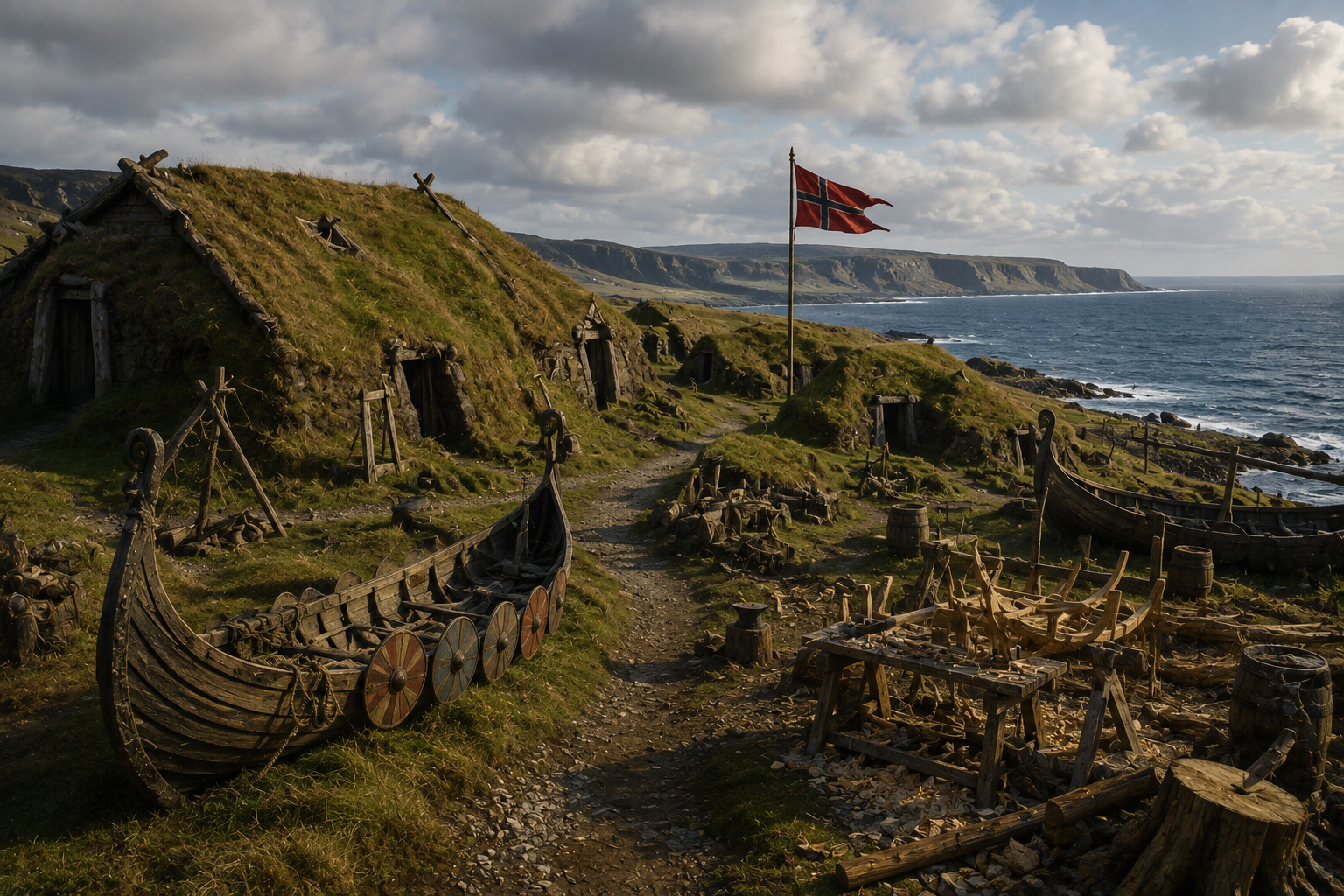
They were building foundations. Eight of them, timber-framed with turf walls, built in a pattern common in Iceland and Greenland and found nowhere in Indigenous North American architecture.
Then came the small finds, and those settled the argument.
A ring-headed bronze cloak pin, which is Norse dress rather than a trade item that could have arrived second-hand. Iron nails and a smithy with slag on the floor, in a region where nobody worked iron. A soapstone spindle whorl, meaning textile work, and the possibility that women were part of the settlement rather than a raiding crew.
What else? Butternuts. Butternuts, plus worked butternut wood.
Butternut trees do not grow in Newfoundland. They grow considerably further south, around the Gulf of St Lawrence and into New Brunswick. Somebody at this site had been there and brought material back.
The Newfoundland camp was not the destination. It was a base for going further.
The Camp Itself
The buildings tell you what the place was for.
Three of the eight were dwellings. The largest had several rooms and could have housed a substantial group. The rest were workshops. One held the smithy. One appears to have been a carpentry shed, with wood shavings and a boat-repair pit.
That is the layout of a maintenance station, not a farm. There are no field boundaries. No animal pens. Nothing suggesting anyone planned to stay through many winters.
The most likely reading is that L’Anse aux Meadows existed to fix ships and store timber while crews explored the coast further south. It was infrastructure.
Where Vinland Was
The two Icelandic accounts, the Saga of the Greenlanders and the Saga of Erik the Red, were written down in the thirteenth century about events two hundred years earlier.
They tell a broadly consistent story. A merchant called Bjarni Herjólfsson is blown off course around 986 and sights wooded coast he does not land on. Leif Erikson buys Bjarni’s ship and goes looking for it.
Three lands get names. Helluland, stone-slab land, probably Baffin Island. Markland, forest land, probably Labrador. Vinland, wine land, somewhere further south where grapes or berries grew.
Later voyages tried to settle. Thorfinn Karlsefni led one with livestock and married couples aboard. The sagas record a child born there, Snorri Thorfinnsson, which would make him the first European born in the Americas.
No individual named in those texts can be confirmed by archaeology. What archaeology confirms is the shape: Norse people, from Greenland, in North America, at roughly the moment claimed, doing roughly what the sagas describe.
Where the two sagas contradict each other, they do it the way stories do rather than the way records do. They disagree about who arrived first and in what order. That is what happens when two families each remember their own ancestor’s part a little more generously.
Why It Ended
The settlement lasted a very short time. We know this because there is no cemetery, no byres for wintering animals. Estimates run from a few seasons to perhaps a decade.
The Greenland colony that launched the voyages held maybe two to three thousand people in total. There was no surplus population to spend on a colony across open ocean.
The crossing was punishing. Roughly three thousand kilometres of North Atlantic, with no safe harbour along the way.
And somebody already lived there. The sagas describe meetings, then trade, then violence with people they called Skrælingar, ancestors of the Dorset and Beothuk. The Norse were badly outnumbered on a hostile coast.
The economics never worked either. Timber mattered to treeless Greenland, but not enough to justify permanent settlement at that distance.
Markland keeps appearing in Icelandic records for centuries afterwards. The last known mention is from 1347, noting a ship returning from there. The Norse did not forget North America. They had no use for it.
Greenland failed too, sometime in the fifteenth century. Cooling climate, a collapsed walrus ivory trade, exhausted pasture. When European ships returned in the sixteenth century, the farms stood empty.
First, and Then Nothing
Precision matters in this context. The Norse did not discover America. People had lived across the continent for many thousands of years, and the sagas record the Norse meeting them.
What the Norse achieved was the first documented contact between the eastern and western hemispheres.
It changed nothing at all.
No sustained contact followed. No crops crossed. No diseases crossed. No usable map reached the rest of Europe. Columbus sailed five centuries later with worse geography and a wrong theory about the size of the planet, and he transformed two hemispheres, because of everything that came behind him.
Leif Erikson arrived first and arrived alone.
L’Anse aux Meadows became Canada’s first UNESCO World Heritage Site in 1978. There is not much to look at. Low grassy ridges. A reconstructed turf hall. Wind coming hard off the water.
And one precisely dated year in which two halves of the world touched, then let go for another five hundred.
Frequently asked questions
Did the Vikings reach America before Columbus?
Yes. Norse timber cut at L’Anse aux Meadows in Newfoundland has been dated to 1021 CE, 471 years before Columbus.
How was the exact year established?
A radiation event in 993 CE left a marker in tree rings worldwide. Researchers found it in Norse-cut wood and counted the rings outward to the bark.
Where was Vinland?
South of Newfoundland, most likely around the Gulf of St Lawrence. Butternuts found at the site only grow in that region.
Why did the Norse leave North America?
Their numbers were too small, the crossing was too long, they met armed resistance, and there was no economic reason to stay.
Who found L’Anse aux Meadows?
Helge and Anne Stine Ingstad, in 1960, guided to the spot by local Newfoundland fishermen.
Sources consulted