

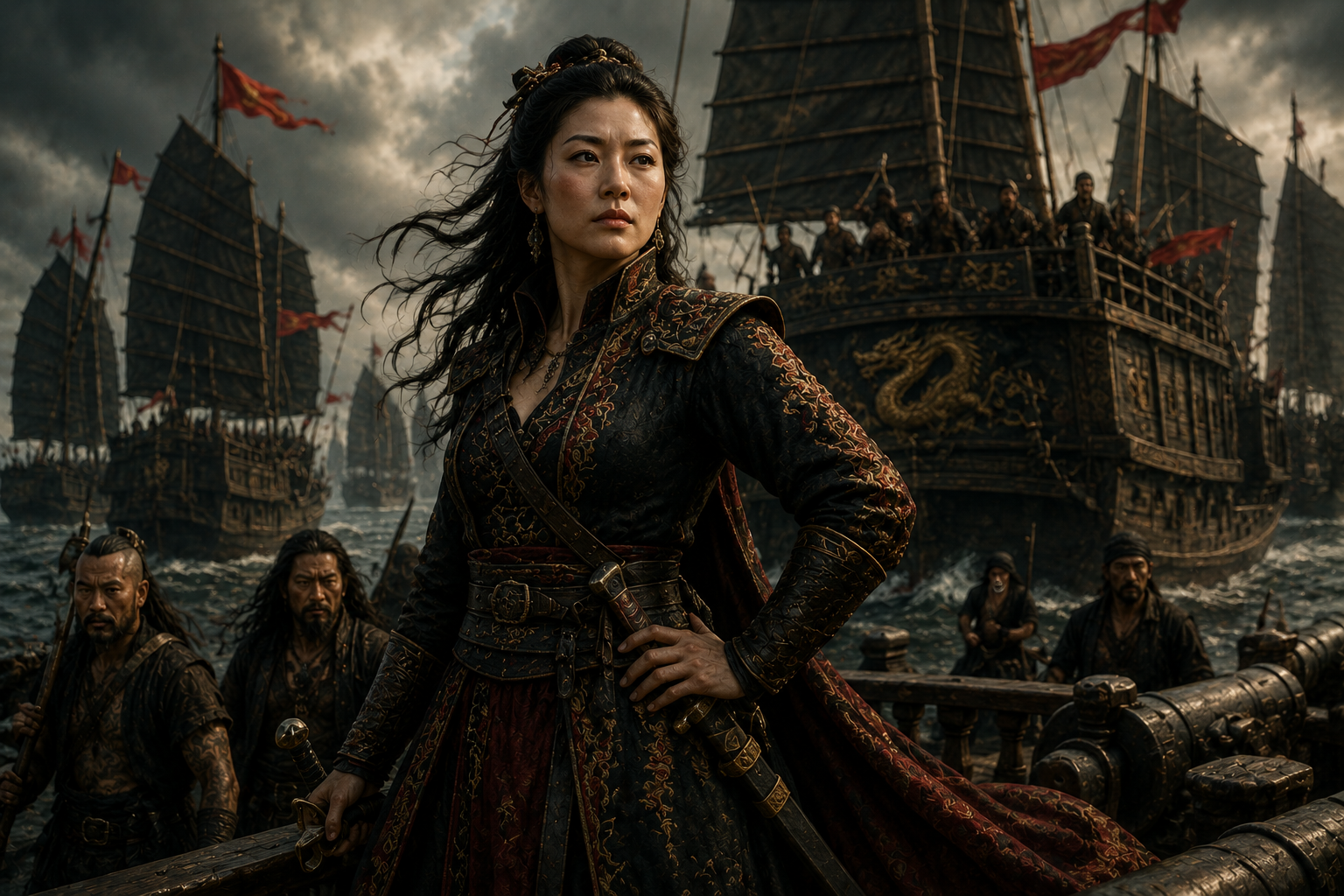
The Qing dynasty sent fleet after fleet. The Portuguese dispatched warships from Macau. The British East India Company contributed vessels of its own to what was, by any measure, a serious military effort. Between them they represented three of the most powerful maritime forces operating in early 19th century Asia.
Ching Shih defeated all of them. Consistently. At a scale that still staggers the imagination when you look at the numbers: 1,800 ships. 80,000 sailors. A legal code stricter than most of the navies she was fighting. A protection racket that functioned with the organized efficiency of a customs authority. She was a former sex worker who, in the space of a few years, built the largest pirate fleet in recorded history and ran it better than governments managed their own enterprises.
Where She Started
Ching Shih was born around 1775 in Guangdong Province in southern China. She worked in a floating brothel in Canton Harbor. This is usually mentioned as though it were a detail to be moved past quickly on the way to the more dramatic parts of the story, but it is actually foundational. The floating brothels of Canton were embedded in the maritime economy of the South China Sea in ways that gave their inhabitants a particular kind of education. You learned the economics of trade and extraction. You learned to read men, their moods and their calculations and the difference between what they said and what they intended. You learned to make yourself essential to people who held power and to understand, from close proximity, exactly how power actually worked.
In 1801, the pirate lord Zheng Yi sought to marry her. The accounts suggest she negotiated the terms. She secured a share of his operations, an equal stake in the enterprise. This was not a conventional arrangement. This was Ching Shih operating with the clarity of someone who understood precisely what she was worth.
Zheng Yi died in a typhoon in 1807. Ching Shih took command. Not claimed it, not inherited it. Took it, through political consolidation and the formation of a crucial alliance with Zheng Yi’s adopted son Cheung Po Tsai, who controlled much of the fleet’s military capacity. She married him. The two power bases became one.
The Code That Made It Work
What distinguished Ching Shih from every other pirate in history was not the size of her fleet, though the size was extraordinary. It was the administrative sophistication she brought to its management.
She promulgated a legal code governing the fleet’s operations with a specificity and consistency that most formal governments of the period could not match. All captured goods had to be reported to a central inventory. A fixed percentage went to the capturing vessel. The rest went to the collective fund. Unauthorized plundering was punishable by death. Rape was punishable by death. Desertion, which she took particularly seriously, was punishable by having both ears removed and being walked through the fleet as a public warning. A deserter caught a second time was executed.
The code was enforced. Consistently. Without exception for rank or prior service. This reliability was what made her operation something closer to a maritime state than a criminal enterprise. Merchants knew that if they paid Ching Shih’s protection fee, their cargoes would arrive safely. That reliability had commercial value. She charged accordingly.
Three Nations at Once
Between 1807 and 1810, Ching Shih fought simultaneously against the Qing government, the Portuguese colonial administration at Macau, and the British East India Company. This was not defensive posturing or opportunistic raiding. This was the controlled exercise of regional power over the Pearl River Delta and the South China Sea trade routes.
The Qing navy suffered multiple humiliating defeats. At one point they captured a Qing admiral and had to be negotiated with for his return. The Portuguese warships sent from Macau fared similarly. The British, who had significant commercial interests in the region and the ships to defend them, found that those ships were inadequate to the task.
Ching Shih at her peak controlled the movement of goods through one of the most commercially vital waterways in the world. Every merchant vessel that passed through paid or risked consequence.
The Peace She Made
In 1810, the Qing government changed strategy. Military action had failed repeatedly. They offered negotiation. The terms Ching Shih received were extraordinary for someone surrendering to a government she had repeatedly humiliated. She kept most of the fleet’s accumulated wealth. Her sailors received amnesty. Cheung Po Tsai received a military commission in the Qing navy and eventually rose to the rank of colonel. Ching Shih herself retired from piracy entirely, returned to Canton, and opened a gambling house.
She lived out the rest of her life in apparent comfort and social respectability, managing a profitable enterprise on shore rather than at sea, occasionally consulted by people who knew her history. She died in 1844, around 69 years old. In her bed. In Macau. Having outlived every warship that had been sent to stop her.
Frequently Asked Questions
Was Ching Shih the most successful pirate in history?
By every significant metric, fleet size, military engagements won, geographic reach, and the terms of her eventual retirement, she has the strongest claim to that title of any pirate for whom records exist.
How did she maintain control of 1,800 ships?
Through a strictly and consistently enforced legal code, a transparent system for distributing plunder, and political skill in managing alliances with key subordinates. The reliability of her governance was itself a source of power.
What happened after she retired?
She negotiated favorable surrender terms, retained most of her wealth, and operated a gambling establishment in Canton until her death in 1844.
How many ships did she command?
Approximately 1,800 vessels across six color-coded squadrons at the height of her
power.
Why is she not more famous?
The Qing imperial records had institutional reasons to minimize the extent of their defeats at her hands. Western maritime historiography focused on the Atlantic and largely overlooked Pacific and Asian maritime history for most of the 19th and 20th centuries.
A Final Thought
She built a navy larger than most nations could field and ran it with more internal coherence than most governments managed their own. She fought three empires to a draw and retired on her terms with her money and her reputation intact. The gambling house she opened was orderly and profitable. Everything she ran tended to be. History treated
her as a footnote for two centuries, which she would have found mildly irritating and deeply unsurprising. She kept her own accounts. The numbers have always spoken clearly enough for anyone willing to look at them.