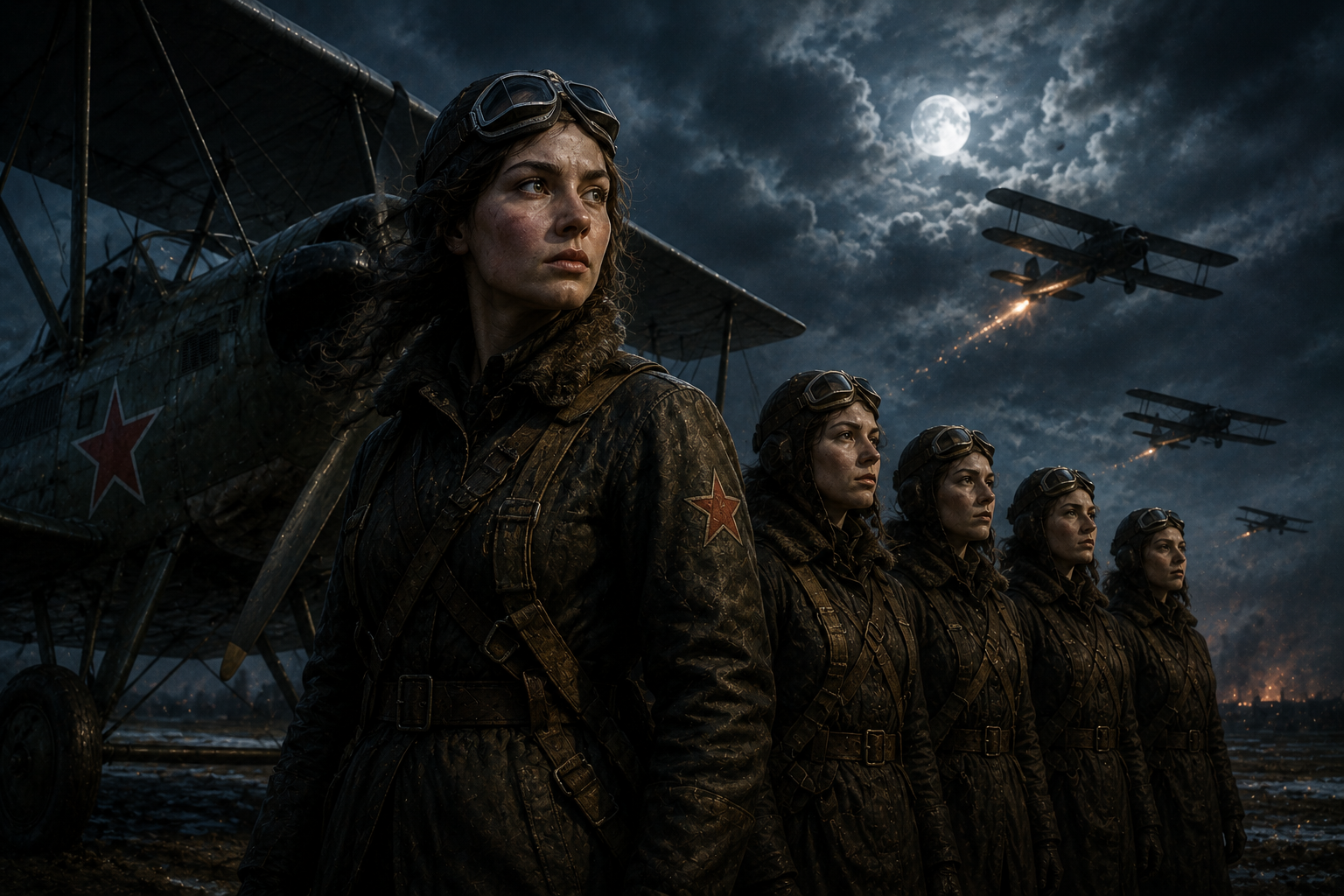
The approach was the thing that made German soldiers stop and listen. No engine sound. Nothing mechanical. Just the soft whisper of canvas wings through the dark air, something almost organic, like a very large bird passing overhead in the night. By the time they heard it, the bombs were already falling.
The Germans called them Nachthexen. Night Witches. They meant it as mockery. The women of the 588th Night Bomber Aviation Regiment wore it as a commendation.
How Marina Raskova Made It Happen
When Germany invaded the Soviet Union in June 1941, the scale of the military catastrophe was immediate and staggering. Soviet losses in the first weeks alone were almost incomprehensible. Marina Raskova, who before the war had been one of the most celebrated pilots in the Soviet Union, holder of multiple long-distance flight records, recipient of the Hero of the Soviet Union award, understood what that catastrophe meant for what was possible. She wrote directly to Stalin. She proposed forming three all-female air regiments.
Stalin, facing the loss of irreplaceable men and equipment at a rate that made improvisation mandatory, said yes.
The women who answered the recruitment call arrived from aviation schools, from flying clubs, from university programs in aeronautics. Many were teenagers. Some had trained for years with visions of peacetime careers in civil aviation and found instead that the only flying available was this. They were given several months of compressed military training and then handed the Po-2.
The Plane That Should Not Have Won
The Polikarpov Po-2 was a training biplane that had been in production since 1928. Canvas over a wooden frame. Maximum airspeed around 100 miles per hour. A bomb load of roughly 300 kilograms when fully equipped, which was less than many single bombs dropped by the aircraft on the other side. No armor. No parachutes for much of the regiment’s operational history, because there was no room for both parachutes and payload and the payload was the point.
Against this the Germans had Messerschmitt Bf 109 fighters, radar installations, searchlight batteries, and anti-aircraft artillery. By any conventional military analysis, the Po-2 was obsolete and useless in a combat environment.
The Night Witches disagreed and demonstrated this disagreement 30,000 times.
They flew only at night, which neutralized most of the fighter threat since intercepting a slow, low-flying wooden aircraft at night was genuinely difficult at speed. They flew at low altitude, which put them below the effective range of radar. They developed a specific approach technique for bombing runs: flights of three planes, two drawing the searchlights and anti-aircraft fire while the third cut its engine and glided in silently from a different direction, released the bombs, restarted and pulled away. Then the roles rotated. Each pilot flew as many as eighteen sorties per night. The regiment completed over 30,000 total sorties across three years of war.
What the Germans Offered
At some point the German military issued a standing order: any pilot who shot down a Night Witch would be awarded the Iron Cross. The same decoration given for significant tactical and strategic achievements was being offered for destroying a plywood biplane.
This was not contempt. It was an honest accounting of how difficult these particular plywood biplanes were to catch. The problem for German fighter pilots was physical. A Messerschmitt going slow enough to match the Po-2’s speed was close to its stall speed, the minimum velocity required to maintain lift. Intercepting a craft moving at 100 miles per hour in a plane that stalls at 90 was not a comfortable operation. The darkness removed the visual advantages
that favored faster, better-equipped aircraft. The low altitude removed radar. What remained was luck and the willingness to fly at the edge of the envelope in the dark. Most nights, nobody earned the Iron Cross.
What They Didn’t Have
The Night Witches operated without a number of things male regiments were provided as standard. Standard-issue military uniforms designed for women were largely unavailable for much of the war. They flew in men’s uniforms several sizes too large, ill-fitting boots, equipment that had been designed and produced for people with different bodies. Their plane was unheated and open-cockpit, which in the Russian winter at altitude meant temperatures that caused physical injury during long sorties.
When a pilot was killed, her comrades took off again the same night. The operational schedule did not accommodate grief. The grief had to be carried in the cockpit on the next sortie and the one after that, filed somewhere in the body alongside the cold and the darkness and the necessity of cutting the engine and trusting the glide.
Frequently Asked Questions
Who were the Night Witches?
Soviet female pilots of the 588th Night Bomber Aviation Regiment, later redesignated the 46th Taman Guards Night Bomber Aviation Regiment, who flew bombing missions against German forces from 1942 to 1945.
What planes did they fly?
The Polikarpov Po-2, a 1928-vintage training biplane made of canvas and wood. Its slow speed and non-metallic construction made it nearly invisible to radar.
Why did the Germans call them Night Witches?
German soldiers described the only warning of an approaching raid as a whooshing sound like a broomstick in the dark, produced by the plane gliding with its engine cut before bomb release.
How many missions did they fly?
The regiment flew approximately 30,000 sorties total, with individual pilots often completing up to eighteen missions in a single night.
Did any survive the war?
Many did. The regiment lost 30 pilots in combat over three years. Surviving members lived well into the postwar decades, some into the 21st century, eventually receiving wider recognition for their service.
A Final Thought
They cut the engines and listened to the wind in the canvas and let the dark do the rest. Eighteen times a night, sometimes more. Canvas wings against radar and Messerschmitts and the full weight of German air defense. The German military offered the Iron Cross for shooting one down, and most nights nobody earned it. The Night Witches flew on through a war that had not planned to need them and would not have survived without them, invisible in the dark above everything, silent as something you cannot quite name.