

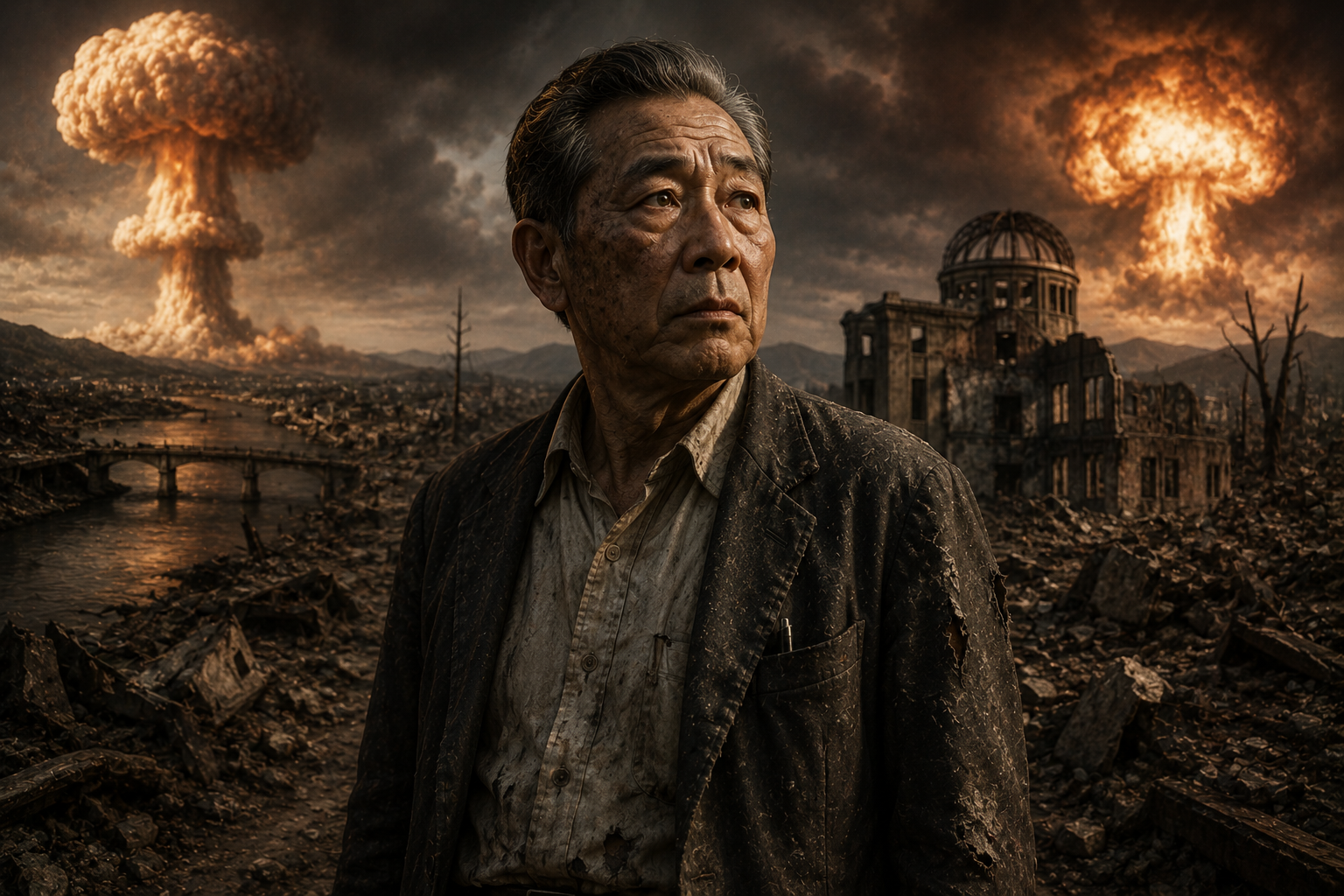
That is where it begins. August 6, 1945. Tsutomu Yamaguchi was a 29-year-old Mitsubishi engineer who had spent three months in Hiroshima on a ship design project. He was due to go home that morning. He was walking to the shipyard, suitcase in hand, when he realized his travel permit was still at the office.
He turned back.
That small reversal, that single administrative detail, placed him in the open at 8:15 a.m. when the Enola Gay released its payload 580 meters above the city. He was approximately three kilometers from where the bomb detonated. The flash came first, then the pressure wave. He was thrown from his feet, temporarily blinded, his eardrums ruptured, the skin of his left arm and face and the back of his neck burned by thermal radiation in the fraction of a second before the shockwave hit.
He survived by falling into an irrigation ditch as the city around him transformed into something that had no precedent in human experience.
The Logic of Returning Home
He spent the night in an air raid shelter, bandaged as best the situation allowed, surrounded by the dead and dying of a city that had ceased to exist in its previous form. Over the following two days he walked to the train station through rubble and found his way to the ferry to Nagasaki. His wife and young son were there. The rest of what he knew was there.
On August 9, he reported to the Mitsubishi office in Nagasaki. He was still bandaged. His ears still rang. He stood in front of his supervisor and tried to explain what had happened to Hiroshima. He described a single bomb that had destroyed a city. His supervisor looked at him with an expression Yamaguchi later remembered as skepticism. No single bomb, the supervisor suggested, could do what Yamaguchi was describing. At that moment, a light filled the window that Yamaguchi recognized.
The Second Time
The bomb that fell on Nagasaki on August 9 was different from the Hiroshima bomb in its design and yield, but the experience from three kilometers away was similar in its immediate violence. The flash. The pressure wave. The building collapsing partially around him. Yamaguchi survived again.
He walked out of what remained of the building into a Nagasaki that had become, in the space of seconds, the same landscape he had just spent three days trying to escape. The radiation sickness came later. Hair loss. High fever. The bone-deep exhaustion that survivors describe as unlike any ordinary illness, as if the body is processing something at a cellular level that it was not designed to survive. He recovered, slowly. His hearing in one ear never fully returned. His burns healed with the slow, imperfect healing that burns produce. He went home. He had children. He lived for sixty-five more years.
What He Did With the Time
For many years Yamaguchi did not speak publicly about his experience. He was not unique in this. The hibakusha, the survivors of the atomic bombings, faced significant social stigma in postwar Japan. Fear of radiation contamination made them objects of discrimination in employment and in marriage. The psychological and social costs of identifying oneself as a bomb survivor were high enough that many chose, for decades, to carry the experience privately.
Yamaguchi eventually began to speak. In his seventies, then his eighties, he gave interviews, traveled, appeared before international bodies, testified about what he had witnessed in terms that were specific and unflinching and rooted in the particular authority of someone who had experienced it twice. His argument was simple and consistent:
nuclear weapons exist and do this, and he had seen what this means, and the people who make decisions about nuclear weapons should be required to understand it.
The Recognition
The Japanese government’s formal recognition came in 2009, when Yamaguchi was 93 years old and in declining health. He was designated the only officially recognized nijuu hibakusha, double bomb-affected person, in Japanese government records. The recognition made his experience part of the official historical record in the most direct way
possible.
He died on January 4, 2010, of stomach cancer, in Nagasaki, the city where he had lived most of his life. He was 93. He had outlived both explosions by 64 years.
Frequently Asked Questions
Was Tsutomu Yamaguchi really present in both Hiroshima and Nagasaki?
Yes. He was in Hiroshima on business on August 6, 1945, when the first bomb fell, and returned to his home city of Nagasaki in time for the second bombing on August 9. Both incidents were formally verified by the Japanese government in 2009.
How far was he from each explosion?
Approximately three kilometers from the hypocenter in both cases. This distance, combined with specific shelter conditions, is understood to have been a decisive factor in his survival of each event.
How old was he when he died?
Yamaguchi died on January 4, 2010, at the age of 93, from stomach cancer, in Nagasaki.
What did he do after the bombings?
He continued his engineering career, raised a family, and in his later years became an active advocate for nuclear disarmament, speaking publicly and before international bodies until shortly before his death.
Are there other known double survivors?
Researchers have identified between 80 and 165 individuals who may have been present in both cities. Yamaguchi is the only one formally recognized by the Japanese government. Many did not report their experiences publicly due to the social costs of hibakusha status.
A Final Thought
He forgot his travel permit and turned back, and that small administrative accident put him three kilometers from the first bomb. He came home to explain what he had witnessed, and home was directly in the path of the second. Twice the world ended around him. Twice he walked out of the rubble. He spent the last years of his life trying to make the people who hold nuclear weapons understand what he understood from having been inside the consequence of them, and the government finally gave him an official piece of paper saying so in 2009, when he was 93 years old and running out of time to be patient about it. He died the following year. Still, probably, not certain that the message had gotten through.