

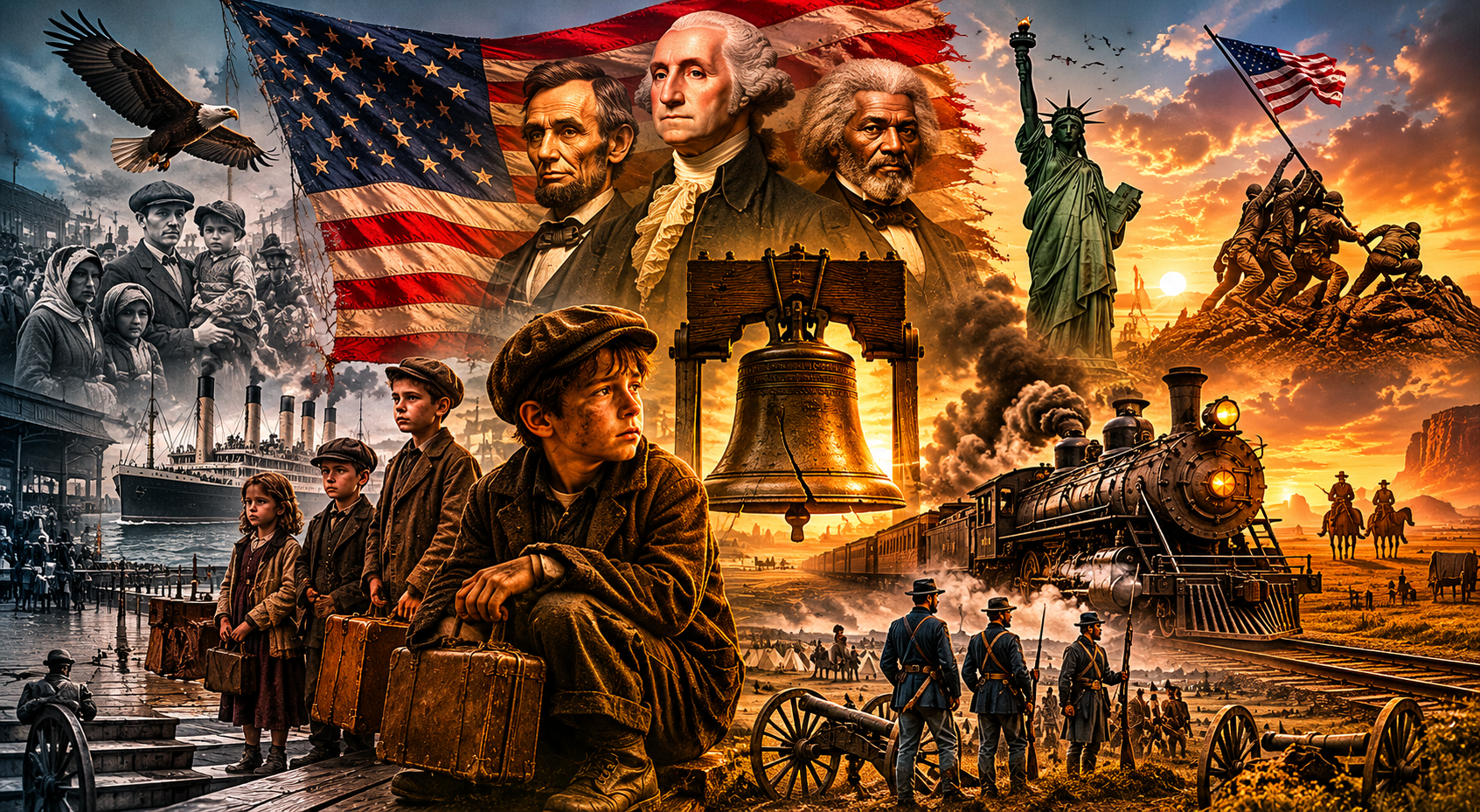
Between 1854 and 1929, approximately 250,000 children were loaded onto trains in New York City and sent west. At each stop along the route, they were presented to the local community in churches, town halls, and sometimes on literal train platforms, while the people who had come to look them over made decisions. The children who were
chosen left with whoever had chosen them. The children who were not chosen got back on the train.
This was considered progressive. This was, in fact, one of the most ambitious social welfare programs in 19th century American history. It was also something else, something the era’s reformers did not have language for and perhaps preferred not to examine.
The Streets That Made It Seem Necessary
New York City in the 1840s and 1850s was absorbing waves of immigration it had no infrastructure to manage. Irish families fleeing the Famine. Italians and Eastern Europeans following the routes that poverty and hope opened before them. They came into a city of tenements where entire families lived in single rooms, where the air in summer smelled of cholera and the streets were full of children whose parents had died or could not feed them.
By 1850, estimates placed somewhere between 10,000 and 30,000 homeless children on the streets of Manhattan alone. They sold newspapers. They picked pockets. They slept in doorways and under market stalls and in whatever shelter could be found between one meal and the next, which often meant not at all.
Charles Loring Brace saw them. He was a 25-year-old minister from a comfortable Connecticut family, recently graduated from Yale Divinity School, newly arrived in the city and immediately, viscerally troubled by what he found. He founded the Children’s Aid Society in 1853 and spent the rest of his life, with genuine conviction and some genuine results, trying to solve the problem of those children.
His solution was the Orphan Trains. Send the children west, to farm families who needed labor and wanted sons and daughters, to the wide open American countryside that Brace and most of his contemporaries believed was morally superior to the urban immigrant slums, where fresh air and honest work and the discipline of agricultural life would do what the city had failed to do.
How the Trains Actually Worked
The process was less formal than most people, encountering it for the first time, can quite believe. Children were gathered, cleaned up, given new clothes, and put on trains with a few accompanying agents. The agents would have arranged in advance with local committees in towns along the route to publicize the children’s arrival. When the train pulled in, the children were presented and the community came to look.
Families could take a child by signing a simple agreement promising care, education, and humane treatment. There was no extended screening process, no home visits before placement, no meaningful verification of the signing family’s character or circumstances. The oversight that followed was limited by distance, by the small number of agents employed by the Children’s Aid Society, and by the reality that a child placed 800 miles away in rural Kansas was extremely difficult to check on.
Some children arrived at families who had longed for them and gave them everything. Real love, real education, genuine belonging. Some of them built lives that would have been impossible in the New York they had been removed from. The Orphan Trains produced governors, sheriffs, farmers, teachers, people who raised their own families in stability they could never have anticipated.
What the Records Also Show
The historical record is not only inspiring. It is also full of children who were taken in as farm labor, who worked from before dawn to after dark and received no education despite what the agreement had promised. Children who were told regularly, sometimes daily, that they were there on sufferance. Children who were separated from siblings on different platforms in different towns and never saw them again for the rest of their lives.
The separation of siblings was perhaps the most quietly devastating element of the whole program. Brothers and sisters who had clung to each other through the streets of New York were divided by the practical logic of placement. Different families wanted different children. Different stops took different people. The distance between Kansas and
Indiana might as well have been an ocean when you were nine years old and had no money and no means of communication and no address for the person you were looking for.
The children who were not chosen at one stop and had to reboard the train had no name for what was being done to them. They just knew that the people on the platform had looked at them and decided against them and that the train was moving again.
The Ideology Behind the Good Intentions
Charles Loring Brace believed fully in what he was doing. He believed rural life was morally healthier than urban life, that the immigrant communities of New York were environments that damaged the children growing up in them, that removal was a gift rather than a violence. These beliefs were not uncommon in his era and among his class. They
were also the beliefs of someone who had never been poor, never been an immigrant, never lived in a tenement, and never been separated from his family.
The program operated with significant class assumptions about who was fit to make decisions and whose family life was a problem to be solved by other people. For Native American children who were sometimes included in the program, an additional layer of colonial logic was present from the beginning.
Frequently Asked Questions
What were the Orphan Trains?
A social welfare program run by the Children’s Aid Society from 1854 to 1929 that relocated approximately 250,000 children from New York City to families across the American Midwest, South, and Southwest.
Were all the children actual orphans?
No. Many had living parents who could not care for them. Some were removed from their families without adequate legal process or genuine parental consent.
What happened to the children after placement?
Outcomes ranged across the full spectrum. Some found families who gave them genuine love and opportunity. Others were treated as cheap labor. Many lost permanent contact with their birth families and with siblings separated on different platforms.
Why did the program end?
The development of state-level foster care systems by 1929 provided more locally administered oversight of child placement and replaced the Orphan Train model.
How can descendants trace their history?
The Orphan Train Heritage Society of America maintains records specifically intended to help descendants identify connections to the movement and locate relevant documentation.
A Final Thought
250,000 children got on trains and went west and what happened to them afterward covers the complete range of what human beings are capable of doing to children in their care, love and neglect and genuine transformation and quiet ongoing cruelty and everything in between. Charles Loring Brace wanted to save them and he saved some of
them and failed others in ways he either could not see or chose not to. The trains stopped running in 1929. The children’s descendants are still, sometimes, trying to find out who they were before someone else’s decision about their future made that question very hard to answer.