
Rain falls somewhere up in the hills, not necessarily anywhere near you. Forty minutes later a wall of water comes down a dry canyon at the speed of a running horse.
Flash floods in this part of Jordan kill people. In 1963 a group of tourists died inside the narrow gorge that forms Petra’s entrance.
The Nabataeans built a city of perhaps twenty thousand people here, in a desert that receives around 150 millimetres of rain a year. How they managed the water is a better story than any carved facade in the place.
Nomads Who Stopped Moving
The Nabataeans began as an Arab people in the deserts of northwest Arabia, and their advantage was knowledge.
Frankincense and myrrh came from southern Arabia, in what is now Yemen and Oman. The Mediterranean world burned enormous quantities of both in temples, at funerals and as medicine. Moving them north meant crossing country that killed the unprepared.
The Nabataeans knew where the water was. They could guarantee a caravan’s passage. They charged accordingly.
By the first century BCE they had moved from tents to a monumental capital, minted coins, written in their own script, and begun negotiating with Rome as a state rather than a tribe.
Getting the Water Right
Start with the flooding, because they did.
The Siq, the 1.2 kilometre gorge leading into the city, sits in a natural drainage channel. The Nabataeans cut a tunnel through solid rock to divert floodwater into an adjacent valley, and built a dam to force it there. Without that one piece of engineering the entrance would be unusable for part of every year.
Then capture. Dams across side valleys slowed and held runoff instead of letting it escape into the desert.
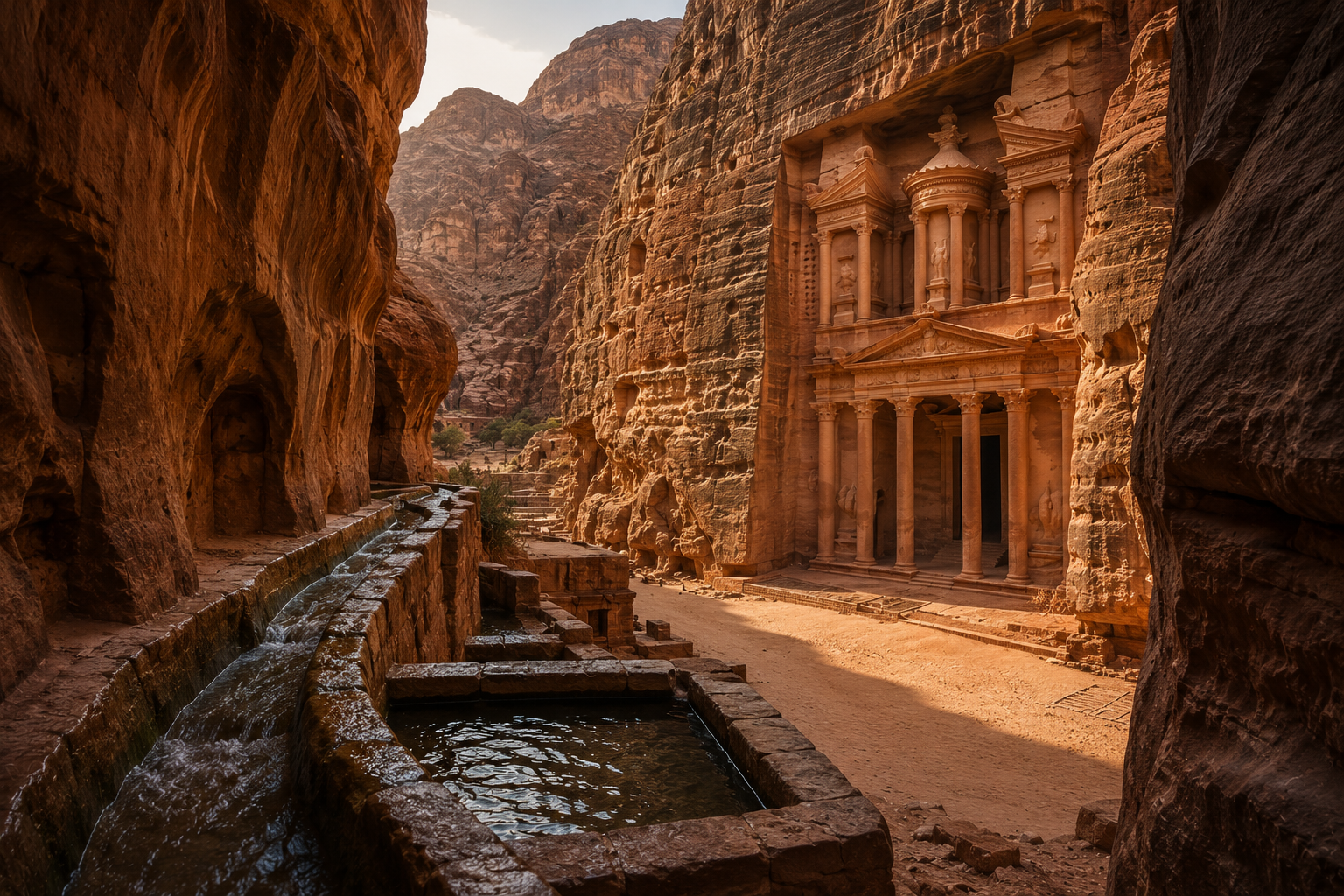
Then transport. Channels cut into the rock faces of the Siq ran for kilometres at carefully calculated gradients. Too steep and the water moves fast enough to erode the channel and lose volume to turbulence. Too shallow and it stops moving. They got it right.
Then storage. Ceramic pipes, with joints shaped to reduce turbulence, fed hundreds of cisterns cut into rock and sealed with waterproof plaster.
Engineering analyses of the system, including work published by Charles Ortloff, found pipe diameters and flow gradients consistent with a designed system rather than one that grew by accident. Somebody sat down and calculated this.
A city that can guarantee water in a desert can support a population, a market, a garrison and a court. Everything else Petra was rests on that.
The Treasury Is a Tomb
Al-Khazneh stands at the end of the Siq, forty metres high, cut back into the cliff rather than built against it.
The name means treasury. It comes from a Bedouin tradition that an Egyptian pharaoh hid gold inside the stone urn at the summit. The urn is solid rock. Bullet marks record generations of people testing the story anyway.
Most scholars read it as a royal tomb, probably of King Aretas IV, who ruled from around 9 BCE to 40 CE.
It is not even the largest structure in Petra. Ad-Deir, usually called the Monastery, is bigger, and reaching it means climbing roughly 800 rock-cut steps. There is also a Great Temple complex from the first century BCE, and a Roman theatre seating around six thousand.
Rome, Then the Ground Moved
Rome annexed the Nabataean kingdom in 106 CE under Trajan and made it the province of Arabia Petraea. The takeover appears to have been peaceful, and Petra continued as a provincial city afterwards.
Its decline came from several directions at once.
Sea routes won first. Better understanding of monsoon wind patterns made shipping between Egypt, Arabia and India cheaper and faster than any camel could manage. Then Palmyra rose in Syria and took much of the overland trade that remained.
Then the earthquake of 363 CE destroyed a large part of the city, and critically, much of its water infrastructure. A second earthquake in 551 damaged what had been rebuilt.
Water was always the vulnerability. A city depending on channels, pipes and plastered cisterns cannot survive repeated seismic damage without money to repair everything, and by the fourth century the money had gone with the trade.
Petra was never fully abandoned. Several Nabataean tombs became churches during the Byzantine period. A cache of carbonised papyrus scrolls found in one of them in 1993 records property sales and inheritance disputes from the sixth century CE. People were still living ordinary administrative lives there long after the caravans stopped coming.
A Borrowed Style
Look closely at Al-Khazneh and it stops looking Arabian.
The columns are classical. There is a broken pediment, a circular structure at the centre of the upper tier, and decorative elements drawn from Hellenistic and Egyptian architecture. Petra’s monumental facades are assembled from a vocabulary the Nabataeans took from everybody they traded with.
That is not imitation. It is what a trading people do. They saw the buildings of Alexandria and the Greek east, liked them, and cut versions into their own cliffs.
Their writing did something similar. Nabataean script developed from Aramaic, and it later became one of the ancestors of the Arabic alphabet. A people usually described as peripheral turn out to sit in the direct line of one of the world’s major writing systems.
Found, and Found Again
Local Bedouin communities always knew where Petra was. They lived in and around it.
In 1812 a Swiss traveller called Johann Ludwig Burckhardt, fluent in Arabic and travelling in disguise, persuaded a guide to take him there on the pretext of making a sacrifice at a nearby shrine. His account brought the site to European attention. That is a different achievement from discovery, and the two get confused constantly.
Petra became a UNESCO World Heritage Site in 1985 and one of the New Seven Wonders in 2007. Around a million people visit each year.
And archaeologists estimate that only 15 to 20 percent of it has been excavated.
In 2016, satellite imagery combined with drone survey identified a large monumental platform buried under sand a few hundred metres from the city centre. Two centuries of study had missed it.
Stone and Arithmetic
The facades get the photographs, and they have earned them. Al-Khazneh appearing at the end of a dark gorge is one of the real sights of the ancient world.
But the Nabataeans’ actual work is the thing carved into the walls above head height. A channel, cut at a precise angle, running kilometres through rock, carrying water to a city that had no business existing where it did.
They built a capital in a desert by being better at arithmetic than the desert was at killing them. It held for four hundred years.
Then the trade moved, the ground shook, and there was nobody left with the money to keep the channels clear.
Frequently asked questions
Where is Petra?
In southern Jordan, roughly 240 kilometres south of Amman, in a basin among the mountains east of the Wadi Araba valley.
Who built it?
The Nabataeans, an Arab people who controlled the incense trade routes of northwest Arabia and made Petra their capital from around the first century BCE.
How did Petra get water in the desert?
Through a flood-diversion tunnel, dams across side valleys, rock-cut channels at calculated gradients, ceramic pipes and hundreds of sealed cisterns.
Is the Treasury really a treasury?
No. Al-Khazneh is almost certainly a royal tomb, most likely of King Aretas IV. The name comes from a later Bedouin legend about hidden gold.
Why was Petra abandoned?
Trade shifted to cheaper sea routes, Palmyra took much of the remaining caravan traffic, and earthquakes in 363 and 551 CE wrecked the water system.
How much has been excavated?
Only around 15 to 20 percent. A large monumental platform was found by satellite and drone survey as recently as 2016.
Sources consulted