Callimachus of Cyrene spent years of his life making a list.
He was a poet, and a good one, but the work that consumed him at Alexandria was bibliographic. He catalogued the library’s holdings by subject, by author, by opening line, noting the length of each work in lines so a reader could tell at a glance whether a scroll had been tampered with. The finished catalogue ran to 120 volumes. It was called the Pinakes, the Tables.
The catalogue is gone. So is nearly everything it described.
That fact has generated more grief, and more nonsense, than almost any other event in ancient history. The popular version involves a fire, a villain, and a single night on which human progress was set back a thousand years. It is a satisfying story and it is not what happened.
Who Wanted a Library That Badly?
Alexander the Great died in 323 BCE, and his generals divided what he had taken. Egypt went to Ptolemy, who founded a dynasty and gave his new capital an ambition: it would take Athens’ place as the mind of the Greek world.
His son, Ptolemy II Philadelphus, pursued that with something close to mania.
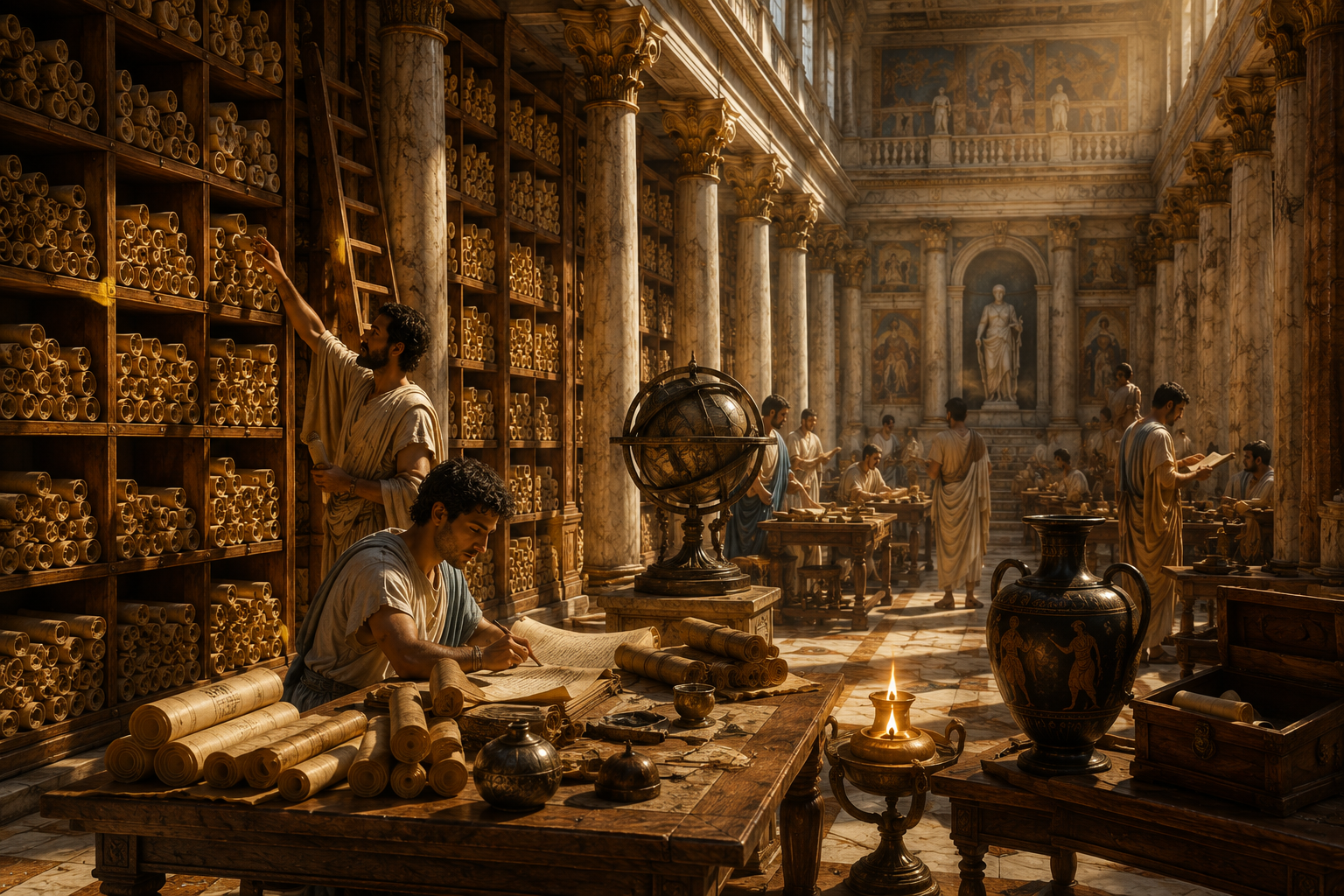
The library was not a standalone building but part of the Mouseion, a shrine to the Muses that operated more like a modern research institute. Scholars lived there at royal expense. They received lodging, meals, and salaries, and in return they were expected to think.
The collection policy was aggressive to the point of theft. Ancient sources describe ships arriving at Alexandria being searched for books, which were confiscated and copied. The library kept the originals. The owners sailed away with the copies.
How large did it get? Estimates run from 40,000 scrolls to 400,000, and ancient numbers are notoriously inflated. What matters is not the total. It is that nothing remotely comparable existed anywhere else on earth.
The People Were the Point
Strip away the shelves and what remains is a concentration of talent that is hard to overstate.
Euclid worked in Alexandria, and his Elements would set the shape of mathematics for the next two thousand years. Eratosthenes, who served as head librarian, calculated the circumference of the Earth using shadows, a well, and geometry, and came startlingly close to the modern figure. Aristarchus of Samos argued that the Earth moved around the Sun roughly eighteen centuries before Copernicus said it again and was believed. Herophilus conducted human dissections and mapped anatomy that would not be improved on for a very long time. Archimedes addressed his treatise The Method to Eratosthenes.
It was in Alexandria that seventy scholars translated the Hebrew Bible into Greek, producing the Septuagint. It was in Alexandria that Homer was edited into the versions we still read.
For about three hundred years, the interesting questions were being asked in one city.
Caesar’s Fire, and Why It Did Not Finish the Job
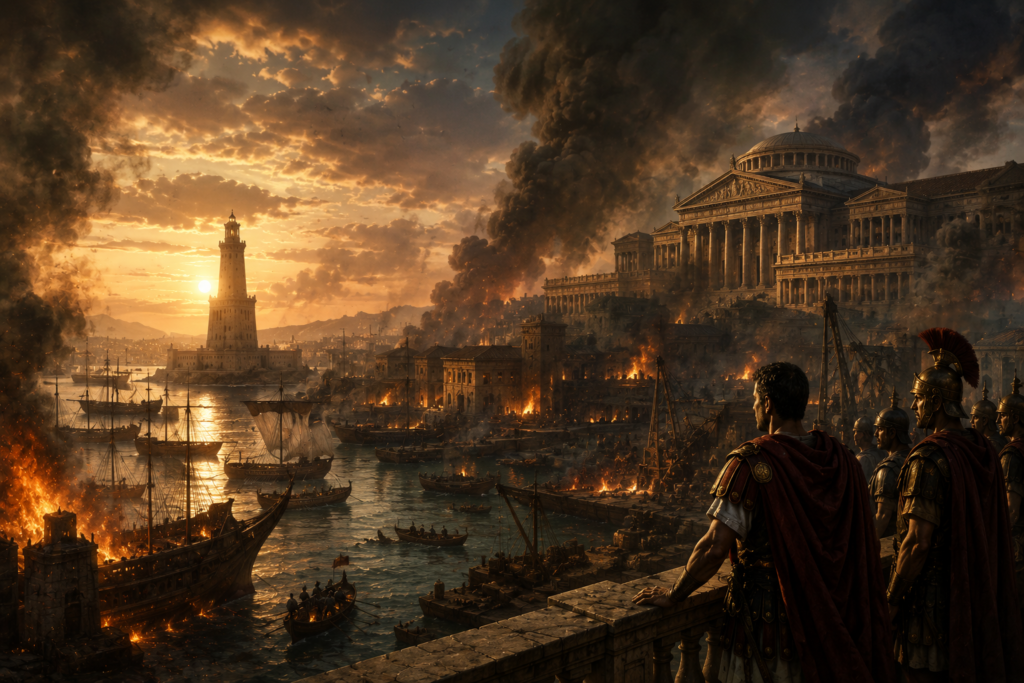
In 48 BCE, Julius Caesar found himself trapped in Alexandria in the middle of an Egyptian civil war. To stop enemy ships reaching him, he set the harbour alight.
The fire spread. Warehouses near the docks burned, and ancient writers report that a very large number of scrolls went with them, possibly tens of thousands.
Here is the part that gets left out. The library kept working.
The geographer Strabo came to Alexandria a few decades later and described the Mouseion as a functioning institution. Scholars continued to be appointed and to publish. Whatever Caesar burned, it was not the library itself, and the story that he ended it is a compression of six centuries into one night.
A Slow Bleeding Out
If you want the actual sequence, it looks less like a crime and more like a chart of declining revenue.
| Date | What happened | What it cost |
| 48 BCE | Caesar’s harbour fire | Heavy losses near the docks; the institution survives |
| c. 20 BCE | Strabo visits | Records the Mouseion as active |
| 272 CE | Aurelian crushes a revolt | The palace quarter, containing the Mouseion, is wrecked |
| 297 CE | Diocletian besieges the city | Further destruction |
| 391 CE | The Serapeum is destroyed | A daughter library lost; how much was still in it is unclear |
| 642 CE | Arab conquest of Egypt | A later legend blames the caliph; no contemporary source supports it |
Under Rome, the money stopped. Emperors saw no reason to fund a Ptolemaic vanity project, and scholars went where the patronage was. The institution shrank, then thinned, then became a memory that people in Alexandria still talked about.
The story that the general Amr ibn al-As burned the books on the orders of Caliph Omar surfaces roughly six hundred years after the event, in a thirteenth-century source. Historians have generally treated it as folklore. By 642 there was almost certainly nothing left to burn.
There is one more thing worth knowing about what a library actually was in the third century BCE. A scroll of papyrus is a physical object with a lifespan. In the dry air of Egypt it might last several centuries. Elsewhere, in damp, it could rot in decades. Every scroll in Alexandria was on a clock from the moment it arrived.
Which means the library’s real work was never storage. It was replacement.
What Was Actually Lost
Here the honest answer disappoints, and it is more useful for that.
The fantasy is that Alexandria held cures, engines, and knowledge that would have carried us to the modern world centuries early. There is no evidence of any such thing. What we lost was overwhelmingly literature, history, and scholarship.
Sophocles is the clearest measure. He wrote more than 120 plays. Seven survive in their entirety.
The rest, however, were not lost in a fire. They were lost because nobody copied them.
This is the mechanism people miss. In the ancient world a text existed only as long as somebody kept transcribing it onto fresh papyrus or parchment. Papyrus rots. Parchment is expensive. A book that went a century without a scribe was a book that had already ceased to exist, whatever happened to any particular building.
Alexandria could not preserve knowledge. Only continuous, expensive, unglamorous human labour could do that, and at some point the labour stopped.
The Fire That Never Came
There is something worth noticing about how badly we want the villain version.
A single catastrophe is bearable. It has a date, a culprit, a moment where things might have gone otherwise. It suggests that if we were careful enough, if we guarded the vault well enough, the knowledge would be safe.
No such comfort is on offer here. Nobody burned the Library of Alexandria. Successive generations of people with tighter budgets, other wars, and more urgent priorities simply stopped paying for it, and then one day the thing they had stopped paying for was not there.
The Bibliotheca Alexandrina opened in Egypt in 2002, near where the original stood. It is a working library with a substantial digital archive.
Whether anyone is still copying in six hundred years is, as it has always been, a question about budgets.
Frequently asked questions
Did Julius Caesar destroy the Library of Alexandria?
No. His fire in 48 BCE damaged part of the collection near the harbour, but the Mouseion continued operating and scholars were still working there decades later.
How many books did the library hold?
Ancient estimates range from roughly 40,000 to 400,000 scrolls. The true figure is unknown, and ancient sources routinely exaggerated.
Who destroyed the Library of Alexandria?
Nobody, in the sense the question implies. It was reduced by fire, war, lost funding and neglect across roughly six centuries.
Was the Serapeum the same as the main library?
No. The Serapeum housed a separate daughter collection. It was destroyed in 391 CE, though how many scrolls remained there by then is genuinely uncertain.
Does anything of it survive?
The physical library is gone. The Bibliotheca Alexandrina, opened nearby in 2002, was built to honour it.
Sources consulted