In 1984 a German historian named Alexander Demandt sat down and counted.
He went through the scholarly literature on the fall of Rome and tallied every cause that serious historians had proposed. He found two hundred and ten.
The list includes Christianity. Lead poisoning. Climate change. Moral decay. Bureaucracy. Bathing. Slavery. Taxation. Deforestation. Malaria. Public entertainment. The absence of a stock exchange.
A question that produces two hundred and ten answers usually has something wrong inside it.
The Assumption in the Question
Ask why Rome fell and you have already agreed to two things. That there was a fall. And that it happened at a moment.
In 476 CE a Germanic commander called Odoacer deposed the emperor Romulus Augustulus and did not appoint a replacement. Every textbook uses that date.
Almost nobody alive at the time believed an empire had ended. Odoacer sent the imperial regalia to Constantinople and ruled Italy as a nominal subordinate of the eastern emperor. Roman law continued. Roman taxes continued. Roman officials kept working.
Meanwhile the Eastern Roman Empire, governed from Constantinople, carried on for another 977 years. It ended in 1453. Its people called themselves Rhomaioi. Romans. Because they were.
So the useful question is narrower. Why did the western administration stop working while the eastern one did not?
Pressure, Accumulating
Several problems built up across centuries. No single one is enough on its own.
Political instability. During the Crisis of the Third Century, roughly 235 to 284 CE, more than twenty emperors held power in fifty years. Most were killed by their own soldiers. Orderly succession stopped existing.
Debased currency. Silver content in the denarius fell steadily as emperors stretched the money supply to pay armies. Inflation followed. Long-distance trade suffered.
Plague. The Antonine Plague of 165 to 180 CE and the Plague of Cyprian from 249 to 262 killed enormous numbers. Both the tax base and the recruitment pool shrank.
Frontier length. Thousands of kilometres of border needed permanent garrisons. The tax system struggled to fund them even in good years.
Division. Diocletian split the administration in the 280s for practical reasons. Over the following century the wealthier east stopped subsidising the poorer west.
None of that is a collapse. Together it describes a state running with no margin at all.
The Century That Broke It
378 · Adrianople
Gothic forces destroy a Roman field army. The emperor Valens is killed on the battlefield. Rome has lost battles before. It has not lost an emperor and an army together in living memory.
406 · The Rhine
Multiple groups cross the frozen river into Gaul, a defeat the Western defence never fully recovers from. From this point the empire is reacting rather than deciding.
410 · Rome Sacked
Alaric’s Visigoths take the city. Militarily it changes little. Rome has not been the administrative capital for years. The psychological effect across the empire is enormous.
439 · Carthage
The Vandals take North Africa. This is the entry most summaries skim past, and it may be the decisive one.
North Africa supplied grain to Rome and substantial tax revenue to the western treasury. Losing it meant the West could no longer pay for the armies needed to recover anything, including North Africa itself.
After 439 the Western Empire is trying to fight its way out of a hole using money it does not have.
455 · Rome Sacked Again
The Vandals return by sea. Western authority is now visibly unable to defend its own capital.
476 · The Formality
Odoacer deposes a teenage emperor and declines to name another. Nobody at the time records it as the end of anything.
The Huns, and What Pushed What
One factor sits behind several of those entries.
From the late fourth century, the arrival of the Huns on the western steppe displaced peoples who had lived along Rome’s frontiers for generations. Goths, Vandals, Alans and others moved, not as raiders after plunder but as populations looking for somewhere to live.
Rome had absorbed migrants before and done it competently. What broke was the rate. Groups arrived faster than the system could settle, tax, recruit and assimilate them, and every unabsorbed group made the next one harder to handle.
Attila himself terrorised both halves of the empire in the 440s and 450s. He died in 453 and his confederation fell apart within a few years. The Huns were a catalyst rather than a conqueror.
Three Historians, Three Empires
The disagreement among scholars is more interesting than any single answer, and all three positions hold up.
Peter Heather argues external pressure was decisive. Rome worked well enough until sustained migration overwhelmed it faster than it could adapt.
Bryan Ward-Perkins argues the collapse was real and severe. He points to material evidence. Pottery quality, roof tiles, building standards, coin circulation, cattle size, literacy. All fall sharply. Calling that a transformation understates a measurable drop in how ordinary people lived.
Peter Brown and the late antiquity school emphasise continuity. The Roman world changed form rather than ending. Successor kingdoms inherited Roman law, Latin, administration and Christianity instead of destroying them.
They are arguing about different things. Causes, consequences, and framing. All three are looking at the same evidence.
What Came Next
The kingdoms that formed in the west were not built by people who wanted Rome gone.
Theodoric, who ruled Italy from 493, had been raised in Constantinople and governed through Roman law and Roman officials. Frankish kings in Gaul kept Roman administration wherever it still worked. Latin remained the language of law, learning and religion across western Europe for another thousand years.
What disappeared was scale. Long-distance trade contracted. Mass-produced pottery gave way to local craft. Nobody built large public buildings. Literacy retreated into the church.
Somebody living in sixth-century Italy had a materially simpler life than their great-grandparents. They also, in most respects, thought they lived in a Roman world.
Frequently asked questions
When did the Roman Empire fall?
The Western Roman Empire is conventionally dated to 476 CE. The Eastern Roman Empire continued until 1453.
What caused it?
No single cause. Political instability, debased currency, plague, unsustainable frontier costs and the loss of North African revenue combined across roughly two centuries.
Did Christianity cause the fall of Rome?
Edward Gibbon argued so in the eighteenth century. The claim is not widely accepted now, partly because the Eastern Empire was equally Christian and lasted another thousand years.
Why did the Eastern Empire survive?
It was wealthier, held shorter and more defensible frontiers, controlled richer tax provinces, and its capital was extremely hard to take.
Was lead poisoning responsible?
No. Roman water left mineral scale inside pipes, limiting exposure, and the timeline does not fit.
What was the Battle of Adrianople?
A defeat in 378 CE in which the emperor Valens was killed and a Roman field army destroyed by Goths. Often treated as the start of the western collapse.
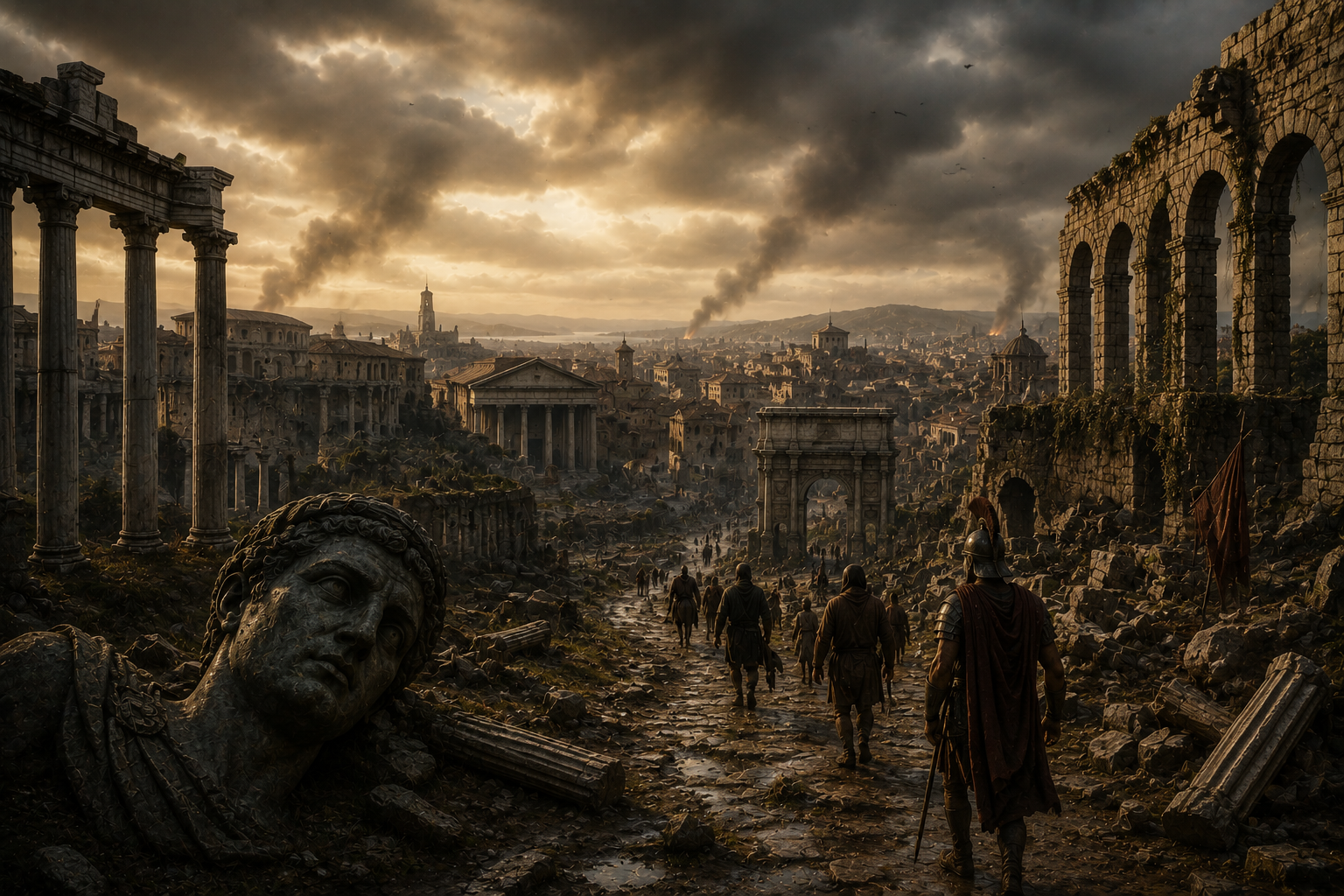
What Happened to the City
Rome itself is a useful measure of what changed.
At its height the city held around a million people. It was the largest urban centre anywhere in the world, fed by grain shipped in from Egypt and North Africa and supplied with water by eleven aqueducts.
By the sixth century the population had fallen to perhaps thirty thousand. Whole districts stood empty. Cattle grazed inside the walls. The aqueducts had been cut during the Gothic wars and most were never repaired.
None of this happened in 476. It happened slowly, over roughly two hundred years, as the systems that made a city of a million possible stopped being funded.
Two Hundred and Ten Answers
Demandt’s list gets quoted as a joke about academic excess. It works better as a diagnosis.
Historians keep finding new causes because each generation looks at Rome and sees what it currently fears. The Victorians saw moral decline. The mid-twentieth century saw economic mismanagement. Recent decades have produced climate and pandemic arguments, which happen to be what we worry about now.
Rome is a mirror with a very long history of being looked into.
The empire itself did something far less dramatic than any of these accounts require. Its western half slowly stopped being able to afford itself. Everything the money had paid for, from armies and roads to grain and walls and officials, quietly stopped happening.
Sources consulted