The Theodosian Walls had stood since 413 CE.
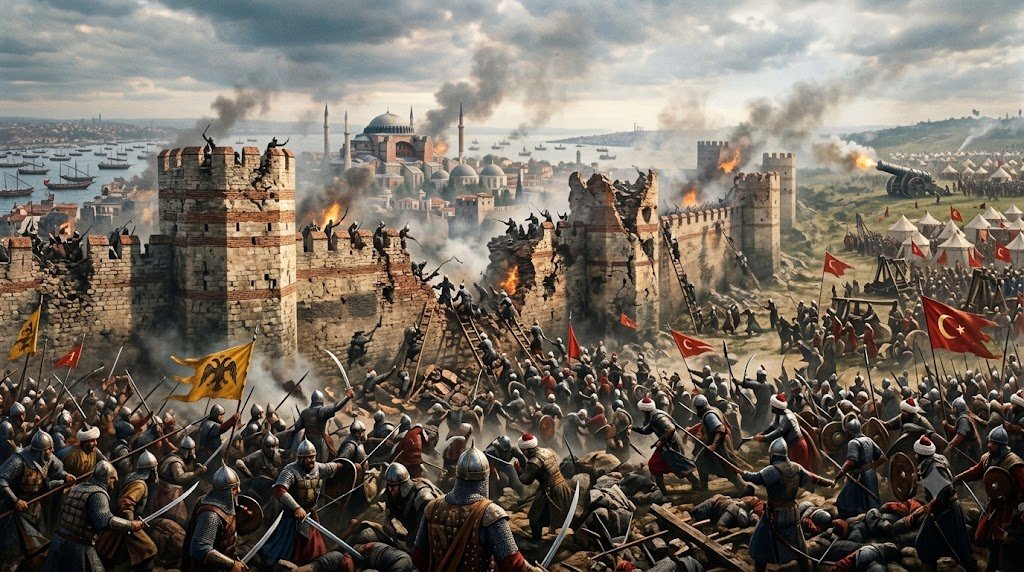
They had turned back Avars, Arabs, Rus, Bulgars and Vikings. Three lines of defence: a moat, an outer wall, and an inner wall twelve metres high and five metres thick. For a thousand years, nothing had broken them.
In 1453 a twenty-one-year-old sultan arrived with a cannon nearly eight metres long, and the arithmetic changed.
A City Already Hollow
The Constantinople of 1453 was a shell of what it had been.
The Fourth Crusade sacked it in 1204, and the city never fully recovered. By 1453 the population had fallen to perhaps 50,000, from a peak of several hundred thousand. Whole districts inside the walls had reverted to fields and orchards.
The empire had shrunk to the city itself, a few Aegean islands, and a strip of the Peloponnese.
The last emperor, Constantine XI Palaiologos, could raise around 5,000 Greek defenders. They were joined by roughly 2,000 foreigners, most importantly a company of Genoese professionals under Giovanni Giustiniani Longo, who was given command of the land walls.
Against them, Ottoman forces estimated at 50,000 to 80,000.
The Cannon Founder
The key figure on the Ottoman side was not a soldier.
Orban was a Hungarian who cast cannon, and he first offered his services to the Byzantines. They could not afford him. Some accounts say they could not pay him at all.
Mehmed II could, and paid him several times what he had asked.
The result was a bombard capable of throwing stone balls weighing over 500 kilograms. It could be fired only a handful of times a day. It took hours to reload and cool. It eventually cracked from its own stresses.
It did not need to do more than it did. For the first time in a thousand years, the walls could be reduced from a distance.
Fifty-Three Days
The bombardment began on 6 April 1453.
On 20 April, four Christian ships broke through the Ottoman fleet and reached the harbour. It was the defenders’ one clear victory and it enraged Mehmed.
On 22 April he answered it with the manoeuvre that decided the siege. The Golden Horn, the city’s harbour, was closed by a massive chain across its mouth. Mehmed had roughly seventy vessels hauled overland on greased wooden rollers, over a hill, and put back in the water on the far side of the chain.
The defenders now had a second front, and nobody to spare for it.
Through early May the assaults were repulsed. The city’s population repaired the breaches every night, working by torchlight, for seven weeks.
The final assault came before dawn on 29 May. Two things broke the defence within minutes of each other.
Giustiniani was seriously wounded and carried from the walls. The sight of the commander leaving collapsed morale among the Genoese and then among everyone else.
At roughly the same moment, Ottoman troops found a small postern gate, the Kerkoporta, left unlocked, and got inside.
Constantine XI was last seen fighting near a breach. His body was never identified.
What Ended
Mehmed made Constantinople his capital and took the title Kayser-i Rûm, Caesar of Rome. It was not an idle boast. He was claiming the inheritance directly, and he had a defensible claim.
Hagia Sophia, built in the sixth century and for nine hundred years the largest cathedral in Christendom, was converted into a mosque.
Two commonly repeated consequences deserve care.
The Renaissance claim. Greek scholars fleeing west are often credited with sparking it. Greek scholars had been migrating to Italy for decades before 1453, and the Renaissance was well underway. The fall added to a process already running.
The exploration claim. The idea that Ottoman control forced Europe to sail west is overstated. The Ottomans wanted trade revenue and kept the routes open. Portuguese Atlantic exploration had begun long before 1453.
What genuinely ended was the Roman state. Whatever one thinks of the term Byzantine, which is a modern coinage, the people inside those walls called themselves Rhomaioi. Romans. Their political line ran continuously back to Augustus.
On 29 May 1453, it stopped. Which is why historians often use the date to mark the end of the Middle Ages.
What Mehmed Built
He did not want a ruin. He wanted a capital, and he had taken a city of 50,000 people built for far more.
He pursued repopulation deliberately, through a resettlement policy called sürgün, moving Muslim, Greek, Armenian and Jewish communities into the city from across the empire. Greeks who had fled were invited back. A Greek Orthodox patriarch was appointed under Ottoman authority.
This became the basis of the millet system, under which religious communities administered their own internal affairs. It was not equality, and non-Muslims paid additional taxes. By the standards of fifteenth-century Europe it was unusually workable.
Building followed. The Grand Bazaar was established. Topkapı Palace was begun in 1459. Mosque complexes with schools and hospitals went up across the city.
Within a century the population had recovered past 100,000.
Seven Thousand Men
The siege gets told as gunpowder overwhelming the old world, which is partly true and misses the numbers.
Seven thousand men held a fourteen-mile perimeter against ten times their number for fifty-three days, repairing the walls nightly, with no relief force coming and no realistic prospect of one.
They lost because there were not enough of them, because nobody came, and because a gate was left open.
The walls did what they had always done. The empire behind them had run out.
Frequently asked questions
When did Constantinople fall?
On 29 May 1453, after a siege of 53 days that began on 6 April.
Who conquered Constantinople?
Sultan Mehmed II of the Ottoman Empire, twenty-one years old at the time, afterwards known as Mehmed the Conqueror.
How were the walls broken?
Primarily by heavy artillery, including a bombard built by the Hungarian founder Orban that fired stone balls weighing over 500 kilograms.
How many defenders were there?
Around 7,000 in total, including roughly 2,000 foreign troops, against an Ottoman force estimated at 50,000 to 80,000.
What happened to the last emperor?
Constantine XI Palaiologos was last seen fighting near a breach in the walls. His body was never identified.
Did the fall of Constantinople cause the Renaissance?
It contributed, but the Renaissance was already underway and Greek scholars had been migrating to Italy for decades beforehand.
Why is 1453 used to mark the end of the Middle Ages?
Because it ended the Roman state, whose political line ran continuously back to Augustus.
Sources consulted: Steven Runciman, The Fall of Constantinople 1453 (1965); Roger Crowley, Constantinople: The Last Great Siege (2005); UNESCO Historic Areas of Istanbul listing.