In the summer of 1348, a Sienese chronicler named Agnolo di Tura buried his five children with his own hands.
He wrote that nobody wept for the dead, because everyone expected death themselves. He wrote that people said this was the end of the world.
Between 1347 and 1351, plague killed somewhere between 30 and 50 percent of Europe’s population. Proportionally, four years of it took more European lives than both world wars combined.
What It Was
The organism is Yersinia pestis, a bacterium carried by fleas that live on rodents. This is not inference. DNA extracted from medieval plague burials has confirmed it directly.
It presents in more than one form, and the difference matters.
Bubonic plague produces the swollen lymph nodes called buboes, in the groin, armpit and neck. It killed roughly half of those infected, usually within a week.
Pneumonic plague infects the lungs and passes directly between people on the breath. It killed almost everyone it touched, and it does not require fleas at all, which explains how the disease moved through European winters.
Where It Started
For a long time the origin was a reasonable guess. In 2022 it became a location.
A team analysing remains from a cemetery at Kara-Djigach, in the Chu Valley of modern Kyrgyzstan, found something unusual in the record. Tombstones there dated to 1338 and 1339 record deaths from pestilence, and the burials cluster in those two years.
Genetic analysis of remains from the site identified a strain of Yersinia pestis ancestral to the one that reached Europe.
The plague had a home, and it was the Tian Shan mountains.
How It Travelled
| Date | Where | What happened |
| 1338 to 1339 | Chu Valley, Kyrgyzstan | Cemetery records deaths from pestilence |
| 1346 | Caffa, Black Sea | Genoese trading post besieged by a Mongol army |
| October 1347 | Messina, Sicily | Ships arrive carrying the disease |
| 1348 | Italy, France, Spain | Rapid spread through the Mediterranean |
| 1348 to 1349 | England, Low Countries | Arrival and devastation |
| 1351 to 1352 | Scandinavia, Russia | The final European reach |
The Caffa siege produced one of history’s more grotesque anecdotes. Gabriele de’ Mussi, writing afterwards, claims the besieging army catapulted plague corpses over the city walls.
The story may be embellished, and fleas on trade goods were a more likely vector than flung bodies. It captures the horror accurately enough regardless.
Living Through It
The sources let us watch a society come apart.
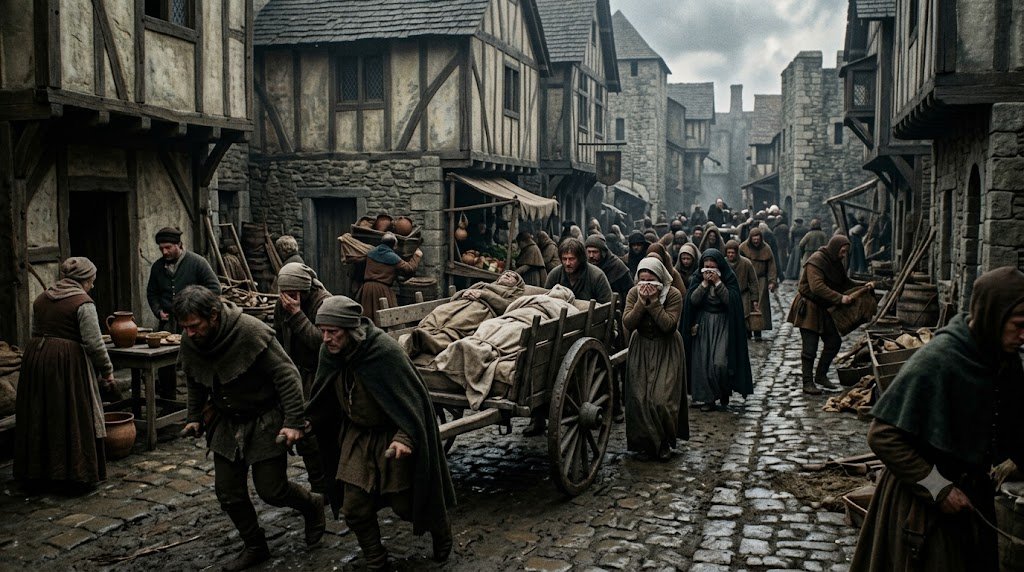
Boccaccio’s introduction to the Decameron describes Florence in 1348: the sick abandoned by neighbours and by their own families, bodies left at doorways for collection, mass graves filled in layers like ships’ cargo.
Explanations were desperate. The medical faculty at Paris, asked by the king for an opinion, blamed a conjunction of Saturn, Jupiter and Mars in 1345 for corrupting the air. Miasma theory dominated, which is why the plague doctor’s beaked mask, a later invention, was designed to hold herbs.
Many read it as punishment. Flagellant processions moved between towns, whipping themselves publicly, until the Church suppressed the movement in 1349.
And then the worst of it. Terrified communities looked for human causes, and Jewish communities were accused of poisoning wells. Massacres followed across the Rhineland and beyond. In Strasbourg, in February 1349, roughly two thousand people were killed, and the killing happened before the plague had even reached the city.
Pope Clement VI issued bulls stating plainly that Jews were dying of the disease alongside everyone else and that the accusations were false. It did not stop the murders.
Some responses were more useful. Port cities began holding arriving ships offshore. Ragusa, now Dubrovnik, imposed a thirty-day wait in 1377. Venice extended it to forty days, quaranta giorni, which is where the word quarantine comes from.
The World Afterwards
Here is the strange part. For many ordinary people who lived through it, life improved.
Pre-plague Europe was overpopulated relative to its farmland. Labour was cheap and land was expensive. Afterwards the arithmetic reversed.
Wages rose. Workers were suddenly scarce and could demand real money for their labour.
Serfdom weakened. A serf could leave for a landlord offering better terms, or for a town needing people.
Legislation failed. England’s Statute of Labourers, passed in 1351, tried to freeze wages at pre-plague levels. It bred deep resentment and fed directly into the Peasants’ Revolt of 1381.
Land use changed. Landowners shifted toward less labour-intensive uses, particularly sheep pasture, which reshaped the English countryside.
The Church came out damaged. It had promised explanation and protection and delivered neither. Its clergy died in enormous numbers, precisely because so many did their duty at deathbeds, and hasty replacement ordinations lowered standards in ways people noticed.
Art registered the shock. The danse macabre, the dance of death, appears across European painting and manuscript illumination in the following decades: skeletons leading away pope, emperor, merchant and labourer alike. It is a genuinely new subject, and it says something about a generation that had watched status offer no protection at all.
It Did Not Leave
Plague returned in waves for more than three centuries. The Great Plague of London in 1665. Marseille in 1720. Outbreaks across Europe and Asia in between.
Alexandre Yersin identified the bacterium in Hong Kong in 1894, during the third pandemic, and it carries his name.
The disease still exists. It is treatable with antibiotics if caught early, and a few thousand cases are reported worldwide each year, mostly in Madagascar, the Democratic Republic of Congo and Peru.
What Agnolo Saw
Historians rightly resist turning the Black Death into a story with a silver lining. Twenty-five to fifty million deaths do not become acceptable because wages rose afterwards, and the benefits fell very unevenly.
But the medieval world that entered 1347 did not come out the other side. What replaced it was more mobile, more sceptical of authority, and considerably more expensive to employ.
All of it caused by a bacterium riding a flea, riding a rat, riding a ship.
Agnolo di Tura survived. His account ends with a line that has not needed improving in seven hundred years: and so many died that all believed it was the end of the world.
Frequently asked questions
What caused the Black Death?
The bacterium Yersinia pestis, spread by fleas on rodents and, in its pneumonic form, directly between people. Its identity has been confirmed by DNA from medieval graves.
How many people died?
An estimated 30 to 50 percent of Europe’s population between 1347 and 1351, with tens of millions more deaths across Asia, the Middle East and North Africa. Ibn Battuta met the plague in Damascus in 1348.
Where did the Black Death start?
In Central Asia. A 2022 study of a cemetery in the Chu Valley of modern Kyrgyzstan, with tombstones dated 1338 and 1339, identified an ancestral strain of the bacterium.
Where does the word quarantine come from?
From quaranta giorni, Italian for forty days, the period Venice required arriving ships to wait. Ragusa had used a thirty-day hold from 1377.
What changed in Europe afterwards?
Labour shortages pushed wages up and undermined serfdom, quarantine and public health measures emerged, and the authority of the Church was weakened.
Does the plague still exist?
Yes. A few thousand cases are reported worldwide each year, mainly in Madagascar, the DRC and Peru. It is treatable with antibiotics if caught early.
Sources consulted: Spyrou et al., “The source of the Black Death in fourteenth-century Central Eurasia”, Nature (2022); Giovanni Boccaccio, The Decameron; Ole J. Benedictow, The Black Death 1346 to 1353 (2004); World Health Organization plague fact sheets.