
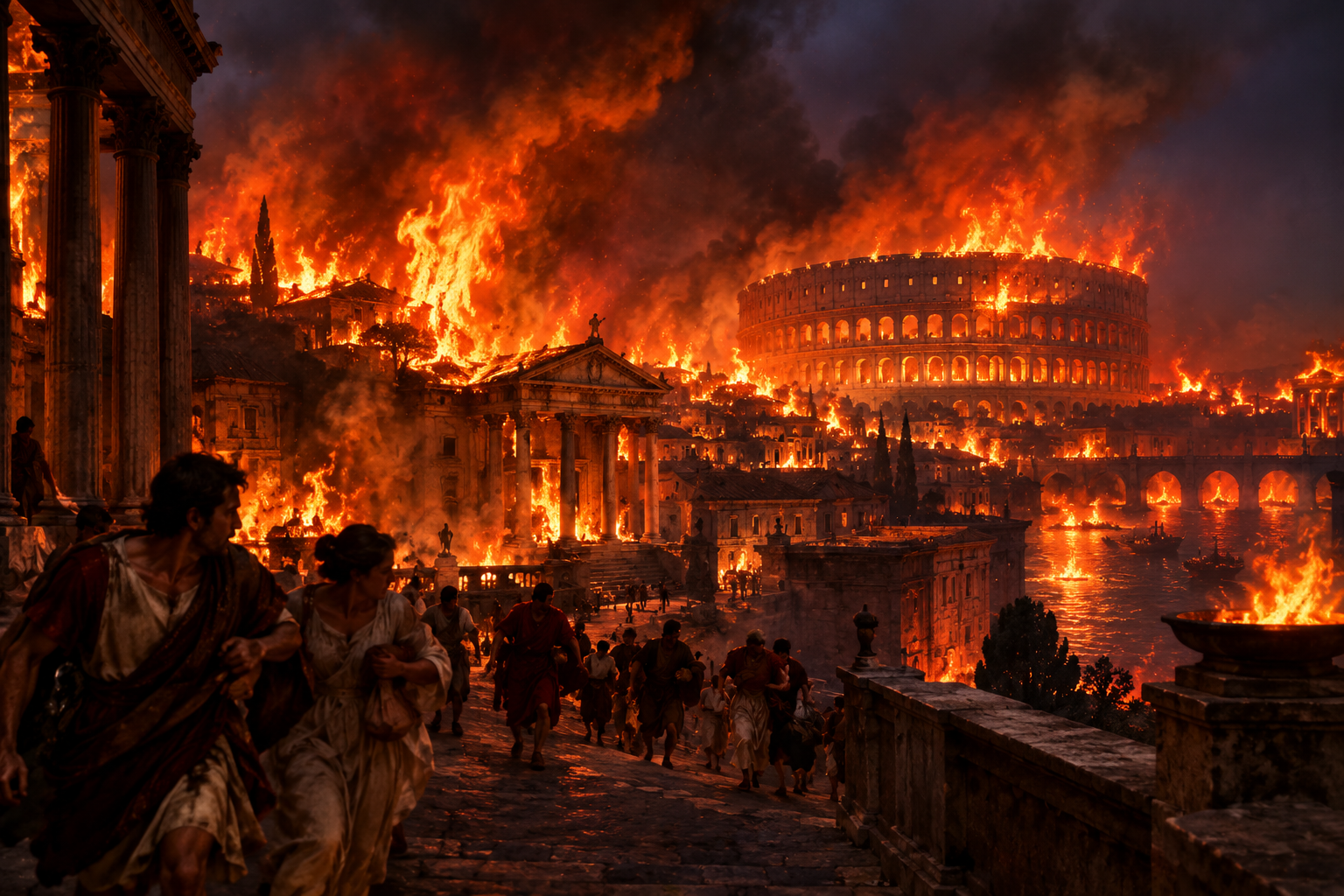
The fire started on the night of 18 July 64 CE, in shops at the eastern end of the Circus Maximus.
Rome was built to burn. Most of the city consisted of insulae, multi-storey apartment blocks with timber floors and upper storeys, packed along narrow streets, heated and lit with open flame. Fires were routine. The city had a brigade, the vigiles, seven thousand strong.
This one got away from them.
Six Days, Then Three More
Tacitus, writing roughly fifty years later, gives the fullest account, and he is the closest thing to a reliable source.
The fire burned for six days before being brought under control by demolishing buildings to create firebreaks. Then it restarted, on property belonging to Tigellinus, Nero’s praetorian prefect, and burned for three more.
Rome had fourteen districts. Tacitus reports that three were destroyed completely. Seven were badly damaged. Four escaped.
The physical losses included buildings that had stood since the earliest days of the city: the Temple of Jupiter Stator, the House of the Vestals, and, Tacitus notes with particular regret, monuments and Greek artworks that could not be replaced.
Thousands were made homeless. The death toll is not recorded, and estimates are guesses.
Where Nero Was
He was at Antium, his birthplace, roughly fifty kilometres away.
Tacitus states this plainly. Nero returned to the city only when the fire approached his own palace complex, and once there he acted decisively: he opened public buildings and his own gardens to the homeless, brought in food from Ostia, and cut the price of grain.
He also introduced building regulations afterwards that were genuinely sensible. Height limits. Wider streets. Mandatory firebreaks between buildings. A requirement for fireproof stone in construction, and for buildings to have their own walls rather than sharing them. Water access improved and regulated.
None of which is what he is remembered for.
The Fiddling
The lyre story is worth taking apart, because it is wrong in an instructive way.
Fiddles did not exist. The instrument in the ancient versions is a lyre or cithara.
More importantly, the three surviving sources disagree, and the earliest is the most cautious.
Tacitus, writing around 116 CE, reports it as a rumour. He says that while the city burned a rumour had spread that Nero had gone on stage and sung of the destruction of Troy. He explicitly frames it as something people were saying, and he notes Nero was at Antium when the fire began.
Suetonius, writing around 121 CE, states it as fact and adds detail: Nero watched from a tower and sang in stage costume.
Cassius Dio, writing over a century later still, elaborates further.
The pattern is the reverse of what reliability looks like. The closest source hedges. The later sources become more confident and more colourful.
Tacitus was around eight years old in 64 CE. Suetonius was not born. Dio was writing 150 years after the event.
The Christians
What Nero did next is the part that mattered most.
Rumour blamed him for the fire, partly because he began construction on an enormous palace complex, the Domus Aurea, on cleared ground shortly afterwards.
Tacitus reports that to end the rumour, Nero found scapegoats. He describes a group called Christians, a small and unpopular sect, being arrested, convicted, and executed with theatrical cruelty: torn by dogs, crucified, burned as lamps in his gardens.
This passage in the Annals is one of the earliest non-Christian references to Christians in Rome. Tacitus, who has no sympathy for the sect and calls their beliefs a destructive superstition, nonetheless writes that people began to pity them, because it was clear they were being destroyed to gratify one man rather than for the public good.
A Roman senator with no religious sympathy is recording that the crowd turned. It is one of the more remarkable pieces of ancient testimony we have.
Did He Do It?
The evidence against is reasonably strong.
He was fifty kilometres away when it started. The fire destroyed parts of the Palatine including his own property. Fires in Rome were common and this one began in a commercial district full of flammable goods.
The evidence usually offered against him is circumstantial: he benefited from the cleared ground, and the fire restarted on his prefect’s property.
The Domus Aurea is genuinely damning to modern eyes. It was vast, gilded, and included an artificial lake and a colossal statue of Nero. Building a palace on land cleared by a disaster you are suspected of causing is not politically clever.
But there is a difference between exploiting a catastrophe and starting one, and the sources do not close that gap.
Tacitus himself declines to decide. He writes that it remained uncertain whether the fire was accidental or set by the emperor, since both accounts were given by authorities.
A historian in 116 CE is telling his readers, plainly, that he does not know. It is the most honest sentence written about the fire in antiquity, and almost nobody quotes it.
Nero Afterwards
The reputation is worth examining, because the sources have a shape.
Tacitus, Suetonius and Cassius Dio were all writing under later dynasties with an interest in Nero looking bad. Tacitus in particular was a senator writing about an emperor who had executed senators, and senatorial historiography is not neutral about that.
That does not make them liars. Nero did have his mother killed. He did execute Seneca, his own former tutor. The cruelty towards the Christians is recorded by a source hostile to the Christians, which is about as strong as ancient testimony gets.
But a hostile tradition tends to accumulate, and Nero’s did. He became a figure into which later centuries poured whatever they found monstrous, and the fiddle arrived somewhere along that road.
What Came After
The Domus Aurea did not last. Nero killed himself in 68 CE, and his successors set about erasing him.
Vespasian drained the artificial lake and built an amphitheatre on the site. That building is the Colosseum, and its name may derive from the colossal statue of Nero that stood nearby.
The palace itself was stripped and buried under later construction, which is why parts of it survived to be rediscovered in the fifteenth century. Renaissance artists, including Raphael, lowered themselves through holes in the ceilings to see the decoration, and the style they copied from those buried rooms took its name from the grottoes they crawled through. Grotesque.
Nero’s palace ended up furnishing the visual vocabulary of the Renaissance, which is not a fate anybody planned.
Frequently asked questions
When was the Great Fire of Rome?
It began on the night of 18 July 64 CE and burned for six days, then restarted and burned for three more.
Did Nero really fiddle while Rome burned?
No. Fiddles did not exist, and Tacitus, the earliest source, reports the story of Nero singing only as a rumour and places him fifty kilometres away when the fire began.
Did Nero start the fire?
It cannot be established.
Tacitus, writing around 116 CE, explicitly says it remained uncertain whether the fire was accidental or deliberate.
How much of Rome was destroyed?
Of fourteen districts, Tacitus reports three destroyed completely, seven badly damaged, and four untouched.
What did Nero do about the fire?
He returned to the city, opened public buildings and his gardens to the homeless, brought in food, cut grain prices, and afterwards introduced building regulations including height limits and mandatory firebreaks.
Why did Nero blame the Christians?
Tacitus reports that rumour blamed Nero, and that he sought scapegoats. Christians were a small and unpopular sect, and Tacitus records that the crowd came to pity them.
Sources. Primary: Tacitus, Annals XV.38–44, trans. A. J. Woodman (2004); Suetonius, Life of Nero, trans. Catharine Edwards (2000); Cassius Dio, Roman History LXII, trans. Earnest Cary (Loeb). Modern scholarship: Miriam Griffin, Nero: The End of a Dynasty (1984), the standard study of the reign.