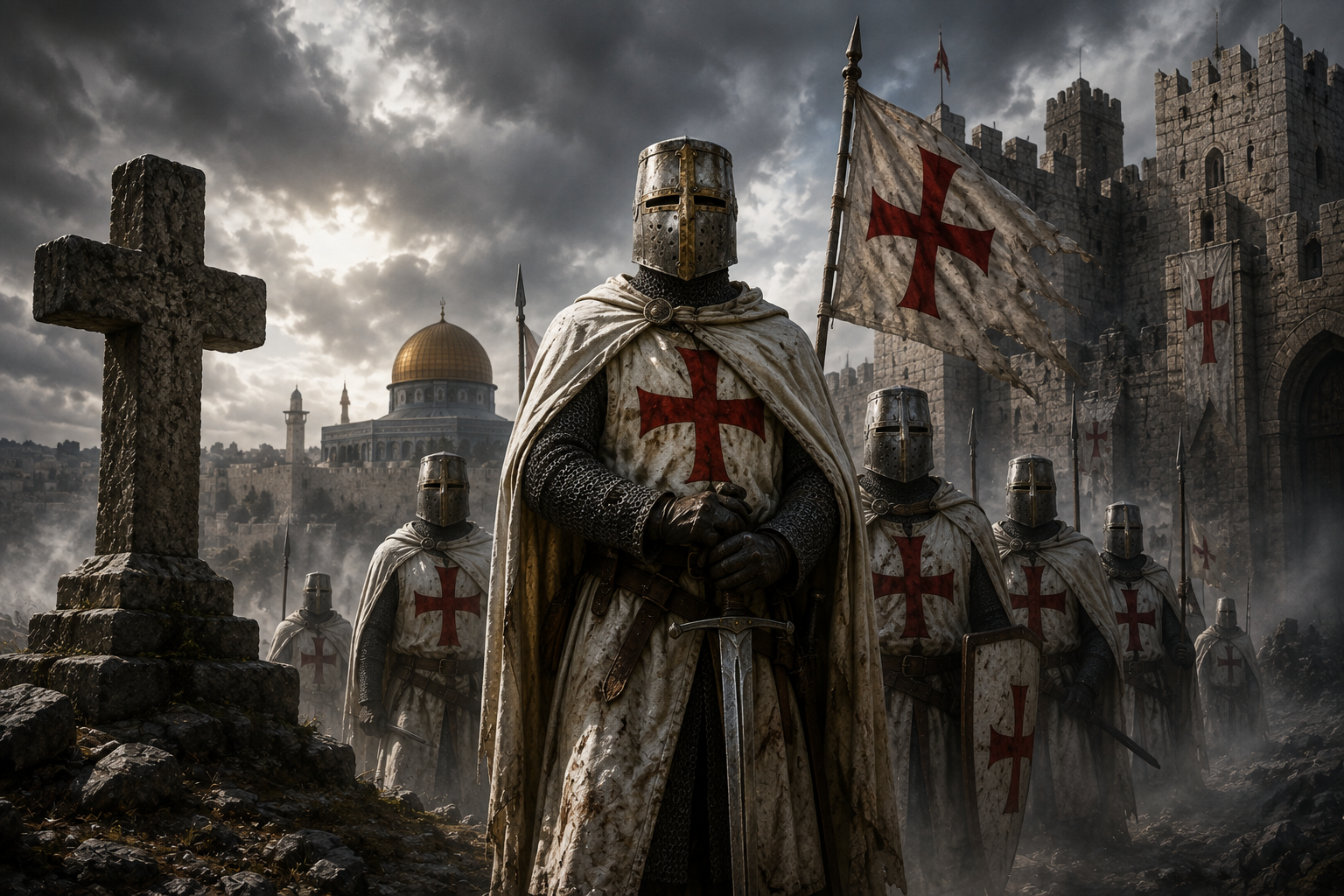
On Friday 13 October 1307, officers of the French crown arrested every Templar they could find in France simultaneously. Another famous trial, that of Joan of Arc, also preserved the accused’s own words.
The operation had been prepared in secret. Sealed orders went out weeks in advance, to be opened on the morning itself. Roughly fifteen thousand people were connected to the order in France, and the arrests swept up several hundred, including the Grand Master.
The date is the origin of a superstition that has outlived nearly everyone who knows why.
What the Order Actually Was
The Knights Templar were founded around 1119 in Jerusalem, after the First Crusade had taken the city and made pilgrimage possible again. Pilgrimage was not safe. Roads between the coast and Jerusalem were dangerous, and pilgrims were being killed in numbers.
Hugh de Payens and a small group of knights proposed a solution: a religious order whose members took monastic vows and also fought.
That combination was genuinely novel and initially controversial. Monks did not fight. Knights did not take vows of poverty and chastity. The order needed theological cover, and it got it from Bernard of Clairvaux, the most influential churchman of the century, who wrote a treatise defending the idea of a warrior monk.
Papal recognition followed. In 1139 the bull Omne Datum Optimum did three things.
It exempted the Templars from local church authority. It made them answerable to the Pope alone. And it freed them from tithes.
They were, in effect, a sovereign military organisation with no local oversight and excellent connections.
Where the Money Came From
Donations arrived from across Europe. Land, revenues, entire estates, given by nobles who wanted the spiritual credit of supporting the crusades without going.
By the mid-thirteenth century the order held property in England, France, Spain, Portugal, Italy, Germany and beyond, and the running of that portfolio required an administrative network.
Which produced the innovation the Templars are actually remembered for by economic historians.
A pilgrim travelling to Jerusalem could deposit money at a Templar house in London or Paris and receive a document. On arrival in the Holy Land, the document could be presented at a Templar house there and the equivalent sum withdrawn, minus a fee.
Money moved without travelling. Robbing a pilgrim on the road no longer got you anything.
The order went further. It held deposits for monarchs. The French crown jewels were kept in the Paris Temple. The Templars lent money, managed estates, arranged transfers between courts, and acted as trustees in disputes.
A monastic order had become, among other things, a bank operating across international borders.
Not the Only Order
The Templars were one of three, and the comparison explains a great deal about what happened to them.
The Hospitallers, founded slightly earlier, ran hospitals as well as fighting. When the crusader states fell they relocated to Rhodes, then Malta, and survive today as the Sovereign Military Order of Malta.
The Teutonic Knights turned north and east, conquering and governing territory along the Baltic. They became a state.
Both found a second purpose after the Holy Land was lost. The Templars did not. Their function had been narrow, their wealth was portable, and after 1291 they were an extremely rich organisation with no obvious job.
The Fighting
The military record deserves recording accurately, because the financial story tends to swallow it.
Templar knights fought as heavy cavalry and were the shock troops of the crusader states. Their rule forbade retreat unless the odds exceeded three to one, and forbade ransom. A captured Templar could not buy his way out, which meant capture generally meant death.
They fought at Montgisard in 1177, where a much smaller crusader force defeated Saladin. They fought at Hattin in 1187, where the crusader army was destroyed and the surviving Templars were executed on Saladin’s orders.
They held castles. Safed, Tortosa, Château Pèlerin. They were the last defenders at Acre in 1291, and the Grand Master died in the fighting.
Acre’s fall ended the crusader presence in the Holy Land. And it removed the reason for the order to exist.
Why the King Wanted Them Gone
Philip IV of France had a specific problem. He was extremely short of money, having fought expensive wars against England and Flanders, and he had already expelled the Jews from France in 1306 and seized their assets. He had debased the currency. He had extracted money from Italian bankers.
He owed the Templars a great deal.
He also had a working method. Philip had already forced a confrontation with Pope Boniface VIII and, after Boniface’s death, had secured the election of a French pope, Clement V, who resided at Avignon rather than Rome.
The charges laid against the Templars in 1307 were spectacular. Denying Christ. Spitting on the cross. Worshipping an idol called Baphomet. Obscene initiation rituals. Sodomy.
Confessions followed, obtained under torture, including from Grand Master Jacques de Molay.
The Chinon Parchment
Here the story acquires a document that changes it.
In 2001, a researcher at the Vatican Secret Archives, Barbara Frale, identified a parchment that had been catalogued incorrectly and effectively lost since 1628.
The Chinon Parchment records a hearing conducted by three cardinals at Chinon in August 1308. They examined Jacques de Molay and other senior Templars, heard their retractions, and absolved them, restoring them to the sacraments.
The Pope had privately found the leadership not guilty of heresy.
He suppressed the order anyway, at the Council of Vienne in 1312, on the grounds that its reputation was damaged beyond repair. The property was transferred largely to the Knights Hospitaller, though the French crown extracted what it could in the process.
In March 1314, de Molay was brought out to a scaffold in Paris to repeat his confession publicly. He retracted it instead, and declared the order innocent. He was burned that evening on an island in the Seine.
What Grew Afterwards
Almost everything popularly associated with the Templars postdates them by centuries.
The Freemason connection begins in eighteenth-century Scotland, when a French speech in 1737 proposed crusader origins for the movement. There is no documented continuity.
The Holy Grail association comes from the twentieth century, not from any medieval Templar source. The Baphomet idol as an occult figure was elaborated by nineteenth-century French occultists, particularly Éliphas Lévi, whose famous illustration dates from 1856.
The Rosslyn Chapel connection, the Oak Island treasure, the bloodline theories: all modern.
What actually survived is quieter. The Templars ran an international financial network two hundred years before anything comparable existed in Europe. They were destroyed by a king who owed them money, using charges his own Pope had privately dismissed.
It is a better story than the buried treasure, with the additional merit of being documented.
Frequently asked questions
Who were the Knights Templar?
A military religious order founded around 1119 in Jerusalem to protect pilgrims, whose members took monastic vows and fought as heavy cavalry.
Why were the Templars destroyed?
Philip IV of France, heavily indebted to the order and short of money, had them arrested in 1307 on charges of heresy. Confessions were obtained under torture.
Did the Templars invent banking?
Not banking as a whole, but they developed an early international credit system allowing pilgrims to deposit money in Europe and withdraw it in the Holy Land.
What is the Chinon Parchment?
A document rediscovered in the Vatican archives in 2001, recording that papal investigators absolved the Templar leadership of heresy in 1308, five years before the order was suppressed.
Are the Freemasons descended from the Templars?
There is no documented continuity. The claim originates in an eighteenth-century speech proposing crusader origins for Freemasonry.
Why is Friday the 13th unlucky?
The superstition is popularly linked to the mass arrest of Templars in France on Friday 13 October 1307, though the connection may be a later attribution.
What happened to Jacques de Molay?
He retracted his confession publicly in March 1314 and was burned that evening on an island in the Seine.
Sources consulted: Malcolm Barber, The Trial of the Templars (1978, revised 2006); Barbara Frale, The Chinon Chart (2004); Helen Nicholson, The Knights Templar: A New History (2001); Vatican Secret Archives, Chinon Parchment.