
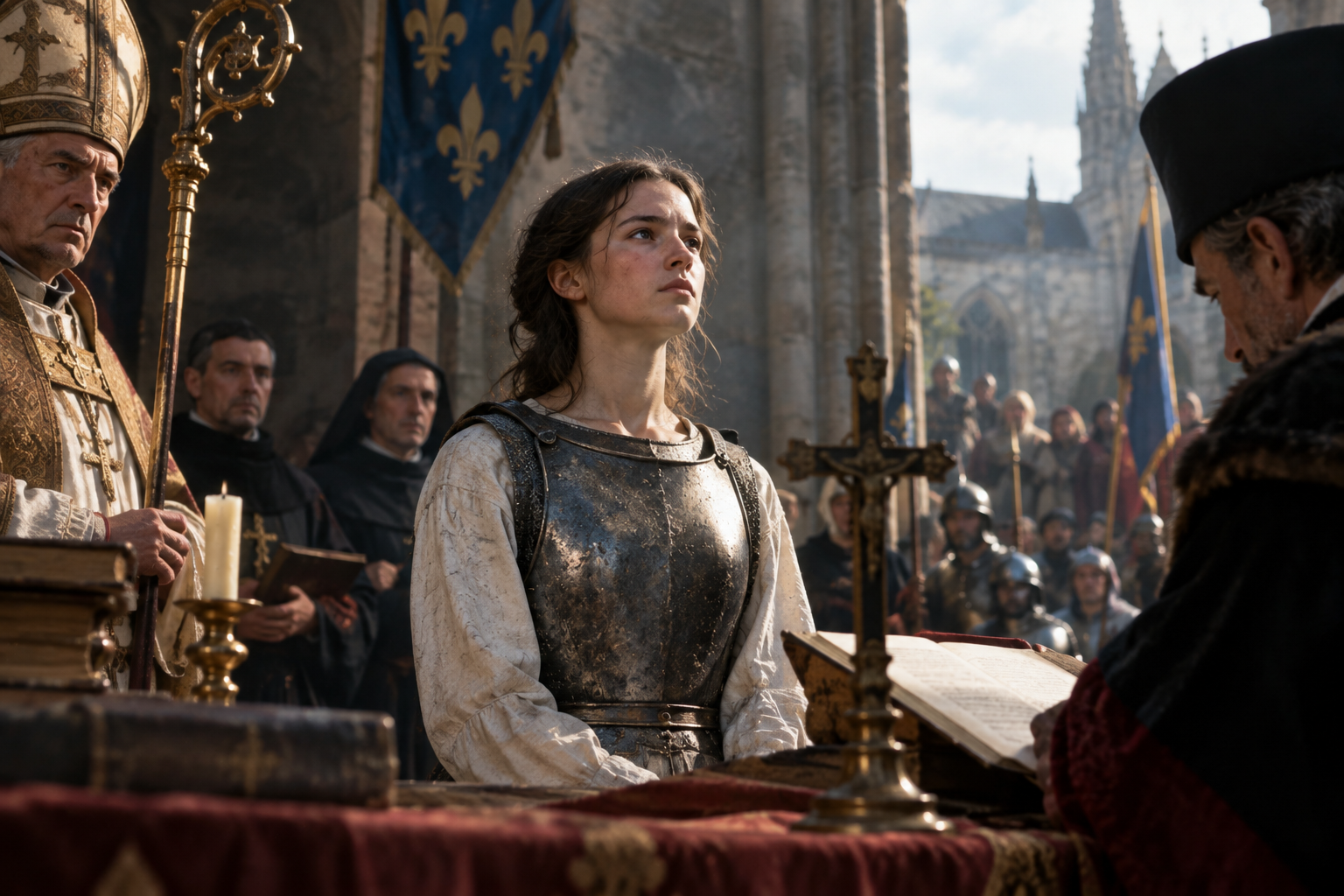
Almost nobody from the fifteenth century speaks to us directly. Peasants do not, women do not, and teenagers certainly do not.
Joan of Arc does, at length, under hostile questioning, for months, because the court that intended to destroy her employed notaries to write everything down.
The transcript of her trial is one of the most extraordinary documents to survive from medieval Europe, and the reason is an irony that has never worn off. The record exists because her enemies were procedurally meticulous. They wanted an unassailable conviction. So they produced a verbatim account of a nineteen-year-old outmanoeuvring a room full of theologians, and then they kept it. More than a century earlier, the Knights Templar had faced a trial of their own.
What the document is
The trial ran at Rouen from January to May 1431, in English-held Normandy, under Pierre Cauchon, Bishop of Beauvais. Notaries recorded the questions and answers in French as they were spoken. The record was later translated into Latin for the official version.
Both survive. There are also, crucially, the records of the nullification proceedings of 1455 to 1456, held after the English were driven out, in which around 115 witnesses who had known her were deposed: her childhood neighbours, soldiers who fought alongside her, the notaries from the first trial, and clergy who had been present.
So we have her own words under interrogation, and then testimony from people who knew her, taken twenty-five years later. For a medieval commoner this is an almost unheard-of evidentiary position.
What she sounds like
The transcript is not what people expect. She is not ecstatic or rambling. She is fast, exact and frequently funny.
Asked whether she was in a state of grace, a question designed as a trap because claiming certainty would be presumption and denying it would be a confession, she replies that if she is not, may God put her there, and if she is, may God keep her there. The notaries record that the assembly was stunned.
Asked repeatedly to describe her voices, she declines to give details, says she will not answer that, and at one point tells the court that she has already answered and they should consult their register. She catches them re-asking questions in different forms.
Asked why she wore men’s clothing, she gives a practical answer about safety in a prison guarded by men, which the nullification testimony corroborates.
The interrogators, over seventy sessions, keep failing to produce a doctrinal error. So the case eventually turns on the clothing and on her refusal to submit her voices to the church’s judgement, which are the two charges the court could actually make stick.
The condemnation, and the mechanics of it
She was worn down eventually. In late May, at the cemetery of Saint-Ouen, faced with the pyre, she signed an abjuration. The document she signed is short. The one entered into the record is long and detailed. The notary Guillaume Manchon later testified at the nullification that the substitution took place.
Days later she resumed male dress and was declared a relapsed heretic, which carried the death sentence. The nullification testimony includes accounts that her women’s clothing was removed from her cell, and that she had been threatened, leaving her without a choice that was not the trap.
She was burned at Rouen on 30 May 1431, aged about nineteen. The English had the ashes thrown into the Seine, specifically to prevent relics.
The nullification trial in 1456 overturned the verdict entirely, finding the process corrupt and the charges unsustained. She was canonised in 1920, nearly five centuries later.
What can and cannot be established
The record permits some firm statements. She existed, came from Domrémy, was around seventeen when she reached the Dauphin at Chinon, was present at the relief of Orléans in 1429, and was captured at Compiègne in 1430. She was examined at Poitiers before being given any role, which is often left out and matters, because it means the French court vetted her before employing her.
The military contribution is debated but not trivial. Contemporary accounts credit her with a decisive effect on morale during the Orléans campaign, at a point when the French position had been deteriorating for years.
What cannot be established, by any historical method, is the nature of the voices. Historians can report what she said about them, consistently, under pressure, over months. Medical explanations have been offered and none can be tested on a person dead for six centuries. The honest position is that she described the experience with complete consistency and that its cause is outside what evidence can reach.
Frequently asked questions
Do we have Joan of Arc’s actual words? As close as any medieval commoner comes. Notaries recorded her interrogation as it happened in 1431, and the transcript survives in French and Latin versions.
Why was Joan of Arc executed? She was convicted of heresy, with the case resting chiefly on wearing men’s clothing and on refusing to submit her claimed revelations to church judgement. The verdict was overturned in 1456.
How old was Joan of Arc when she died? About nineteen. She was born around 1412 and was burned at Rouen on 30 May 1431.
Was her trial fair? The nullification proceedings of 1455 to 1456 found it corrupt, and witnesses including one of the original notaries testified to procedural abuses, including the substitution of her abjuration document.
Did she actually fight in battles? She carried a banner and was present at engagements including Orléans, where she was wounded by an arrow. Contemporary accounts emphasise her effect on morale and her presence under fire.
What happened to her remains? She was burned at Rouen and her ashes were thrown into the Seine on English orders, to prevent them being collected as relics.
Sources
Primary: the trial record itself. Pierre Tisset and Yvonne Lanhers edited the condemnation trial, Procès de condamnation de Jeanne d’Arc (1960 to 1971). Pierre Duparc edited the nullification proceedings, Procès en nullité de la condamnation de Jeanne d’Arc (1977 to 1988). In English, Daniel Hobbins, The Trial of Joan of Arc (2005), is the best modern translation of the condemnation record, and W. P. Barrett’s earlier version is freely available.
Modern scholarship: Régine Pernoud, Joan of Arc: By Herself and Her Witnesses, which is built directly on the two trial records. Larissa Juliet Taylor, The Virgin Warrior (2009). Craig Taylor, Joan of Arc: La Pucelle (2006), a documentary collection.