
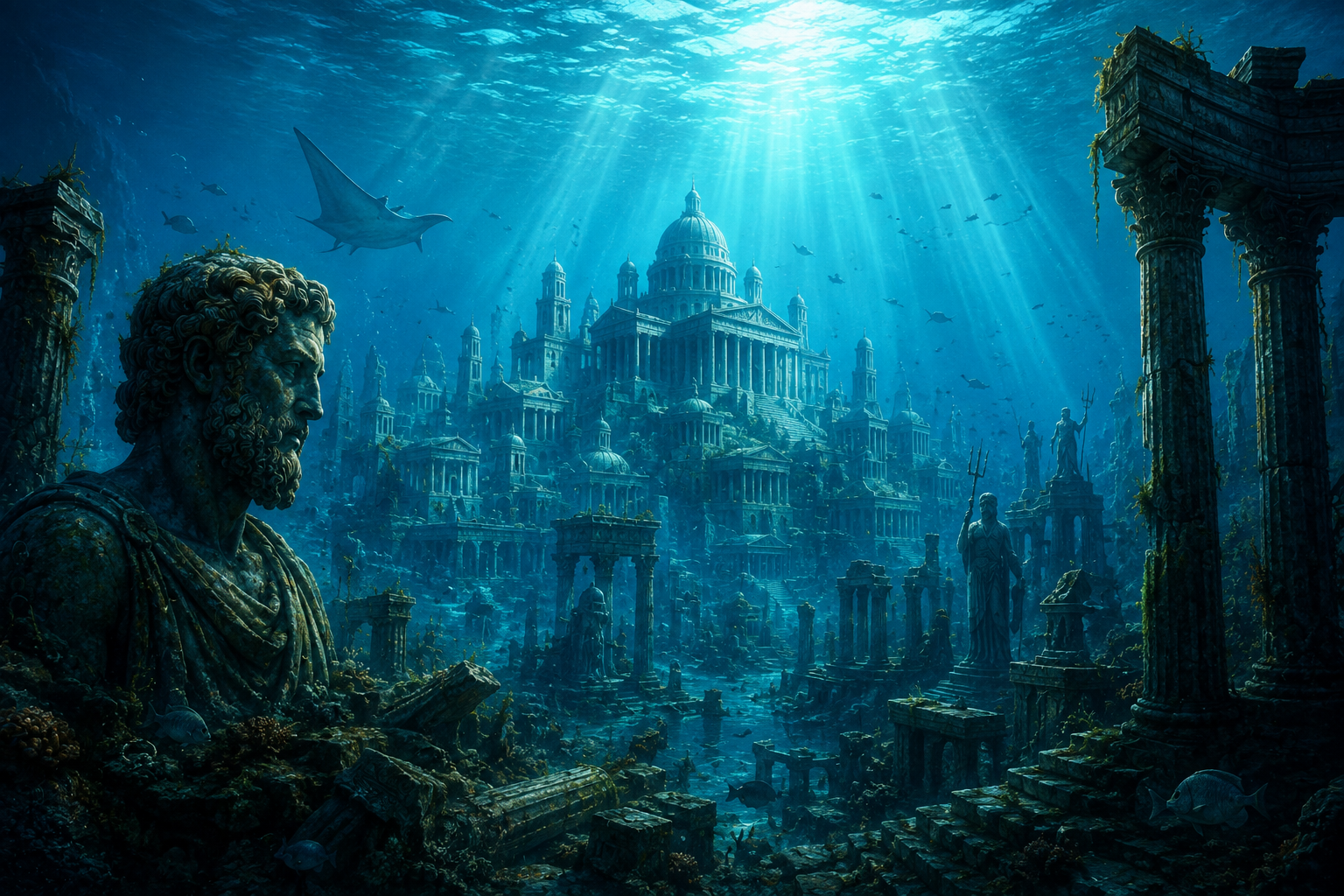
Trace any Atlantis theory backwards far enough and it narrows to a point.
Not a ruin. Not an inscription. Not a fragment of pottery pulled from a seabed. Two dialogues, written by one Athenian philosopher in about 360 BCE, and nothing before them anywhere in the historical record.
That is the whole evidential base. Everything else, and there is an enormous amount of everything else, was built on top of it.
The Man Who Made It Up
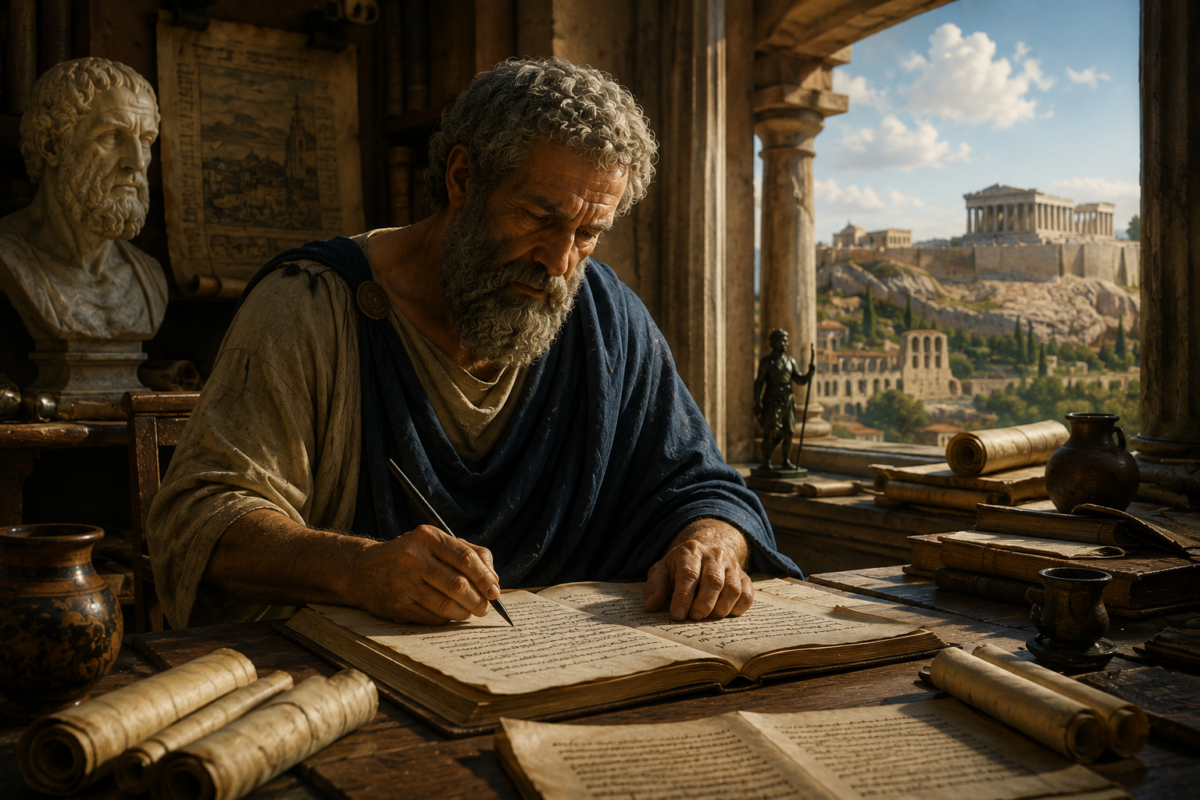
Plato tells the story across two texts, Timaeus and Critias. A character named Critias claims he heard it from his grandfather, who heard it from the Athenian lawmaker Solon, whom it was told to by priests in the Egyptian city of Sais.
Count the layers. Egyptian priests to Solon to a grandfather to Critias to the reader. Four removed before the story reaches anyone we can name with confidence, and no Egyptian source has ever been found saying anything of the kind.
The place Plato describes lies beyond the Pillars of Heracles, past what we now call Gibraltar. It is enormous, rich in metals, arranged in concentric rings of land and water, ruled by kings descended from Poseidon. It grows arrogant, attacks Athens, is defeated, and sinks in a single day and night.
He dates all this to nine thousand years before Solon. That places it around 9600 BCE.
Two Problems, Both Fatal
The date is the first. In 9600 BCE, human beings everywhere were living in small groups without agriculture, cities, metallurgy or ships worth the name. The Neolithic had not begun. A naval empire capable of invading the Mediterranean is not merely unlikely at that date; it is incompatible with everything we know about the period.
The second problem is what the story is doing.
Plato was not writing history. He was writing philosophy, and Atlantis has a job inside the argument. A disciplined, virtuous, idealised early Athens defeats a wealthy, arrogant naval power that has lost its way.
Plato had lived through Athens losing the Peloponnesian War. He had watched a maritime empire destroy itself through overreach. Reading Atlantis as a cautionary parable requires no interpretive gymnastics whatsoever.
Aristotle, who studied under him, seems to have thought so too. A remark preserved through later writers holds that the man who invented Atlantis was also the one who sank it.
Then there is the detail that ought to settle it. Critias is unfinished. Plato abandoned the dialogue mid-sentence and never returned to it. That is a strange way to treat a genuine historical record and an entirely normal way to treat a device you have finished using.
There is also the matter of how much detail Plato supplies. He gives the dimensions of the great plain, the number of the canals, the composition of the walls, the colours of the stone quarried from beneath the island, the specific arrangement of the concentric rings.
Historians rarely write like that about the distant past, because they cannot. Novelists do it constantly, because specificity is what makes an invention feel solid.
How a Parable Became an Industry
Modern Atlantis belief is not really descended from Plato at all. It descends from an American congressman.
In 1882, Ignatius Donnelly published Atlantis: The Antediluvian World. It argued that Atlantis was real, that it had been the mother civilisation of the ancient world, and that every advanced culture from Egypt to Mexico had learned what it knew from Atlantean survivors.
The book sold enormously. It also established a method that almost every later theory still uses:
- Find a similarity between two distant cultures. Pyramids will do.
- Insist the similarity is too specific to be coincidence.
- Propose a lost parent civilisation that taught both.
- Name it Atlantis.
Step two is where it fails. Independent invention is one of the most consistently observed patterns in human history, and pyramids are simply what you build when you want height and permanence and you do not have arches, steel, or a way to distribute load any other way. Broad base, narrow top. It is not a shared secret. It is gravity.
There is a further problem with Donnelly’s tradition that deserves naming rather than tiptoeing around. A great deal of early Atlantis literature was written by people who could not accept that the peoples of Africa and the Americas had built their own monuments, and who reached for a vanished pale-skinned civilisation to explain them. That assumption is dead in scholarship. Its residue is still visible in a surprising amount of popular Atlantis material.
The One Theory Worth Taking Seriously
Around 1600 BCE, the volcanic island of Thera erupted. It was among the largest eruptions of the last ten millennia. The Bronze Age town of Akrotiri was buried in ash and preserved, streets and frescoes intact. Tsunamis struck Crete, and the Minoan civilisation there declined not long afterwards.
Set that against Plato:
| Plato’s Atlantis | Thera and the Minoans | |
| Date | c. 9600 BCE | c. 1600 BCE |
| Location | Beyond Gibraltar | Inside the Aegean |
| Scale | Vast, continental | A small island group |
| End | Sank in a day and a night | Eruption, tsunami, decline |
| Evidence | None | Excavated, dated, visible |
The parallels are real: a sophisticated seafaring culture, sudden destruction involving the sea, an island partly swallowed, and a catastrophe large enough to leave a cultural memory that could plausibly have reached Egypt.
The differences are equally real, and they are about eight thousand years and two thousand kilometres wide.
The defensible position is that Plato may have inherited a distorted folk memory of Thera and used it as material. That is a long way from Atlantis having existed.
Why We Keep Looking
Here is what I find genuinely interesting about all this.
The instinct behind Atlantis belief is not stupid. It is the suspicion that the past is bigger than we have been told, and that suspicion is correct. Göbekli Tepe, properly excavated only from the 1990s, pushed monumental architecture back thousands of years and rearranged a lot of textbooks. The Indus Valley script remains unread. We keep finding things.
The problem is not the instinct. It is the method.
Göbekli Tepe was found by digging in Anatolia. Atlantis is found by wanting it, and the wanting has never once produced an artefact.
Meanwhile Aksum minted gold coins, Nazca drew figures across a desert plateau, and the Indus cities ran drainage systems that would embarrass parts of the modern world. All of them real, all of them documented, all of them stubbornly refusing to resolve into a clean story with a beginning and an end.
Which is, in the end, why Atlantis keeps winning. It is the only lost civilisation that comes pre-finished.
Frequently asked questions
Was Atlantis a real place?
There is no archaeological or historical evidence for it. Atlantis appears only in two dialogues by Plato and in no earlier source of any kind.
Where did Plato say it was?
Beyond the Pillars of Heracles, meaning past the Strait of Gibraltar in the Atlantic.
Could Atlantis have been the Minoans?
The Thera eruption around 1600 BCE offers real parallels and may have influenced Plato, but the date is off by roughly eight thousand years and the location does not match.
Why do people still believe in it?
Largely because of Ignatius Donnelly’s 1882 book, which popularised the idea and supplied the reasoning that most later theories still follow.
Has any evidence ever been found?
No. Expeditions have searched the Atlantic, the Mediterranean, the Caribbean and elsewhere without recovering a single verified artefact.
Sources consulted