
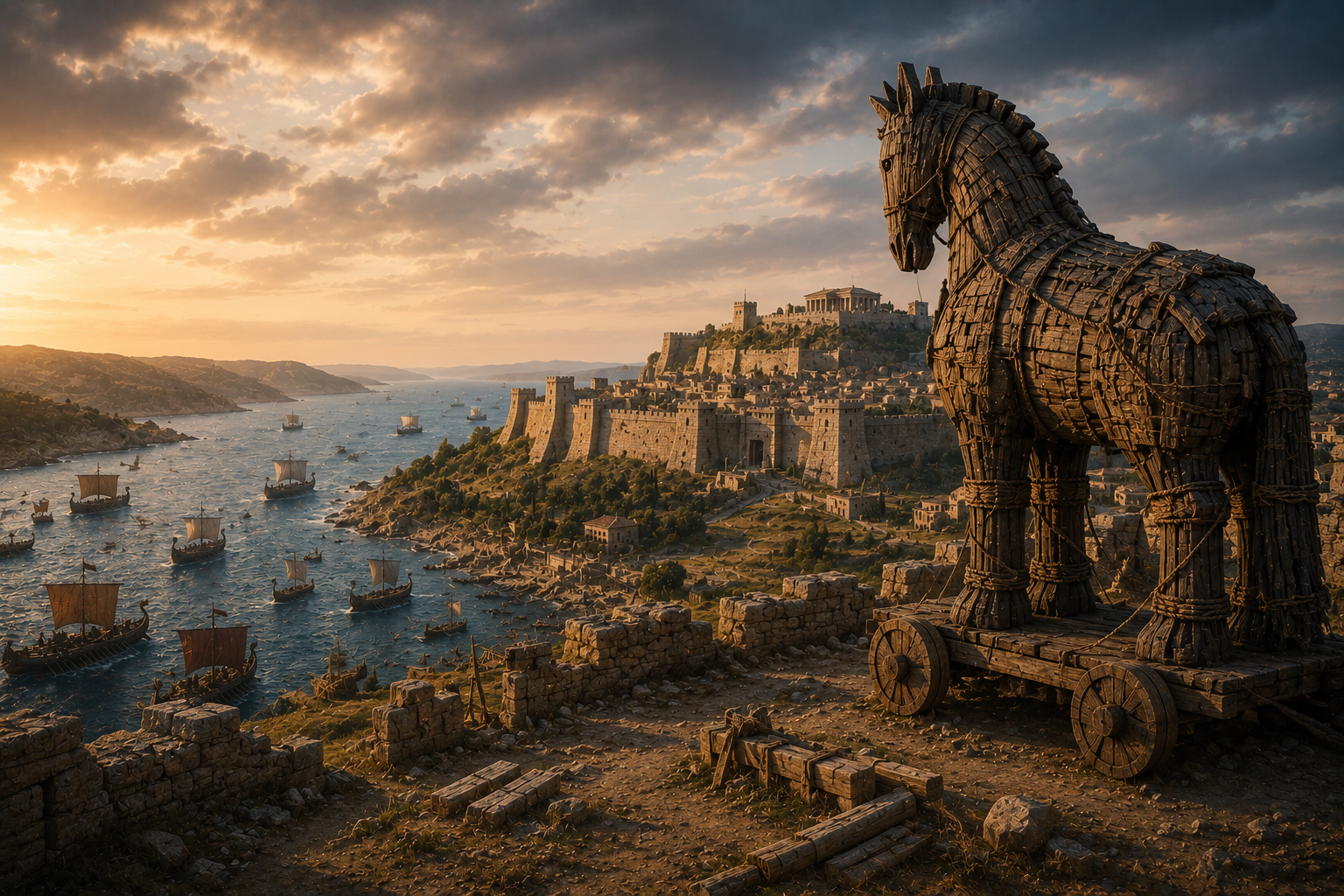
Frank Calvert owned part of the hill, and scholars still ask was the trojan war real.
He was a British expatriate in the Dardanelles, an amateur archaeologist with a sharp eye and no money. By the 1860s he had worked out that a mound called Hisarlik was almost certainly Troy. He bought a share of the land. He dug test trenches. He wrote to the British Museum asking for funds to excavate properly. This raises the question: “was the trojan war real?”
They said no.
Then a wealthy German businessman passed through, and Calvert told him everything he knew.
What Schliemann Did With It
Heinrich Schliemann started digging at Hisarlik in the early 1870s. His name is the one attached to the discovery. Calvert appears mostly as a footnote, which is roughly how Schliemann treated him in print.
Schliemann was right about the site and reckless about everything else.
Convinced Homer’s city lay at the bottom, he drove a vast trench straight down through the mound. He destroyed layers on the way to what he wanted. Modern excavators still work around the damage.
He found gold. He announced it as the treasure of King Priam and photographed his wife Sophia wearing it. The hoard turned out to date from around 2400 BCE, more than a thousand years too early for any plausible Trojan War.
The treasure then had a career almost as chaotic as its finder. Schliemann smuggled it out of Ottoman territory and was sued for it. Most of it went to Berlin. It vanished at the end of the Second World War and surfaced in Moscow in 1993, where it remains, with Turkey and Germany both claiming it.
Nine Cities Stacked in One Hill
Hisarlik holds at least nine main settlement phases, one on top of another, spanning roughly three thousand years.
| Phase | Approximate date | Why it matters |
| Troy I to V | c. 3000 to 1750 BCE | Early Bronze Age. Schliemann’s gold came from here |
| Troy VI | c. 1750 to 1300 BCE | Large, wealthy, strong walls. Possibly ended by earthquake |
| Troy VIIa | c. 1300 to 1180 BCE | Destroyed by fire and violence. The leading candidate |
| Troy VIII to IX | c. 700 BCE to 500 CE | Greek and Roman city on the same ground |
From 1988, excavations led by Manfred Korfmann changed the picture again. Geophysical survey found a lower city spreading around the citadel, far larger than anyone had assumed.
Troy was not a hilltop fort holding a few hundred people. It was a walled city of several thousand, sitting at the entrance to the Dardanelles.
That location is the point. Whoever held Troy could tax or block a great deal of shipping.
Why That Hill Mattered
The Dardanelles is a strait roughly sixty kilometers long, and it has a strong current running south out of the Black Sea.
Sailing ships in the Bronze Age could not fight that current without a steady northerly wind behind them. So they waited. Sometimes for weeks, anchored on the shore near the entrance, until the weather turned.
Troy sat exactly there.
A city positioned at a spot where every ship must stop and wait is a city that can sell food, water, shelter, and protection. It can charge for passage. Or refuse it.
Manfred Korfmann argued this was the real basis of Troy’s wealth, and it explains something the poem does not. Why anyone would fight over that hill more than once.
The Tablets at Hattusa
The best evidence for a real conflict does not come from Troy at all. It comes from clay tablets found at Hattusa, the Hittite capital in central Anatolia.
Hittite diplomatic records mention a place called Wilusa repeatedly. Linguists connect that name to Ilios, Homer’s other word for Troy. The same records mention Ahhiyawa, a power across the sea, widely identified with the Achaeans, Homer’s word for the Greeks.
The friction lasted generations. A treaty from around 1280 BCE names a ruler called Alaksandu of Wilusa, which sits uncomfortably close to Alexandros, the second name Homer gives Paris. The Tawagalawa letter refers back to an old disagreement between the Hittites and Ahhiyawa over the same city. Other tablets record Wilusa changing hands and needing military intervention.
None of that describes a ten-year siege launched over a stolen queen. It describes a valuable city on a contested border, fought over more than once.
How a Memory Lasts Four Hundred Years
Here is a complication people skip past.
Greek writing disappeared during the Bronze Age collapse and did not return until roughly the eighth century BCE. For those intervening generations nobody could write anything down. The past was carried by professional oral poets working inside a strict metrical system that made memorization possible.
Traditions of that kind behave predictably. Names survive. Places survive. The fact of a conflict survives. Motivation, dialogue and specific incidents do not.
You can see the seams in the poem itself. The Iliad describes bronze weapons and boar-tusk helmets that had gone out of use centuries before Homer. It also describes iron tools and cremation burials from his own era. Objects from three or four different periods sit inside the same battle scene, because each generation of reciters furnished the story with whatever it could picture.
The poem is layered like the hill it describes.
The Bigger Fire
Troy VIIa did not burn on its own.
Between roughly 1200 and 1150 BCE, the eastern Mediterranean came apart. Mycenaean palaces burned across Greece. The Hittite empire disintegrated. Cities across the Levant were destroyed or abandoned. Writing disappeared in several places at once.
Historians call it the Late Bronze Age collapse, and its causes remain contested. Drought. Migration. Systems failure. The Sea Peoples. Possibly all of it at once, each factor making the next one worse.
Troy’s destruction sits inside that. Which raises a possibility the poem does not allow for.
The city may not have fallen because of a war fought over it. It may have fallen because the whole world it belonged to was falling, and Troy went down with everything else.
What Was Actually Found
Schliemann wanted to prove Homer was a reporter. He failed.
What he uncovered instead, by accident and at considerable cost, was a three-thousand-year-old city at the precise location the poem gives, holding a burnt layer at roughly the right date, named in the diplomatic correspondence of an empire nobody had connected to the story.
Frank Calvert, who worked it out first and could not afford to prove it, died in the Dardanelles in 1908. There is a small memorial to him at the site now.
The Iliad is not history. It is a memory of a real place, and the memory held up considerably better than anyone expected.
Frequently asked questions
Was Troy a real city?
Yes. The site at Hisarlik in northwestern Turkey has been excavated since the 1870s and holds at least nine main settlement phases across roughly three thousand years. This raises the question: was the trojan war real?
Is there evidence the Trojan War happened?
Troy VIIa was destroyed by fire and violence around 1180 BCE, and Hittite records confirm repeated conflict over the city. The specific war Homer describes is not confirmed.
Was the Trojan Horse real?
There is no evidence for it. Homer barely mentions the horse. The detailed version most people know was written by Virgil roughly seven centuries later.
Who really discovered Troy?
Frank Calvert identified Hisarlik in the 1860s and owned part of the mound. Heinrich Schliemann excavated it from the 1870s and received nearly all the credit.
What is Wilusa?
A city named repeatedly in Hittite records, which most scholars identify with Ilios, Homer’s alternative name for Troy.
Why does the Iliad describe weapons from different periods?
Because it was composed orally across four centuries. Each generation of reciters described the objects it knew.
Where is Troy today?
At Hisarlik in Çanakkale Province, northwestern Turkey, near the entrance to the Dardanelles. A UNESCO World Heritage Site since 1998.
Sources consulted