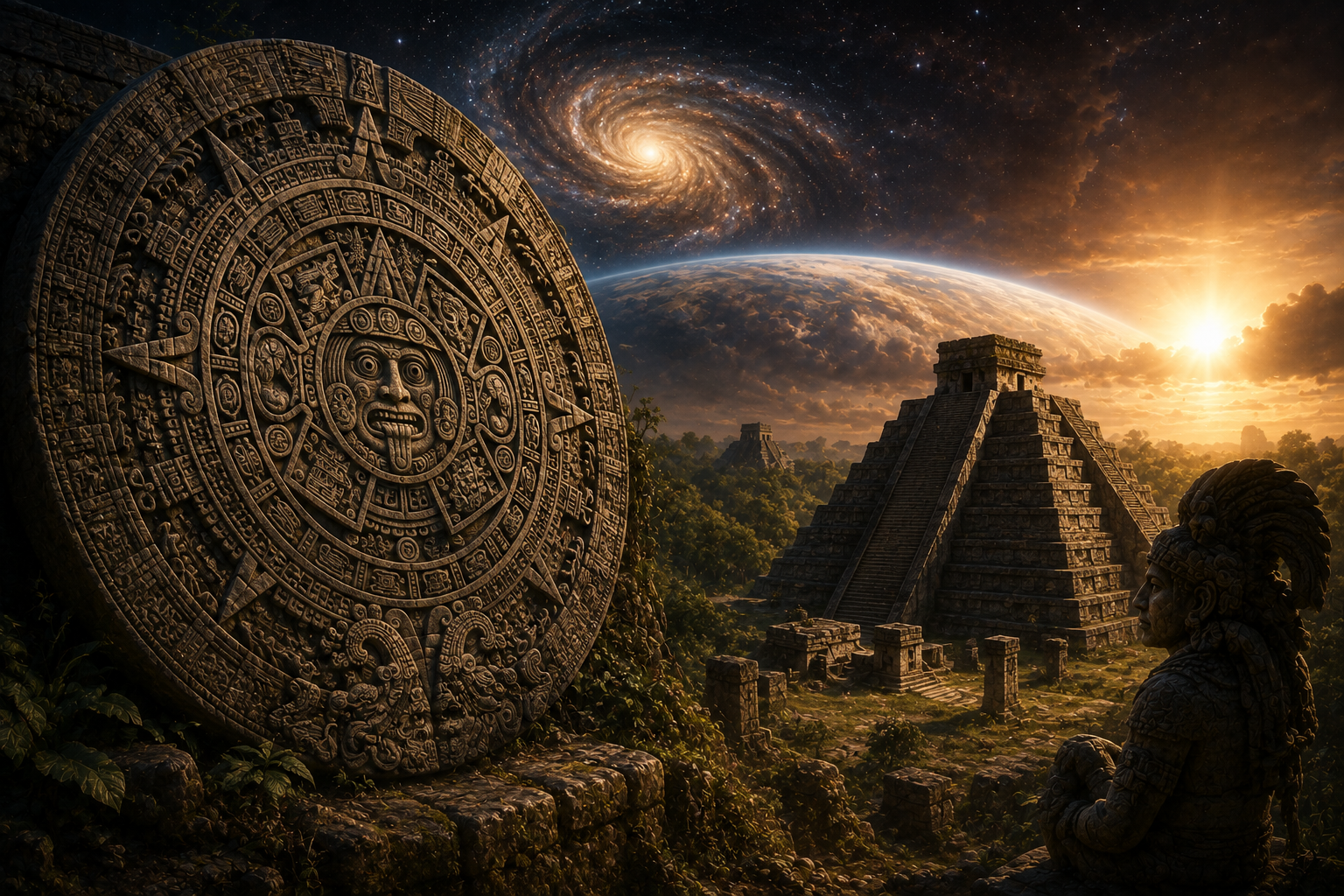
On 21 December 2012, a cycle in the Maya Long Count calendar completed.
Nothing else happened.
That non-event had been preceded by a decade of documentaries, a Hollywood disaster film, thousands of books, and enough public anxiety that NASA set up a dedicated page answering questions. A survey conducted in the run-up found significant numbers of people worldwide believed the world might end.
The Maya had not predicted anything of the kind. Working out how the misunderstanding happened is more interesting than the debunking.
Three Calendars at Once
The Maya ran multiple calendars simultaneously, and each did a different job.
The Tzolk’in is a 260-day ritual cycle, combining thirteen numbers with twenty day names. Its origin is debated. Proposals include the human gestation period and the interval between zenith passages of the sun at certain latitudes.
The Haab’ is a 365-day solar year: eighteen months of twenty days, plus a five-day period called Wayeb’ considered unlucky.
Run the two together and they realign every 52 years. That period, the Calendar Round, was the basic long unit of Mesoamerican timekeeping, and it was shared well beyond the Maya.
The problem with a 52-year cycle is that it cannot date anything beyond a single lifetime without ambiguity. Which is why the Maya built a third system.
The Long Count
The Long Count is a linear tally of days from a fixed starting point, and it is the calendar 2012 was about.
Its units are straightforward:
- K’in, 1 day
- Winal, 20 k’in, or 20 days
- Tun, 18 winal, or 360 days
- K’atun, 20 tun, roughly 19.7 years
- B’ak’tun, 20 k’atun, roughly 394 years
A Long Count date is written as five numbers. The starting point, correlated to the Gregorian calendar, falls on 11 August 3114 BCE.
On 21 December 2012, the count read 13.0.0.0.0. The thirteenth b’ak’tun completed.
That is the entire basis of the prophecy.
Why Thirteen Mattered, and Why It Did Not
Thirteen is a significant number in Maya cosmology, and a cycle of thirteen b’ak’tuns does appear in some creation accounts. The current world was said to have begun when a previous count of thirteen b’ak’tuns completed.
But the Long Count does not stop at thirteen. It has higher units above the b’ak’tun, and Maya inscriptions use them.
The clearest evidence comes from Palenque. An inscription in the Temple of the Inscriptions projects forward to a date in the year 4772 CE, commemorating an anniversary of the accession of the ruler K’inich Janaab’ Pakal.
A civilisation that carves a date more than two thousand seven hundred years past the supposed end of the world is not expecting the world to end.
The One Text That Mentions It
Out of thousands of surviving Maya inscriptions, exactly one refers to the 2012 date directly. It is Monument 6 from Tortuguero, in Tabasco, Mexico.
The monument is damaged, and the crucial passage is partly destroyed.
What survives appears to say that on the date in question, a deity called Bolon Yokte’ K’uh will descend, or will be displayed. Bolon Yokte’ is associated with conflict, creation and transitions between cycles.
Epigraphers, including David Stuart and Stephen Houston, read this as a formulaic reference to a calendrical ceremony rather than a prophecy. There is no destruction in the text.
A second possible reference was found at La Corona in Guatemala in 2012, and it too is contextual, mentioning the date in connection with a ruler’s political circumstances rather than any cosmic event.
Two references. Neither apocalyptic.
Where the Prophecy Came From
The idea has a traceable modern lineage, and no Maya source in it.
Michael Coe, a distinguished Mayanist, wrote in The Maya in 1966 that the completion of the current Great Cycle would be accompanied by Armageddon. He was speculating, and later revised the framing, but the sentence circulated.
Frank Waters expanded on it in 1975. José Argüelles’ The Mayan Factor, published in 1987, connected the date to a New Age framework and to the Harmonic Convergence event of the same year. Argüelles’ work drew heavily on numerology and on ideas with no Maya basis.
Then the internet, then publishing, then Hollywood, and by the late 2000s the claim had accumulated additions the earlier authors had never made: a rogue planet called Nibiru, a galactic alignment, a pole shift.
Modern Maya communities, of whom there are roughly six million, were largely not consulted throughout. Several Maya elders and organisations objected publicly to the use of their calendar, and some pointed out that the cycle’s completion was understood locally as a renewal rather than an ending.
What the Maya Actually Thought About Time
Setting 2012 aside, the underlying view of time is worth understanding, because it is genuinely unlike the European one.
Maya time is cyclical and layered. Cycles complete and begin again, and events that occur at the same point in a cycle are understood to resonate with each other. A king performing a ritual at the close of a k’atun is repeating something his predecessors did and his successors will do.
Cycle endings were therefore significant occasions. They required ceremony, monuments and renewal. What they did not require was catastrophe.
This is why the Tortuguero inscription mentioning a deity descending reads to epigraphers as routine. A cycle ends, a god is invoked, a ceremony is held. That is what cycle endings were for.
What the Calendar Actually Shows
Strip away the 2012 material and what remains is a genuine achievement in observational astronomy.
The Dresden Codex, one of four surviving Maya books, contains eclipse tables and a Venus table tracking the planet’s synodic period with an error of roughly two hours over 481 years.
Maya inscriptions record dates in the deep past, including one at Coba referring to a period of time expressed in units so large it runs into billions of years.
They developed positional notation and a symbol for zero, independently, centuries before either reached Europe.
The calendar was designed to keep track of enormous spans of time without losing count. It was very good at it. And on 21 December 2012, it did exactly what it was built to do, which was roll over and keep counting.
Frequently asked questions
Did the Maya predict the world would end in 2012?
No. The date marked the completion of the thirteenth b’ak’tun in the Long Count calendar. Maya inscriptions project dates far beyond it.
What is the Long Count calendar?
A linear tally of days from a fixed starting point correlated to 11 August 3114 BCE, using units of k’in, winal, tun, k’atun and b’ak’tun.
What happens after a b’ak’tun ends?
The count continues. The Long Count has units above the b’ak’tun, and Maya texts use them.
Is there any Maya text about 2012?
One clear reference, on Monument 6 from Tortuguero, which epigraphers read as describing a calendrical ceremony rather than a prophecy. The passage is partly damaged.
Where did the 2012 prophecy come from?
From modern authors, beginning with a speculative line in Michael Coe’s The Maya in 1966 and expanded substantially by José Argüelles in 1987.
What is the Palenque inscription?
A text in the Temple of the Inscriptions projecting forward to a date in 4772 CE, which demonstrates the Maya expected time to continue well past 2012.
Sources consulted: David Stuart, The Order of Days (2011); Anthony Aveni, The End of Time: The Maya Mystery of 2012 (2009); Mark Van Stone, 2012: Science and Prophecy of the Ancient Maya (2010); NASA public information on 2012.