
In 1969, three men exploring a cave near Pasca, south of Bogotá, found a ceramic vessel.
Inside it was a small gold object, roughly twenty centimetres long. A raft, carrying a central figure surrounded by attendants, cast by the lost-wax method in a gold and copper alloy.
It depicts a ceremony that Spanish chroniclers had described four centuries earlier and that Europe had spent three hundred years catastrophically misunderstanding.
The Gilded Man
The Muisca lived in the highlands of the Colombian Andes, above 2,500 metres, in a society organised around agriculture, salt production and remarkably skilled goldworking.
When a new chieftain took power, the ritual reportedly went like this.
He was stripped, coated in a sticky resin, and covered in gold dust until he gleamed. He was rowed on a raft to the centre of Lake Guatavita, loaded with gold and emerald offerings.
At the centre he threw the treasure into the water and then washed the gold from his own body into the lake. The offerings were for the deity believed to live beneath the surface.
Spanish chroniclers heard this in the 1530s and called the man el dorado, the gilded one.
How a Man Became a City
The transformation is a case study in compounding rumour.
- A gilded man performs a ceremony at a specific lake.
- Spanish accounts describe a ruler so rich he wears gold as clothing.
- If a ruler is that rich, the reasoning runs, his city must be richer.
- If the city has not been found, it must lie further into the unexplored interior.
- The interior is enormous, so the search can continue indefinitely.
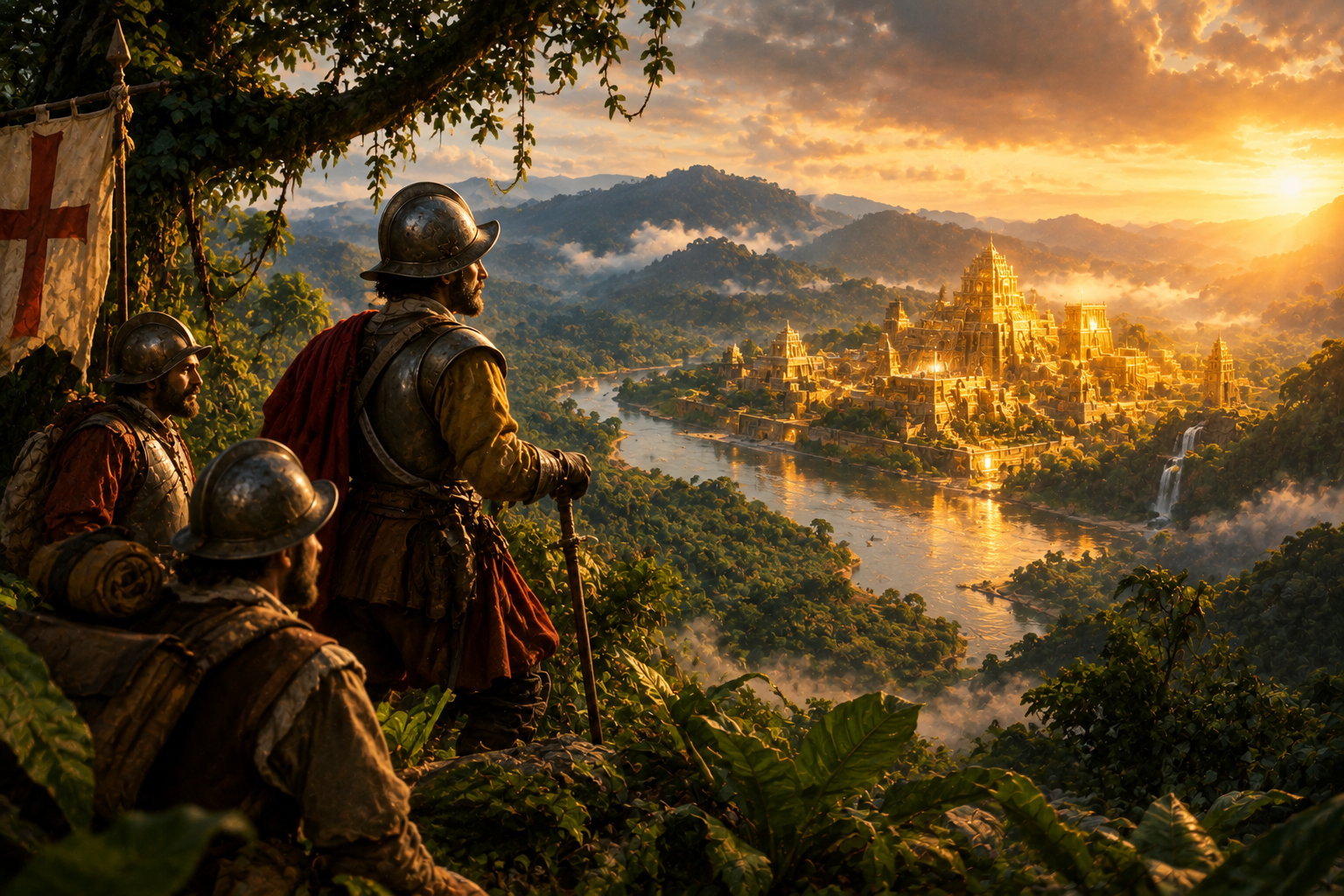
By the 1540s El Dorado was a golden city. By the end of the century it was a kingdom called Manoa, on the shores of a great lake somewhere in Guiana.
The legend had become unfalsifiable. Every failed expedition proved only that nobody had gone far enough.
What It Cost
Jiménez de Quesada, Belalcázar and Federmann converged separately on the Bogotá plateau between 1536 and 1539. Muisca political structure collapsed within a few years under conquest, forced labour and introduced disease.
Gonzalo Pizarro and Francisco de Orellana set out in 1541. Pizarro’s force was nearly destroyed. Orellana, sent downriver to find food, could not return upstream and simply kept going, emerging at the Atlantic after roughly eight months as the first European to descend the Amazon.
He mapped a continent by failing to find a city that did not exist.
Walter Raleigh explored the Orinoco in 1595 and published an influential account of what he had not found. He returned in 1617. His son was killed, no gold was recovered, and Raleigh was executed on his return to England in 1618.
They Did Drain the Lake
Lake Guatavita has been attacked repeatedly by people convinced the gold was still at the bottom. The striking thing is that they were partly right.
In the 1580s a merchant named Antonio de Sepúlveda organised the cutting of a notch into the rim, lowering the water by around twenty metres. Gold objects were recovered. The cut later collapsed, killing workers.
In 1898 a British company drained the lake almost completely. The exposed mud baked solid in the sun before anything could be extracted, and by the time equipment arrived the water had returned. The company went bankrupt.
The Colombian government banned further attempts in 1965, and the lake is now protected.
What Was Actually Taken
The people at the centre of the legend rarely appear in retellings of it.
Muisca goldwork was melted for bullion in enormous quantities. What survives does so largely because it had been deposited as offerings in lakes, caves and shrines, out of Spanish reach.
The Gold Museum in Bogotá now holds around 34,000 gold objects. Many are tunjos, small votive figures made deliberately rough and flat, because they were never meant to be worn.
They were made to be given away.
Which reframes the entire legend. The Spanish were hunting accumulated treasure. The Muisca were manufacturing objects whose whole purpose was to be surrendered.
What Orellana Wrote
There is a coda worth adding.
Orellana’s expedition down the Amazon produced an account, written by the Dominican friar Gaspar de Carvajal, describing large settled populations along the river: villages within sight of each other, roads inland, worked pottery.
For four centuries this was treated as exaggeration. The Amazon was assumed to be incapable of supporting dense populations, and Carvajal was dismissed as embellishing.
Recent archaeology has substantially revised that. Terra preta, dark anthropogenic soils created by human management, has been found across large areas. Lidar survey has revealed earthworks, causeways and settlement complexes beneath the canopy.
The Amazon was considerably more populated than anyone believed, before introduced disease swept through it in advance of Europeans.
The Spanish went looking for a golden city, missed the actual civilisation they were paddling past, and were disbelieved for four hundred years when they described it.
The Raft
The Muisca Raft sits in the Gold Museum in Bogotá, and it is the closest thing to proof the story has.
Not proof of a golden city. Proof that the original report was accurate before Europe embellished it beyond recognition.
The Spanish were told the truth in the 1530s and could not accept how small it was. A chieftain, a lake, a ceremony, and a genuine but finite quantity of gold.
They spent three centuries, thousands of lives and several fortunes chasing the version they had invented themselves, while the object at the centre of it sat in a cave in a clay pot, twenty centimetres long, waiting until 1969.
Frequently asked questions
What was El Dorado?
Originally a person, not a place. The name means “the gilded one” and referred to a Muisca chieftain who covered himself in gold dust during an initiation ritual.
Was El Dorado ever found?
No golden city was ever found because none existed. The ceremony behind the legend was real and is confirmed by the Muisca Raft, found in 1969.
Where did the ceremony take place?
At Lake Guatavita in the Colombian highlands, north-east of modern Bogotá.
Did anyone try to drain the lake?
Yes, repeatedly. A partial drainage in the 1580s recovered gold, and a British company drained it almost fully in 1898 before the mud baked solid.
What is the Muisca Raft?
A gold votive object about twenty centimetres long, found in 1969, showing the raft ceremony described by Spanish chroniclers. It is held in the Gold Museum in Bogotá.
What happened to Walter Raleigh?
His 1617 expedition failed, his son was killed, and he was executed on his return to England in 1618.
Sources consulted: Museo del Oro, Bogotá, Muisca Raft collection notes; John Hemming, The Search for El Dorado (1978); Walter Raleigh, The Discoverie of Guiana (1596).