
Hammurabi’s laws were carved on a black stone pillar over two metres high, and set up where anyone could see them.
That is the point people miss about the Code of Hammurabi. It was published. Around 1754 BCE, a king put 282 laws in a public place, in writing, so that, as the prologue says, the strong should not oppress the weak.
Whether it worked is another question. But the idea that law should be visible and fixed rather than whatever the official in front of you decides is not a small idea, and Babylon had it nearly four thousand years ago.
Two Babylons
The city has two distinct high points, separated by more than a thousand years, and confusing them causes most of the muddle in popular accounts.
Old Babylonian, roughly 1894 to 1595 BCE, is Hammurabi’s period. He came to a minor city-state and turned it into the dominant power in Mesopotamia.
Neo-Babylonian, 626 to 539 BCE, is Nebuchadnezzar II’s. This is the Babylon of the Ishtar Gate, of the biblical exile, and of the walls that classical writers could not stop describing.
Between them the city was sacked by Hittites, ruled by Kassites, and dominated by Assyria. It kept recovering, which is itself unusual.
The Code
Hammurabi’s stele was found not in Babylon but at Susa, in modern Iran, taken there as plunder by an Elamite king around 1150 BCE. It is now in the Louvre.
The 282 laws cover contract, property, family, wages, medical fees, agriculture and criminal offences. Some are famous.
If a man destroys the eye of another man, his eye shall be destroyed. The principle of proportional retaliation, lex talionis, appears here in one of its earliest written forms.
Less famous, and more revealing, is that the penalties are graded by social class. Injuring a free man costs more than injuring a commoner, which costs more than injuring a slave. It is not equality before the law. It is predictability before the law, which was still an advance.
Some provisions are strikingly practical. A surgeon whose patient dies has his hand cut off, which is severe, but the same code sets his fee for a successful operation. Builders are liable for houses that collapse.
The City Nebuchadnezzar Built
Herodotus described Babylon’s walls as wide enough for a four-horse chariot to turn on top. He also gave the city dimensions that archaeology does not support, and he probably never went there.
What excavation has confirmed is impressive enough.
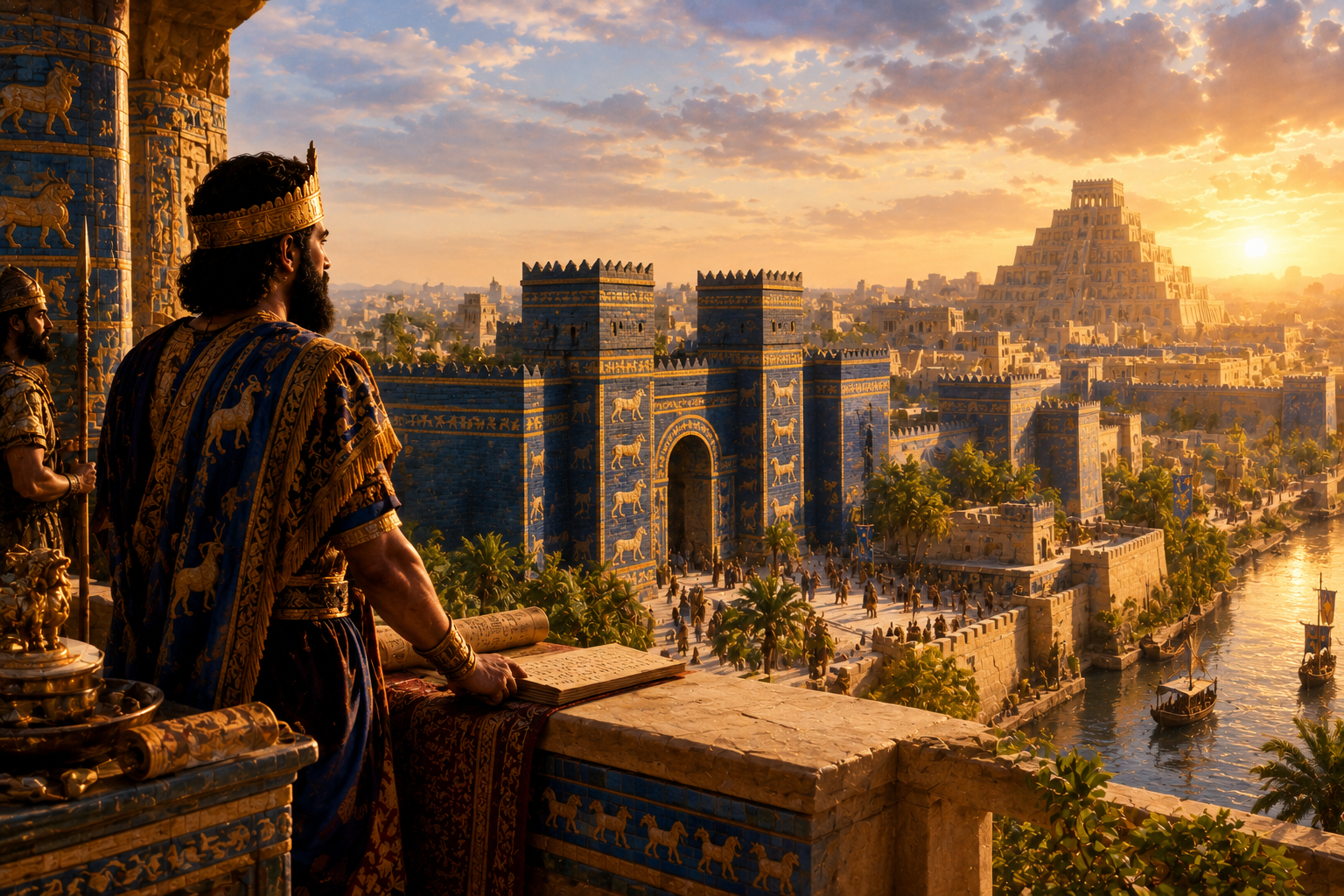
The Ishtar Gate, built around 575 BCE, was faced in glazed blue brick and decorated with rows of dragons and bulls in moulded relief. A reconstruction using original bricks stands in the Pergamon Museum in Berlin.
The Processional Way ran through it, lined with lions. The temple complex Etemenanki, a ziggurat dedicated to Marduk, stood at the centre of the city and is the most likely origin of the Tower of Babel story.
The city walls, the palaces, the canal system: Babylon under Nebuchadnezzar was among the largest cities on earth, and possibly the largest.
The Gardens Nobody Can Find
The Hanging Gardens are one of the seven wonders of the ancient world, and there is a serious problem with them.
No Babylonian source mentions them. Nebuchadnezzar left extensive building inscriptions listing his projects in detail, and the gardens are absent. Herodotus, who described Babylon at length, does not mention them either.
Every account comes from Greek and Roman writers, all of them later, none of them eyewitnesses.
Excavation at Babylon has not found them.
Stephanie Dalley of Oxford has argued a striking alternative: that the gardens were real but were at Nineveh, built by the Assyrian king Sennacherib around 700 BCE, and that later writers attached them to the more famous city. Assyrian sources describe an elaborate garden with a water-raising system, and Sennacherib’s own inscriptions boast about it.
The argument is not universally accepted. What is agreed is that the gardens are not attested where they are supposed to be.
The Exile
In 597 and again in 587 BCE, Nebuchadnezzar took Jerusalem. The temple was destroyed and a substantial portion of the Judean elite was deported to Babylonia.
The Babylonian Chronicles, cuneiform tablets in the British Museum, record the first capture independently of the biblical account, which is a rare case of two entirely separate traditions describing the same event.
The exile lasted until Cyrus of Persia took Babylon in 539 BCE and permitted a return. The period is generally regarded as decisive in the development of Judaism, and much of the Hebrew Bible took its final shape in and after it.
Babylon consequently appears throughout later Jewish and Christian scripture as a symbol of worldly power and oppression, which is why the name still carries a charge in English.
What They Actually Knew
Setting aside the gardens and the biblical resonance, Babylonian achievement in the exact sciences is genuinely remarkable.
They used a sexagesimal number system, base sixty, which is why an hour has sixty minutes and a circle has 360 degrees. That convention is Babylonian and it is still in use.
Their astronomical records are continuous over centuries, recorded nightly on tablets, and they were accurate enough to predict eclipses and planetary positions. Greek astronomers, including Hipparchus and Ptolemy, drew on them directly.
A tablet known as Plimpton 322 lists what appear to be Pythagorean triples, more than a thousand years before Pythagoras.
Writing It Down
Everything we know about Babylon rests on clay.
Cuneiform was written by pressing a reed stylus into wet clay, which was then dried or baked. The result is close to indestructible. Fire, which destroys papyrus and parchment, bakes clay tablets harder.
Several hundred thousand tablets have been recovered from Mesopotamian sites, and a substantial proportion have never been fully translated. They include not only royal inscriptions and literature but school exercises, shopping lists, letters complaining about the quality of delivered copper, and legal disputes over inheritance.
That last category is why we know so much about ordinary Babylonian life. The archive is not a curated selection of what a king wanted remembered. It is the paperwork.
What Is There Now
The site lies about eighty-five kilometres south of Baghdad.
Saddam Hussein ordered reconstruction over the original foundations in the 1980s, with bricks stamped bearing his own name in imitation of Nebuchadnezzar’s practice. Archaeologists regard the work as damaging.
Coalition forces built a military base on the site in 2003, causing further harm through excavation, vehicle movement and the filling of sandbags with archaeological material.
Babylon was inscribed as a UNESCO World Heritage Site in 2019, after decades of argument about its condition.
A city that published its laws in public, kept astronomical records for centuries, and gave us the sixty-minute hour is worth more careful treatment than it has recently had.
Frequently asked questions
Where was Babylon?
In Mesopotamia, on the Euphrates, roughly eighty-five kilometres south of modern Baghdad in Iraq.
What is the Code of Hammurabi?
A set of 282 laws inscribed on a stone stele around 1754 BCE and displayed publicly. It is among the earliest substantial written legal codes.
Did the Hanging Gardens of Babylon exist?
No Babylonian source mentions them and excavation has not found them. One scholarly argument places them at Nineveh instead, built by the Assyrian king Sennacherib.
Who was Nebuchadnezzar II?
The Neo-Babylonian king who ruled from 605 to 562 BCE, built the Ishtar Gate, and deported the Judean elite to Babylonia.
Why does an hour have sixty minutes?
Because the Babylonians used a sexagesimal, base-sixty number system, and the convention has survived in timekeeping and in the 360-degree circle.
What was the Tower of Babel?
Most likely Etemenanki, the ziggurat dedicated to Marduk that stood at the centre of Babylon.
Sources consulted: Code of Hammurabi, Louvre collection records; Stephanie Dalley, The Mystery of the Hanging Garden of Babylon (2013); Babylonian Chronicles, British Museum; UNESCO World Heritage listing, Babylon (2019).