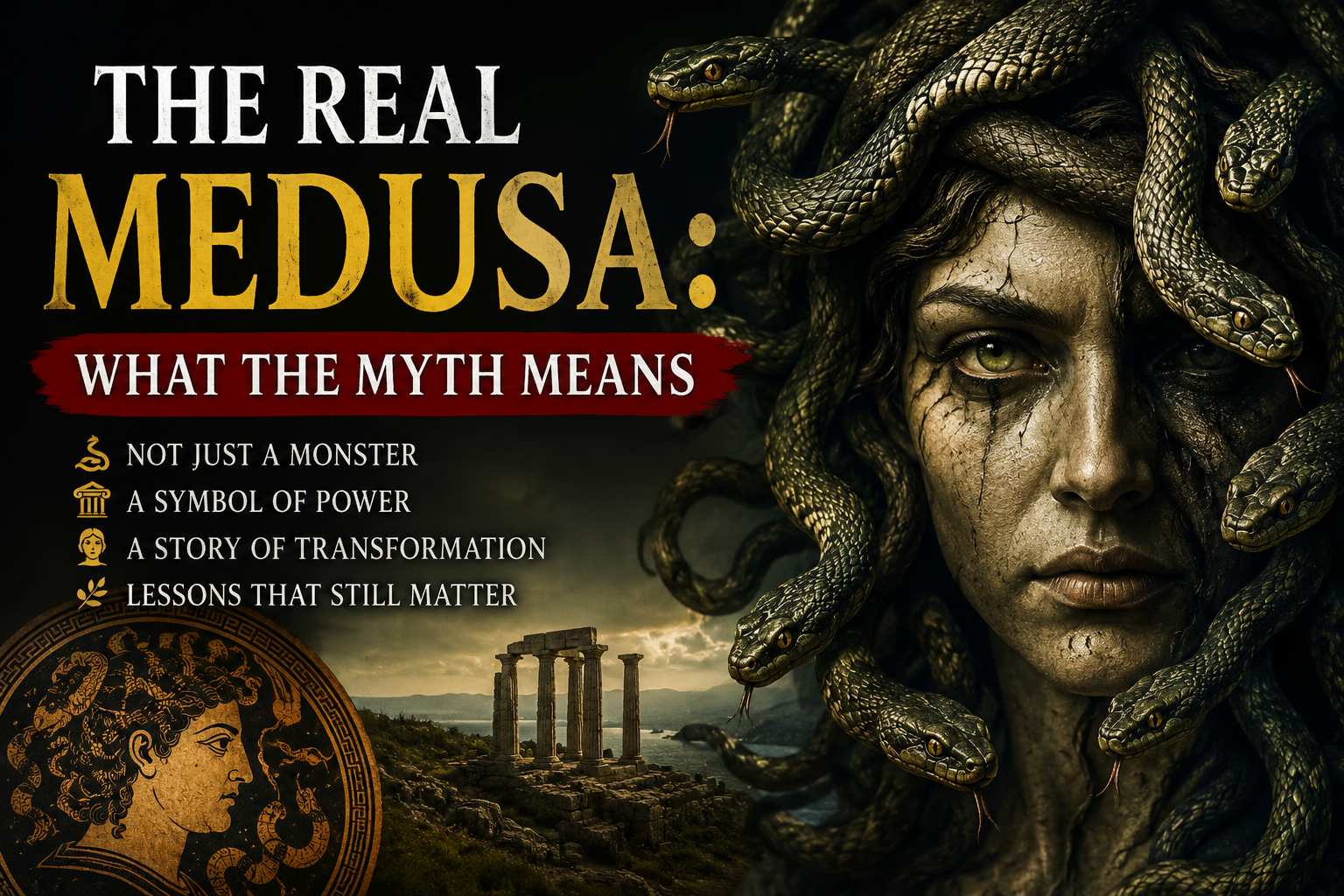
The head is what everyone remembers. Severed, dripping, brandished like a trophy.
Perseus holding it aloft, the hero’s face carefully averted, the great Gorgon vanquished at
last. That is the image Western art has returned to compulsively for two millennia. The
monster. The killing. The triumph.
What gets left out is everything that happened before.
The Story We Were Given
You know this version. Medusa was one of three Gorgon sisters, monstrous from birth, with serpents for hair and a gaze that turned living men to stone. She lived at the edge of the world with her sisters Stheno and Euryale, and she was the only mortal among them, which is why Perseus could kill her. Athena helped. Hermes helped. The gods provided a mirrored shield, winged sandals, a sickle sharp enough. Perseus crept up while she slept
and took her head off.
Simple. Heroic. Final.
But Ovid, writing his Metamorphoses in Rome around 8 CE, preserved a different version of how Medusa came to be. And once you read it, the trophy head looks very different.
She Was Not Born This Way
In Ovid’s account, Medusa was not a monster. She was a woman, and she was beautiful. Her hair in particular was famous, the kind of beauty that made people stop mid-sentence and stare. She was also a priestess of Athena, sworn to celibacy, devoted to the goddess whose temple she served.
Poseidon, god of the sea, raped her in Athena’s own sanctuary. What followed has the logic of a nightmare. Athena, furious at the violation of her
sacred space, punished Medusa. The woman who had been assaulted in a holy place was transformed into something that could never be approached again. Her famous hair
became serpents. Her face became a weapon. Her gaze, once admired, became lethal. Ovid does not comment on the justice of this arrangement. He simply records it, as if it were entirely ordinary.
The Arithmetic of Divine Power
There is a reason Athena punished Medusa instead of Poseidon. She couldn’t touch him. He was her equal in divine hierarchy, her uncle, one of the three brothers who divided the world between them when the Titans fell. To challenge him directly would require a conflict she could not win.
Medusa was mortal. Medusa was reachable. Read it one way and it is cruelty. Read it another, darker way, and it is armor. A woman violated by a god was remade into something no god would dare approach. The transformation that looks like punishment might also be the only protection on offer in a world where the more powerful party faces no consequences at all. Whether Athena intended mercy or malice, the result was the same.
Medusa was exiled to the world’s edge, isolated, unreachable, monstrous. And eventually, when the gods needed a hero’s quest to unfold, they handed Perseus the tools to kill her.
The Head That Refused to Stop Working
Here is the thing about Medusa that the myth keeps insisting upon: she was dangerous long after she was dead.
Perseus used the severed head as a weapon for years. He turned enemies to stone at banquets. He rescued Andromeda from a sea monster by showing it that face. The power did not end at her death. It transferred to whoever held what remained of her.
The Gorgoneion, her face reproduced as a symbol, was stamped on Greek shields, carved into temple friezes, painted on pottery, cast on coins, worn as amulets. Her image was apotropaic, meaning it was used to ward off evil, to protect against the very forces it supposedly embodied. The monster’s face placed at the heart of what you wanted to keep
safe.
The Temple of Artemis at Corfu, one of the oldest Greek temples we have found, places Medusa at its very center. Not at the margins. Not as a warning carved on the outer wall. At the center, flanked by Pegasus and the full cast of mythological grandeur. That is not how you display a simple villain.
What the Centuries Did With Her
The Victorians loved Perseus. The lone hero overcoming the impossible, guided by divine favor and his own courage. Their paintings show him triumphant, beautiful, righteous. Medusa is the obstacle, the thing cleared away so the story can continue.
Contemporary readings tend in the opposite direction, reclaiming her as a figure of justifiable fury, a symbol of the woman punished for her victimhood, her rage rendered monstrous precisely because it terrified people in power. That reading has its own political urgency and its own validity.
But the oldest reading, the one Ovid kept alive, is neither triumphant nor purely angry. It is sorrowful and clear-eyed in equal measure. A woman in a temple. A violation that went unpunished. A transformation that passed itself off as justice. A death that was required for someone else’s heroism. Her face, even severed, even weaponized, even carved into stone for two thousand years, has never quite stopped watching.
Frequently Asked Questions
Was Medusa always a monster in Greek mythology?
No. In Ovid’s Metamorphoses, she was born fully human and transformed into a Gorgon by Athena after Poseidon violated her inside Athena’s temple. The monstrous form was punishment visited on the victim rather than the perpetrator.
Why did Athena punish Medusa instead of Poseidon?
Poseidon was Athena’s divine equal, beyond her direct authority. Medusa, as a mortal, was the accessible target for Athena’s rage at the desecration of her sacred space.
What does Medusa symbolize?
She has carried many meanings across history: the dangerous feminine, the justified rage of the wronged, the protective power of the monstrous. Her face was widely used in the ancient world to ward off evil, turning the monster into a guardian.
What was born from Medusa’s blood?
When Perseus beheaded her, the winged horse Pegasus and the giant warrior Chrysaor sprang from the blood that fell into the sea. Even in death, she kept generating extraordinary things.
Is the Gorgoneion a real artifact?
The Gorgoneion, Medusa’s face used as protective imagery, appears throughout ancient Greek art and architecture. Examples survive on shield emblems, temple friezes, pottery, and coins dating back more than 2,700 years.
A Final Thought
Medusa’s story is not about a monster killed. It is about what happens when the person who holds power decides the person who was wronged is the more convenient problem to solve. They turned her into something terrible and then killed her for being terrible and called that heroism. Her face ended up on shields, on temples, on the walls of the houses people were trying to protect. Two thousand years later, here we are still looking at her, still trying to understand what she is telling us about the world that made her