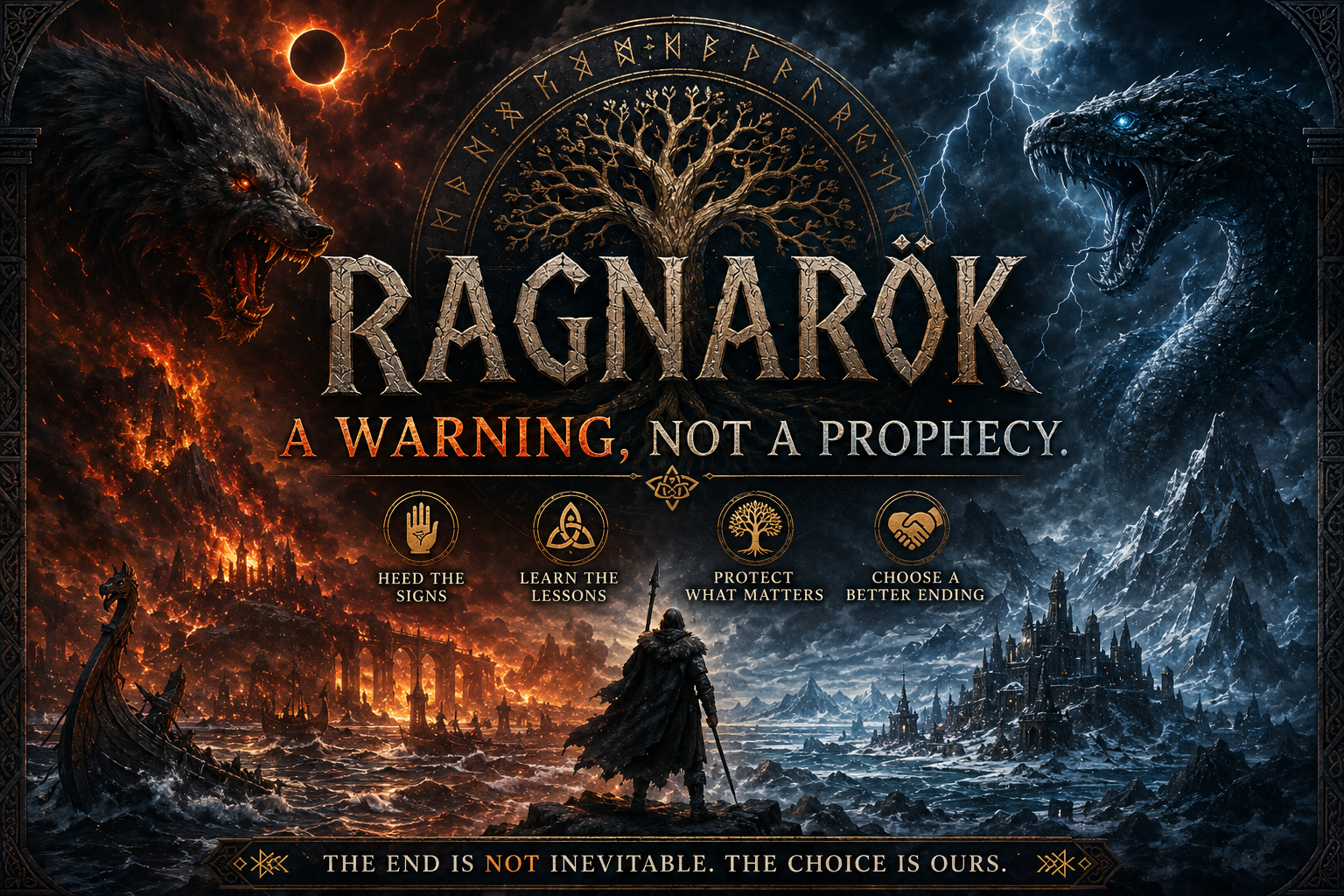
There is a serpent at the roots of the world tree. It has been there since the beginning. Gnawing. Patient. Certain. The Norse called it Nidhogg, and they did not invent it as a symbol of some distant catastrophe. They invented it as a description of the present moment, of every present moment, of the quiet ongoing destruction that runs beneath
everything you can see and touch and call safe.
Ragnarok was not coming. Ragnarok was always already here.
What Actually Happens When the World Ends
The oldest surviving accounts, preserved in the Poetic Edda and the Prose Edda, those medieval Icelandic manuscripts collecting oral traditions far older than themselves, describe the end of everything with a specificity that feels almost journalistic. This is not vague apocalyptic poetry. This is an event itinerary.
First comes Fimbulwinter: three winters without a summer between them. Harvests fail. Livestock die. And then, more devastating than the cold itself, the social bonds begin to snap. Families turn on one another. The world does not end because of monsters first. It ends because people stop being good to each other when survival becomes the only priority.
Then the monsters are released. Fenrir, the great wolf, breaks the magical rope that has held him since before human memory. The Midgard Serpent rises from the ocean floor, so enormous that it has always encircled the whole world, and it finds the shore. Loki, bound beneath a mountain with serpent venom dripping onto his face as punishment for crimes the myths only partially explain, escapes. The dead sail on Naglfar, a ship built from the untrimmed fingernails and toenails of corpses, because the Norse even imagined the logistics of apocalypse.
The gods march out to meet it. And they die.
The Deaths That Matter
Odin is swallowed whole by Fenrir. His son Vidar avenges him, tearing the wolf’s jaws apart with his hands, but Odin is gone. Thor kills the Midgard Serpent, which he has been trying to do for his entire mythological life, and then takes nine steps and falls. Poisoned.
Nine steps is specific. Someone counted. Tyr and the great hound Garm kill each other simultaneously. Loki and Heimdall, who have despised each other for longer than the myths bother to record, kill each other at the same moment. And then Surtr, the fire giant who has been waiting at the edge of the world since before the gods were born, walks through what remains and sets it all ablaze. The sea swallows everything.
Then Something Surfaces
Here is the part that usually gets left out of the dramatic retellings. After the fire and the flood, after every divine death and every monstrous victory, after all of it, the earth rises again. Green. Quiet. New. Baldr returns from the dead. The surviving gods find the golden chess pieces from Asgard lying in the new grass, as if the universe left them as notes for whoever arrived next. Two humans had hidden in a place called Hoddmimir’s Holt, surviving on morning dew, and they walk out into this new world and begin again.
The end was not the end. The game pieces are in the grass. Someone has to pick them up.
The Viking conception of courage was never about winning. It was about how you stood when losing was certain. Not defiance for its own sake, not denial, not the bargaining of a man who cannot accept what is coming. Just: clear eyes, a sword, and the decision to go forward anyway. To face the wolf knowing the wolf wins.
That is a philosophy. A genuinely useful one. And it is significantly more honest about the nature of things than most of what gets called optimism.
The Winter That May Have Been Real
Some scholars believe Fimbulwinter is not purely symbolic. The year 536 CE was catastrophic in ways we can now measure in ice cores and tree rings. A volcanic eruption, possibly in Iceland, threw so much ash into the atmosphere that the Northern Hemisphere experienced years of reduced sunlight and failed harvests. Scandinavian communities were devastated. Archaeological evidence shows significant population disruption across the region.
If that reading is right, then Ragnarok preserved a cultural memory of an actual catastrophe so severe that the only container large enough to hold it was the end of the world. A people encoded their worst lived experience into myth so it would survive, intact and carrying its full weight, through the generations that followed.
A Final Thought
The wolves have always been running. That is what the skalds understood and what makes this mythology feel less like fiction and more like a description of Tuesday morning. Everything is in motion. Everything is being gnawed at. The question Ragnarok actually asks is not whether the end is coming. The question is how you carry yourself while it does. Odin prepared for sixty years for a battle he knew he would lose. He walked into the wolf’s jaws clear-eyed and resolved. The chess pieces ended up in the grass anyway. Someone always comes along to pick them up.
Frequently Asked Questions
What is Ragnarok in Norse mythology?
Ragnarok is the final battle and apocalypse of Norse cosmology, during which most gods are killed, the world is consumed by fire and flood, and then reborn from the sea with a few survivors and a new beginning.
Do any gods survive Ragnarok?
Several survive: Baldr returns from death, and Vidar, Vali, and a few others remain to inhabit the renewed world. The myth is not simply about destruction but about what persists and grows again after it.
What triggers Ragnarok?
Ragnarok begins in earnest when Loki escapes his imprisonment and Fenrir breaks free. It is preceded by Fimbulwinter, three consecutive winters without summer, during which social order collapses before the monsters even arrive.
Is Ragnarok based on real events?
Some scholars connect the Fimbulwinter element to the documented climate catastrophe of 536 CE. Whether this shaped the myth or the myth absorbed it later, the connection is taken seriously by a number of researchers in Norse studies and historical climatology.
How does Ragnarok end?
After Surtr burns the world and the sea rises over everything, the earth surfaces again, green and renewed. Baldr returns, surviving gods regroup, and two humans emerge from hiding to repopulate everything.