
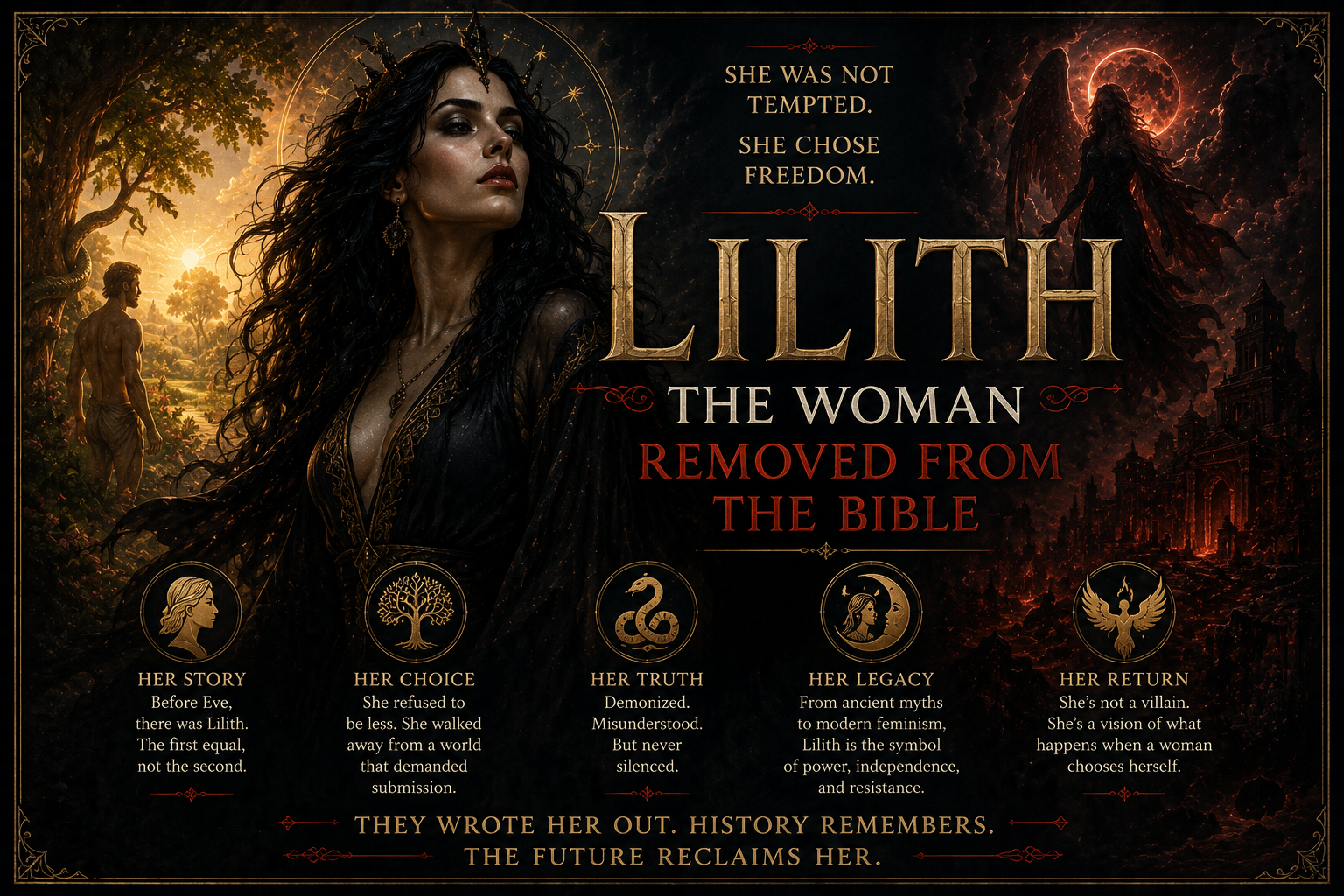
She was there before Eve. Before the rib, before the garden became a parable about obedience, before the serpent was introduced as the explanation for human misery. There was a first woman, and she refused to stay, and the people who wrote the story eventually decided the cleanest solution was to pretend she had never existed at all.
They almost got away with it.
The Contradiction in the Text
Genesis has an inconsistency that most readers walk past without noticing, partly because the text does not call attention to it and partly because we have been trained to read it as one continuous narrative rather than two distinct accounts sewn together.
Chapter 1 is clear: God created human beings, male and female, simultaneously, in His image, on the sixth day. Equal in origin. Made at the same moment from the same source.
Chapter 2 tells a different story. Adam is alone. Adam names the animals. Adam is still lonely. God creates woman from Adam’s rib as a companion and helper for him. These are not the same story. They cannot be harmonized without someone getting erased.
For centuries, rabbinical thinkers asked the obvious question: if there was a first woman created simultaneously with Adam in Chapter 1, who was she, and where did she go before Chapter 2 began? The Alphabet of Ben Sira, a rabbinical text composed sometime between the 8th and 11th centuries CE, supplied the answer. Her name was Lilith. And she left.
What She Refused
The account is precise about the cause of the conflict, which is what makes it so startling. Adam wanted Lilith to lie beneath him during sex. She refused. Her argument was not defiant posturing but a statement of logic: they had been created from the same earth, at the same moment, in the same image. She was not beneath him. She had never been beneath him. He would not accept this. She would not compromise it. She spoke the true name of God aloud, a name too sacred to be uttered, and used its power to leave the garden entirely. Three angels were sent after her with instructions to bring her back. She refused them too. As punishment, she was told that one hundred of her
demon children would die every day.
She accepted this. Think about that. She accepted the cost and still did not go back.
The Architecture of Demonization
What happened to Lilith after she refused to return is one of history’s more revealing examples of how patriarchal systems handle women who won’t cooperate. You cannot argue with someone who has already left. You cannot shame someone who has accepted the consequences. What you can do is make her into a monster.
And so the woman who refused subordination became a creature of the night who stalked sleeping men for their seed, who killed newborns in their cribs, who was the source of all nocturnal terror. Amulets were made against her. They were placed in birth rooms and beside cradles across Jewish communities for centuries.
The logic is transparent once you see it. If she will not protect the social order by submitting to it, she becomes the threat that makes the social order necessary. The monster outside the wall is what justifies the wall.
Older Than Genesis Lilith almost certainly predates the Genesis narrative. Her name connects to either the Sumerian word for wind spirits or the Hebrew word for night, depending on which etymology you prefer, and Mesopotamian texts several centuries older than the Hebrew Bible contain female demonic figures with strikingly similar characteristics: beautiful, nocturnal, dangerous to sleeping men and newborn children, associated with the desert and the liminal spaces outside civilization.
She appears once in the Hebrew Bible itself, in Isaiah 34:14, in a passage describing the desolation of Edom after God’s judgment. The English translations have called her a screech owl, a night creature, a night bird. The Hebrew word is Lilit. She was always there. They just kept translating her away
The Long Return
The 19th century began her rehabilitation in Western culture. John Collier painted her in 1887, standing bare and serene with a serpent coiled gently around her, looking nothing like a monster and everything like someone who had found peace on her own terms. By the late 20th century she had become something close to an icon for female autonomy, the original woman who said no and meant it.
Whether that contemporary reading honors or flattens the actual tradition is a question worth keeping open. The rabbinical Lilith is more complicated than a feminist symbol, stranger, more morally ambiguous, genuinely dangerous in ways that do not resolve cleanly into empowerment narratives. What she was, at minimum, is this: the woman they needed to remove before the story they wanted to tell could begin.
Frequently Asked Questions
Is Lilith mentioned in the Bible?
Once, in Isaiah 34:14, though most English translations obscure the reference by rendering the Hebrew Lilit as a type of owl or night creature. Her detailed mythology comes from later rabbinical texts, primarily the Alphabet of Ben Sira.
What is Lilith known for in mythology?
In traditional Jewish folklore she is associated with nocturnal danger, the death of infants, and the seduction of sleeping men. In contemporary readings she is more often a symbol of female autonomy and the refusal of imposed subordination.
What is the Alphabet of Ben Sira?
A medieval rabbinical text containing the fullest surviving account of Lilith, including her creation alongside Adam, her refusal to submit, her departure from Eden, and her transformation into a demonic figure.
How is Lilith different from Eve?
In the tradition that includes both women, Lilith was created simultaneously with Adam from the same earth, making them equals in origin. Eve was created later from Adam’s body. The equality of Lilith’s origin is precisely what produced the conflict.
Why did Lilith leave Adam?
According to the Alphabet of Ben Sira, Lilith refused Adam’s insistence on sexual dominance, citing their equal creation. When he would not accept this, she spoke the name of God and flew away from Eden, choosing exile over submission.
A Final Thought
They removed her from the text and replaced her with someone more agreeable. They
made her into a demon who killed babies and stole men’s souls in the dark. They wrote
amulets against her name and put them beside cradles in the night. And still she persists,
in the margins of Isaiah, in the structure of every story about the woman who was asked to
kneel and chose instead to leave. Lilith never asked to be a symbol. She just left. And that,
across four thousand years, has been enough to make her unforgettable.
Also Read: Inanna: The Goddess History Erased