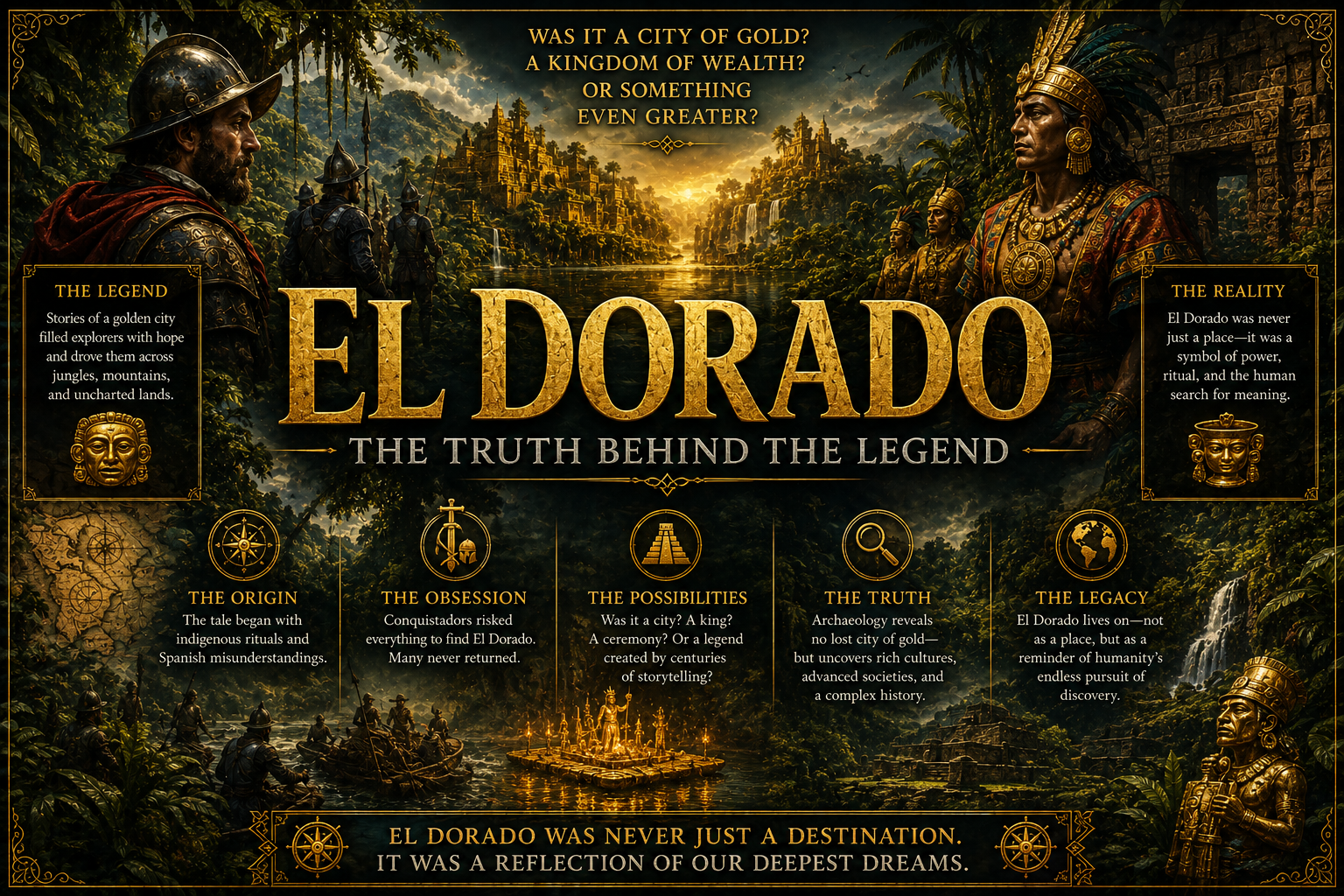
Picture a man standing on a raft in the middle of a cold mountain lake, his entire body dusted with gold. Not decorated with gold. Covered in it, every surface of skin coated until he gleams in the high-altitude light above what is now Colombia. Around him, offerings of emeralds and gold objects. Thousands of people watching from the shore. And then, when the moment arrives, he dives.
The gold falls from him in the water. It catches the light on the way down and then settles to the bottom of the lake, gone. The people cheer. The new chieftain surfaces, clean, transformed, legitimated by what he gave away.
That was El Dorado. Not a city. A ceremony. A man on a raft choosing to let the gold go. The Spanish, when this story reached them, heard something entirely different.
The Translation Error That Killed Hundreds
El Dorado means the golden one. El hombre dorado: the gilded man. The story that moved through the Spanish colonial information networks after the conquest of Peru was not a story about a place. It was a story about a ritual. The Muisca people of the Colombian highland savanna performed this coronation ceremony at Lake Guatavita, a
perfectly circular crater lake set in green hills that look almost too beautiful to be real. New chieftains were covered in resin and gold dust, rowed to the center of the lake, and there they made their offering.
The story reached Spanish ears through layers of translation, interpretation, and the particular distortions introduced by people who were already looking for gold and therefore heard gold in everything. By the time the tale had traveled far enough, the man had become a city. The ceremony had become an address. And expedition after expedition set out to find a place that had never existed.
They walked into the Amazon basin. They crossed the Andes. They died of starvation and disease and violence and simple bewilderment in terrain they had no capacity to navigate. Francisco de Orellana descended the entire length of the Amazon River in 1541 essentially by accident, swept downstream by currents too strong to fight after his
expedition fragmented and left him with no viable path back. He became the first European to traverse that river from source to sea, a genuinely remarkable achievement, because he had gone looking for something that was not there.
What Was Actually There
The Muisca were extraordinary metalworkers. The Museo del Oro in Bogota holds more than 55,000 pieces of pre-Columbian gold, and a significant portion of that collection is Muisca work. Breastplates, pendants, ritual figures, offerings, objects of such technical and artistic sophistication that they constitute one of the great bodies of metalwork in any culture from any era.
The most famous single object is the Muisca raft, discovered in 1969 in a ceramic jar in a cave near Bogota. It is about ten centimeters across. A chieftain stands at the center, surrounded by attendants and upright poles flying pennants, all rendered in gold. It depicts, in exquisite detail, the ceremony that the Spanish mistook for a city. It was made by the people who performed the ceremony, as what appears to be a votive offering commemorating or propelling the ritual.
The raft is real. The ceremony was real. The gold at the bottom of Lake Guatavita, whatever remains of it after colonial drainage attempts, is real. The city was a story about a misunderstanding.
The Obsession That Would Not Die
Knowing the truth did not help. The Spanish found Lake Guatavita early. In 1545 they attempted to drain it, forming human chains to carry water out by gourd and bucket, lowering the level enough to recover some gold objects from the exposed mud. They found gold. Not enough gold to justify the fantasy, but enough to prove the lake held something. Which only intensified the belief that somewhere else, something more was waiting.
Sir Walter Raleigh made two expeditions to the Guiana region of South America in search of El Dorado, in 1595 and again in 1617. The second expedition cost him his son’s life and his own reputation. When he returned to England empty-handed, it contributed to the political circumstances of his execution. He was a man of genuine intellect and
ambition, and he walked into the jungle twice looking for something that had always been
a ceremony in a lake.
What the Failure Found
This is the strange grace note of the whole disaster. The expeditions that destroyed themselves searching for an imaginary city produced some of the earliest and most detailed European records of South American geography, ecology, and indigenous cultures. Orellana’s Amazon journey became foundational for everything that followed.
The mapping of the continent’s interior, for all its brutal colonial context, was a consequence of a search founded on a fundamental misreading. History accumulates its knowledge in odd ways. Sometimes the most useful map is drawn by someone going in the wrong direction
Frequently Asked Questions
Was El Dorado a real place?
El Dorado was a real ceremony, not a real place. The Muisca coronation ritual at Lake Guatavita involved covering a chieftain in gold dust and offerings, which the Spanish misunderstood through layers of translation as a golden city.
What happened at Lake Guatavita?
New Muisca chieftains were covered in resin and gold dust and rowed to the center of the lake, where they and their attendants cast gold and emerald offerings into the water as a coronation ritual. Colonial attempts to drain the lake in search of accumulated gold met with limited success.
Did the Spanish ever find El Dorado?
No. They were searching for something that did not exist as they imagined it. Multiple expeditions across more than two centuries failed to find a city of gold.
Where is the Muisca golden raft today?
At the Museo del Oro in Bogota, Colombia, where it has become one of the most visited pre-Columbian artifacts in South America.
Who was Francisco de Orellana?
A Spanish conquistador who in 1541 to 1542 became the first European to navigate the full length of the Amazon River, largely by accident, after his El Dorado expedition fragmented and the current made return impossible.
A Final Thought
A man stood on a raft and was covered in gold and dove into a cold mountain lake and let the gold fall away from him in the dark water, and the Muisca understood this as the moment power began. The point was not the gold. The point was the letting go. The Spanish heard the story and saw only the gold and spent two centuries dying in the jungle
looking for a city that was always actually a ceremony about giving something precious away. They found the lake. They missed what it meant. Some misunderstandings run deep enough to constitute a tragedy, and this one cost more lives than anyone thought to count.