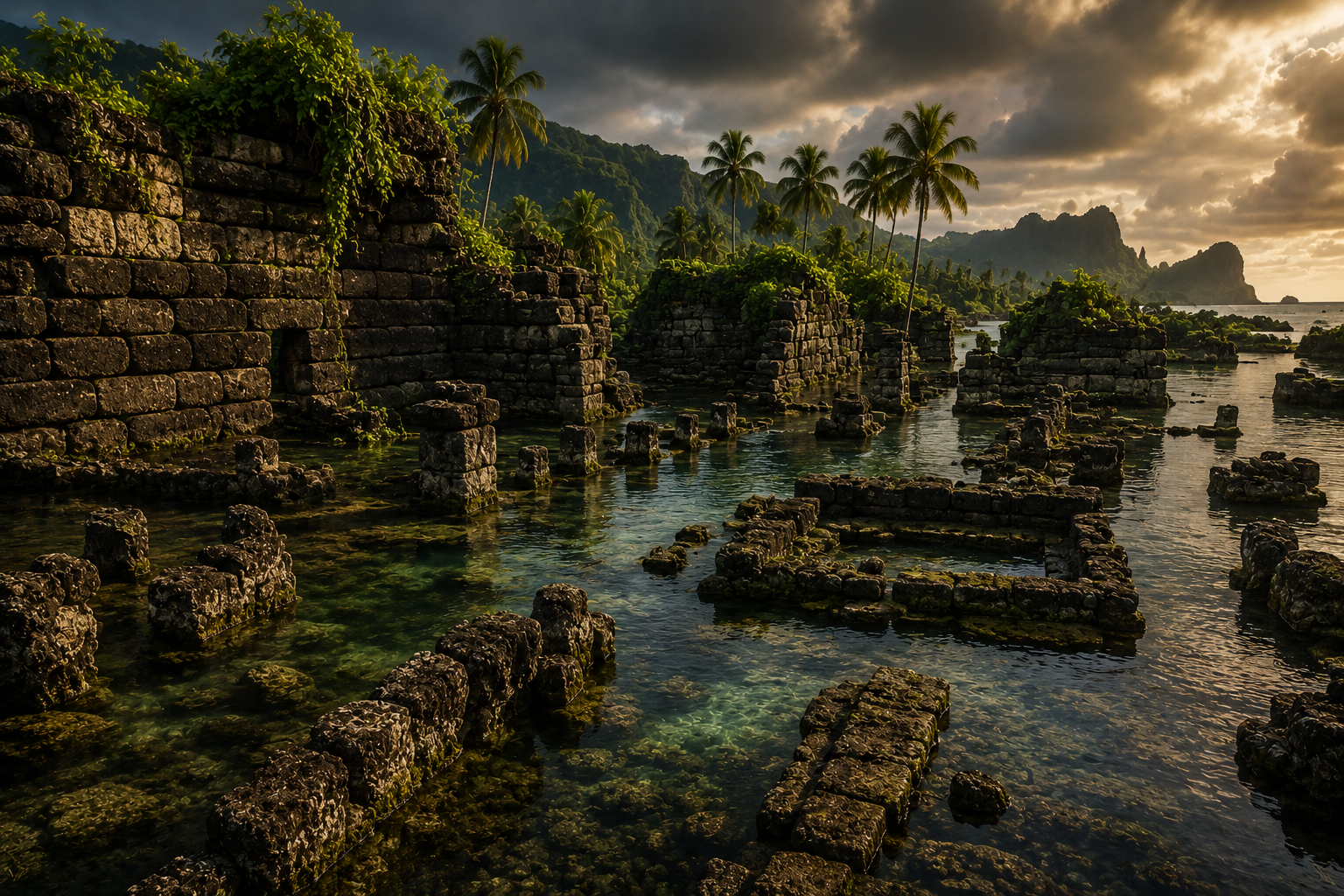
The Pacific Ocean, east of Pohnpei island in Micronesia, holds something that should not be possible. Ninety-two artificial islets, each one constructed from basalt and coral, connected by a network of tidal canals navigable by small boat. Walls nine meters high in places. Individual basalt columns weighing fifty tons. A city. Not beside the sea. On top of it.
Nobody has fully explained how the fifty-ton columns were moved here. Nobody has explained how they were lifted and stacked with the precision that has allowed some of these walls to stand for eight centuries. The people who built it left no written record of what they were doing or why. What they left was the thing itself, enormous and patient and still, mostly, buried in mangroves and water.
The Engineering That Should Not Exist
The basalt columns at Nan Madol are not hauled from nearby. The main quarry site is on the other side of Pohnpei island, miles away across water. The columns are hexagonal prisms, naturally formed by the cooling of volcanic rock, and they are stacked in alternating layers in a technique that modern engineers describe as impressively stable for
a marine environment. Log-cabin style, the layers interlocking so that the walls resist lateral pressure. In a place where waves are a constant destructive force, the builders solved a serious structural problem.
How they got the columns to the site is genuinely unknown. Rafts are the obvious answer, and experimental archaeology has demonstrated that raft transport of basalt columns is physically possible with sufficient labor. But the details: how you load a fifty-ton column onto a raft without modern equipment, how you keep it stable in open water, how you then unload it and set it in the precise location required without letting it sink or shift, these details have not been demonstrated in any convincing reconstruction. Local tradition says the founding brothers of the Saudeleur dynasty used magic. They flew the stones into place.
Every culture that faces an engineering problem beyond its apparent capacity reaches for the supernatural as an explanation. It is what humans do when the evidence does not fit the tools. That does not make the magic real. But it does make the gap between the stones and any mundane explanation feel very wide.
Power, Ritual, and the Architecture of Water
Pohnpeian oral history tells the story of the Saudeleur dynasty, a ruling lineage that governed Pohnpei with concentrated autocratic power for roughly five centuries before being overthrown around 1500 CE by a man named Isokelekel. Nan Madol was their seat of power: ceremonial center, administrative hub, sacred burial ground, oracle site.
Different islets served different functions. Some held the elaborate tombs of dead rulers. Some were administrative centers where tribute was received and redistributed. Some housed sacred eels in specially built pools and the eels, fed and tended with great care, were consulted as divine intermediaries. The whole complex was a spatial language of power, each element in deliberate relationship to the others.
Building your capital on artificial islands in a lagoon made it defensible. It also made it symbolic. The sea was not the limit of the city. The sea was part of it, the canals its roads, the water its defining element rather than its obstacle. Whoever lived here lived in a way that demonstrated, visibly and permanently, that the Saudeleur dynasty operated by different rules than ordinary people.
What Eight Centuries of Sea Did to It
When the Saudeleur dynasty was overthrown, Nan Madol lost the institutional engine that had built and sustained it. No central authority meant no organized labor, no tribute system to maintain the walls, no ritual specialists to tend the eels and the tombs and the sacred functions that had given the place its meaning.
The mangroves moved in. They are patient and thorough colonizers. The tidal action that the walls were built to resist began its slow work on structures no longer being maintained. Eight hundred years of tropical climate, salt air, and biological growth have done significant damage to what was once the most architecturally ambitious project in the Pacific.
UNESCO inscribed Nan Madol on its World Heritage List in 2016 and simultaneously listed it as endangered, which is an honest and somewhat bleak combination. The resources required to stabilize and study the site are considerable. The remoteness of Micronesia and the limited institutional capacity of a small island nation make adequate preservation genuinely difficult.
What Lies Beneath the Water
Less than a third of the site has been properly studied. Ground surveys suggest there may be more structures beneath the lagoon floor than are visible above it. Whatever sank during construction or collapsed over centuries is still down there.
Frequently Asked Questions
Where is Nan Madol?
In the lagoon off the eastern shore of Pohnpei island, in the Federated States of Micronesia, in the western Pacific Ocean.
How old is Nan Madol?
Occupation began around 800 to 1000 CE, with the major construction phase during the Saudeleur dynasty between approximately 1200 and 1500 CE.
How were the basalt logs transported?
Unknown. Raft transport is the working hypothesis, but the specific technique for moving and placing fifty-ton columns has not been definitively demonstrated.
Is Nan Madol a UNESCO World Heritage Site?
Yes, inscribed in 2016 and simultaneously placed on the List of World Heritage in Danger due to preservation concerns.
Why was Nan Madol abandoned?
The overthrow of the Saudeleur dynasty around 1500 CE ended the centralized power that had built and maintained the city. Without institutional support, the complex was left to the sea.
A Final Thought
Somewhere below the water around Nan Madol, more basalt columns lie where they sank during construction, detritus of a project conducted over centuries in the middle of the sea. The walls that remain above water are the testimony of what did not sink. That it was built at all, in those conditions, by people who left no written explanation of how they managed it, is its own monument. The stones are patient. The sea is patient. The answer to how they got there, if it exists anywhere, is still waiting down in the dark where the columns rest.