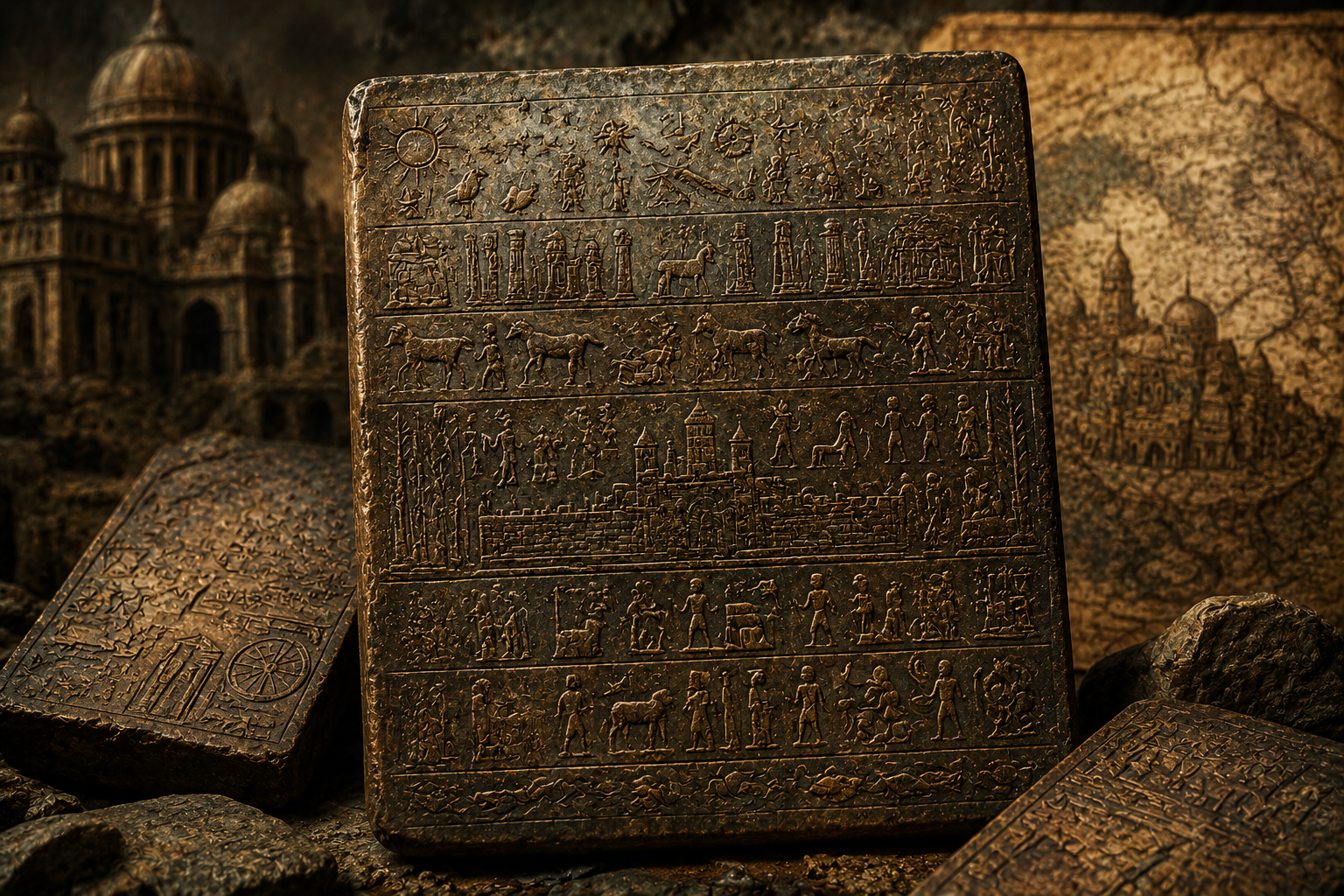
In a burial pit in Transylvania in 1961, a Romanian archaeologist named Nicolae Vlassa found something he could not quite account for. Three small clay tablets, unbaked and fragile. Two rectangular ones, one disc-shaped with a hole through its center. Each one covered with incised symbols.
He sent photographs to colleagues. The colleagues sent them to specialists. The specialists looked at the symbols and noted, with considerable unease, that they resembled early Sumerian pictographic writing. They were not identical to Sumerian signs, but close enough that the resemblance felt meaningful rather than coincidental. Several specific
signs matched.
The problem was the dating. The tablets appeared to be approximately 7,000 years old. Sumerian cuneiform, the writing system those signs were supposed to resemble, did not appear until around 3200 BCE. That gap is more than two thousand years.
Either the tablets contained writing that predated all known writing by a significant margin, or the resemblance to Sumerian was coincidental, or the dating was wrong, or something happened in the ancient world that current models do not adequately account for. Sixty years of scholarship have not closed the question.
The Discovery at Tartaria
Tartaria is a village in the Mures River valley, in the part of Romania that was once called Transylvania and is now simply a region of a modern country, though the old name carries its gothic weight regardless. Vlassa was excavating a site associated with the Vinca culture, a Neolithic civilization that flourished across southeastern Europe from roughly 5500 to 4500 BCE.
The Vinca people were not primitive in any meaningful sense. Their settlements show evidence of organized spatial planning. Their pottery is technically sophisticated and aesthetically complex. Their figurines, hundreds of them recovered from sites across the region, demonstrate a visual vocabulary maintained with remarkable consistency across a
wide geographic area. This was a culture with genuine artistic traditions, long-distance trade networks, and the kind of social organization that leaves visible archaeological traces.
In the burial pit alongside the tablets, Vlassa found burned human bones, figurines, andshells. The tablets themselves were small, the largest only a few centimeters across. Theyhad been fired after excavation for preservation but were unbaked when found, whichcomplicated the dating process in ways that later became important to the controversy.
The Symbols Themselves
Look at the tablets and you will see marks that are undeniably intentional. Not randomscratches. Repeated symbols. Some appearing in rows, suggesting sequence. Someisolated, suggesting individual significance. And some strikingly, uncomfortably similar tosigns from the early pictographic phase of Sumerian writing, the phase that precedes fully
developed cuneiform.
The match is not perfect. These are not identical systems. But when archaeologist Marija Gimbutas and others began comparing Vinca symbols across the culture’s range, they found a consistent set of marks appearing across a geographic area spanning hundreds of kilometers, across centuries of time. Whatever these symbols meant, they meant the same things to different people in different places over a long period. That is the behavior of a shared symbolic system.
Whether a shared symbolic system is writing depends on what you require writing to do. If you require it to encode spoken language in a way recoverable by anyone who knows the code, the tablets may fall short. If you require only that marks be used consistently to carry specific meanings, the bar is cleared.
What Scholars Actually Disagree About
Three serious positions have been maintained since the tablets were discovered, and the debate between them has not definitively resolved. The first holds that the tablets represent genuine proto-writing or writing, predating
Mesopotamian script by over two millennia, and that the resemblance to Sumerian signs
represents either independent parallel development or evidence of contact between southeastern Europe and the Near East far earlier than current models allow. This position has the most dramatic implications and is consequently the most contested.
The second holds that the symbols are a notation system, meaningful marks used for specific purposes, perhaps ritual, perhaps counting, perhaps something culturally specific that we have no framework to interpret, but not writing in the full linguistic sense. This position accommodates the evidence without requiring a rewrite of the timeline.
The third holds that the dating is unreliable, that the tablets may have been deposited with older materials in a context that made them appear older than they were. This position resolves the problem by questioning the problem’s premise.
Why It Matters Beyond the Tablets
If the Tartaria tablets are genuine pre-Sumerian writing, the history of human symbolic communication is more distributed, more ancient, and more geographically diverse than the standard account allows. Writing did not begin in one place and spread outward.
It emerged, possibly independently, in multiple locations among multiple cultures. If they are proto-writing, they are still remarkable evidence of a European Neolithic civilization systematically underrepresented in the popular imagination of prehistory.
Frequently Asked Questions
What are the Tartaria tablets?
Three small clay tablets discovered in Romania in 1961, incised with symbols resembling early Sumerian pictographic writing. They date to approximately 5500 to 5300 BCE, potentially making them the oldest writing-like artifacts ever found.
Are they the oldest writing in the world?
Disputed. If the dating is accurate and the symbols constitute writing, they predate Mesopotamian cuneiform by more than 2,000 years. Whether the symbols are writing or a proto-writing notation system remains unresolved.
Where are the tablets now?
In the National History Museum of Transylvania in Cluj-Napoca, Romania.
What was the Vinca culture?
A Neolithic civilization that flourished in southeastern Europe, primarily in present-day Serbia and Romania, between roughly 5500 and 4500 BCE, characterized by sophisticated pottery, figurines, and a consistent body of symbolic marks.
Why do the symbols resemble Sumerian writing?
This is the central mystery. The resemblance may indicate early long-distance cultural contact, independent parallel development, or coincidental similarity. No consensus explanation exists.
A Final Thought
Three small tablets in a burial pit in Transylvania. Symbols that should not be where they are, made when they should not have been possible. The bones buried alongside them were burned, and the meaning of that burning is lost with whoever lit the fire. The tablets sit in a museum in Cluj-Napoca, quiet and certain of their own significance, entirely indifferent to whether we are ready to understand them. Some questions are older than our tools for asking them. These particular questions are older than the concept of writing itself, which makes them very old indeed.