

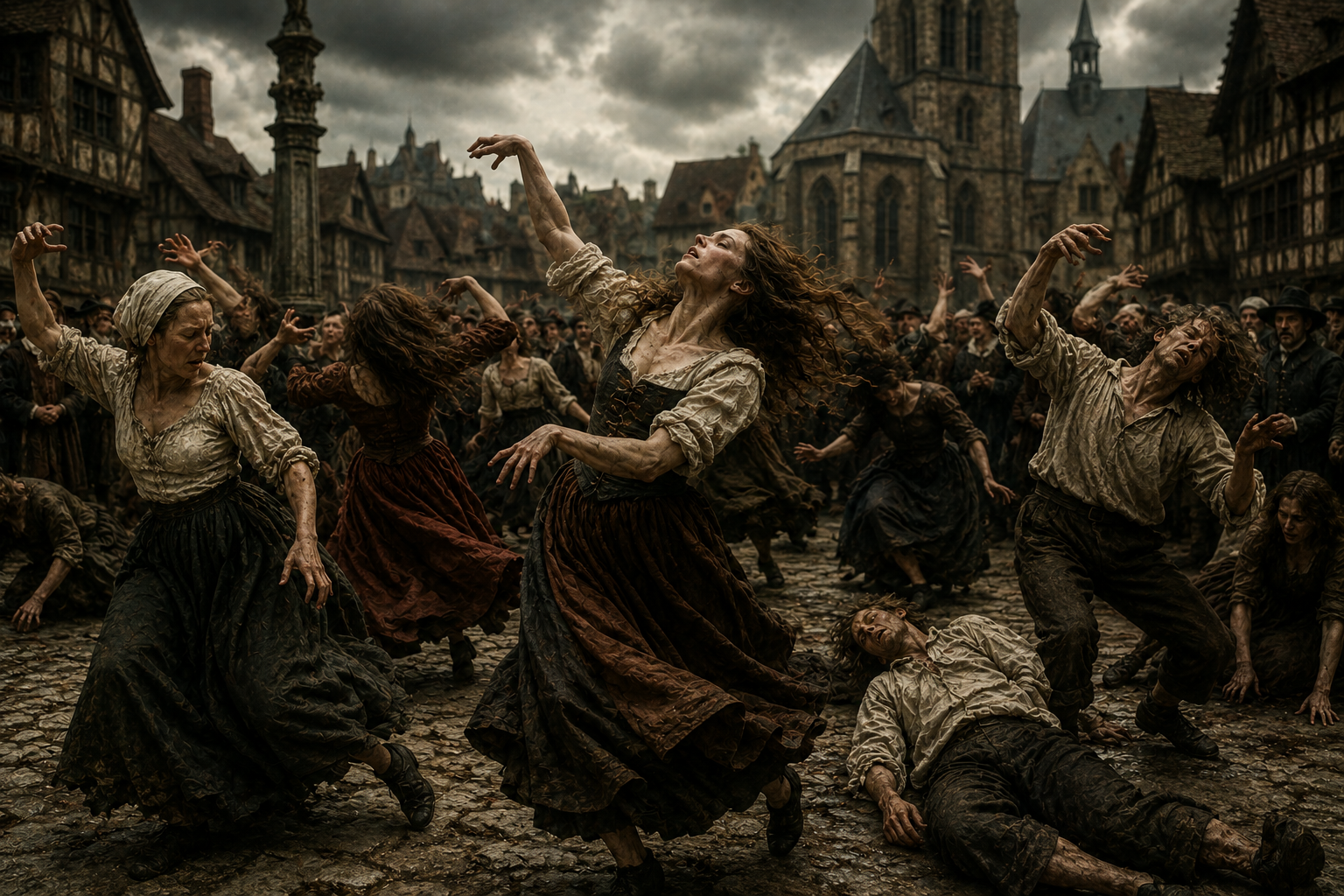
July 1518. Strasbourg. A woman named Frau Troffea walked outside and startedvdancing. There was no music. She had not planned it. She simply began moving and could not stop.
Six days. That is how long she danced before anyone understood that something was very wrong. Her feet bled through her shoes. She collapsed repeatedly and rose again, still moving, her body running on something other than will. By the end of the first week, a dozen others had joined her. By the end of the month, the number had grown to four hundred.
People began to die. Fifteen a day, at the worst of it. Exhaustion, heart failure, stroke. The dancing continued.
What the Records Say
This is not folklore. Two independent sets of contemporary records document what happened in Strasbourg between July and September 1518: the city council minutes, which are administrative records of a thoroughly practical kind, and medical opinions commissioned by the council to explain and address the outbreak. Both treat the dancing plague as a real event with real casualties.
The municipal response was, by the standards of the time, well-intentioned and catastrophically wrong. The physicians consulted concluded that the dancers suffered from a hot sickness of the blood and that the cure was more dancing. If the affliction could be danced through to its natural end, it would pass. Professional musicians were hired. A hall was cleared. The dancers were encouraged.
This made things considerably worse. New dancers kept joining. The infection, if you can call it that, spread through the crowd. Within days the council reversed its approach entirely, banned all music and public dancing, sent the most severely afflicted to a shrine of St. Vitus some miles away, and began the slow work of waiting for it to end. It did, over the following weeks, subside.
The World Those People Were Living In
Understanding what happened in Strasbourg requires understanding what Strasbourg was in 1518. Historian John Waller, who has written the most thorough modern study of the episode, is emphatic on this point: the dancing plague did not occur in a comfortable city having a bad year. It occurred at the end of a decade of accumulated catastrophe.
Harvests had failed repeatedly across the region. Famine was not a distant threat but a present reality that people were living inside. Syphilis had arrived in Europe roughly two decades earlier and was moving through populations with the speed and terror of a new plague. Plague itself was not gone. The social fabric of a community straining under this kind of sustained pressure was frayed in ways that left people vulnerable to precisely the kind of collective psychological crisis that Strasbourg experienced.
What the dancers were experiencing was real. Not performed. Not chosen. The symptoms were physical. The suffering was genuine. The deaths were documented.
St. Vitus and the Particular Logic of Medieval Belief
One detail elevates the Strasbourg case from peculiar to genuinely illuminating. The city had a chapel dedicated to St. Vitus, a saint associated with epilepsy, chorea, and involuntary movement disorders. The physicians who examined the dancers diagnosed them with a condition requiring this saint’s intervention.
St. Vitus was also credited, in the folk religious tradition of the region, with a specific curse: those who offended him would be made to dance before his statue for a full year. Here is the feedback loop that John Waller describes. A community under extreme stress becomes susceptible to psychogenic illness. That illness manifests in involuntary dancing because dancing is what the relevant belief system provides as the available form for this kind of affliction. The diagnosis reinforces the belief framework that generated the symptoms. The belief framework spreads the behavior to others who share it and who are subject to the same stresses.
This is not pretending. This is not mass deception. The conversion of psychological extremity into physical symptom is a documented neurological phenomenon. The brain generating real physical experience from overwhelming psychological pressure is, in a different context, the same mechanism that produces phantom limb pain or the physical symptoms of grief.
What Mass Psychogenic Illness Actually Means
The phrase mass hysteria carries a condescension that does not belong in serious discussion. The people who danced in Strasbourg were not weak, or credulous, or foolish in any way that distinguishes them from us. They were people under pressures most contemporary readers have never experienced, whose psychological and physiological
resources for managing those pressures ran out in a way that expressed itself in their bodies rather than their minds.
This happens. It has been documented in schools, factories, military units, and communities across multiple centuries and cultures. The specific form it takes varies by what the surrounding culture provides as a template. In 1518 Strasbourg, the template was a dancing saint’s curse. The suffering it produced was entirely real.
Frequently Asked Questions
Did people really die during the Dancing Plague of 1518?
Contemporary records, including the city council minutes and medical documentation, indicate that at the outbreak’s height approximately fifteen people per day were dying from exhaustion, stroke, and cardiac failure caused by uncontrollable dancing.
What caused the Dancing Plague of 1518?
The most widely accepted explanation is mass psychogenic illness, extreme collective psychological stress manifesting as real physical symptoms and spreading through social and cultural contagion among a population sharing both the stress and the belief framework.
How long did the Dancing Plague last?
From July to September 1518, approximately two months, before subsiding after the authorities banned public dancing and music and removed the most severely affected individuals from Strasbourg.
Were there other dancing plagues in history?
Yes. Similar episodes were recorded multiple times in the Rhine valley during the 14th and 15th centuries. The 1518 Strasbourg outbreak was the largest and most thoroughly documented.
Was ergot poisoning responsible?
Some earlier explanations proposed ergotism, poisoning from a fungus affecting rye crops, as the cause. Modern historians find this inadequate because ergotism typically produces seizures and paralysis rather than coordinated dancing, and ergot poisoning does not spread through social contagion.
A Final Thought
She stepped into the street and began to dance and could not stop, and four hundred people followed her into that terrible motion over the weeks that followed. Whatever broke open in Strasbourg in the summer of 1518, it broke because the ground underneath had been cracking for a decade. The dancers were not mad. They were people at the absolute limit of what the human body and mind can hold, and when the limit was crossed it expressed itself the only way it knew how. The music no one else could hear. The feet thatbled and kept moving. The particular mercy of it finally, finally stopping.