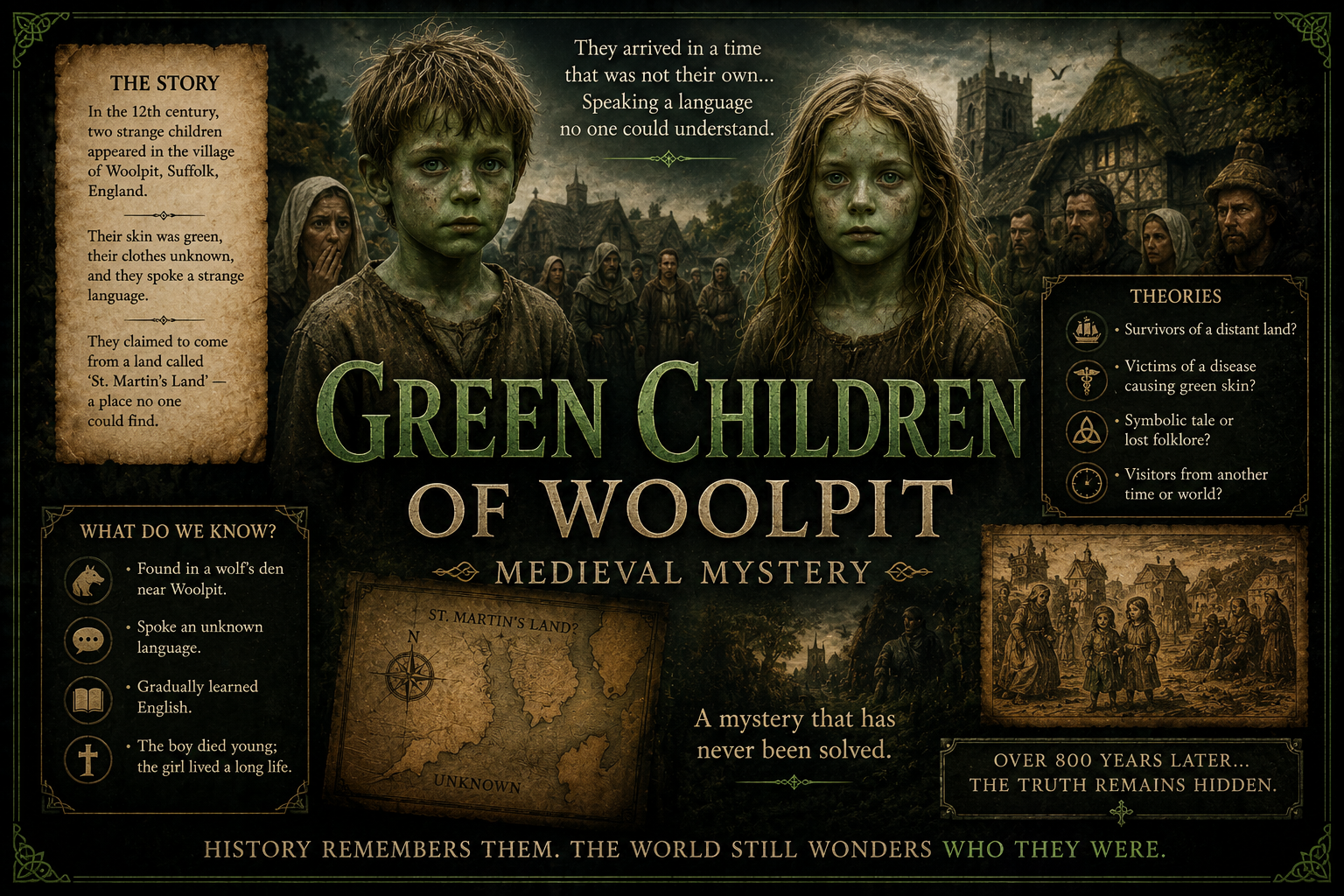
It was harvest season. The reapers were working the fields near Woolpit, that unremarkable village in Suffolk whose name came from the old Anglo-Saxon word for wolf traps, and what they found at the edge of one of those ancient pits was not a wolf.
Two children. Crouched and frightened and green.
Not figuratively green. Not sallow from illness, not pale from cold. Green, the way new leaves are green, the way spring is green, an unmistakable color that had no business being on a human face.
They spoke in a language nobody recognized. They would not eat anything offered to them for weeks. And when they finally began to explain themselves, what they said made everything stranger rather than less strange.
What Two Medieval Chroniclers Recorded
The incident is preserved in two independent sources: Ralph of Coggeshall’s Chronicon Anglicanum and William of Newburgh’s Historia Rerum Anglicarum, both written within decades of the events they describe. Neither man was a credulous gossip writing down fairy stories. Both were serious chroniclers working in the tradition of medieval historical scholarship, which meant they recorded what they believed to be true and tried, sometimes fruitfully, to explain it.
Both agree on the essentials. During the reign of King Stephen, during that particular stretch of English history so miserable that one chronicle called it the nineteen long winters, reapers near Woolpit found two children in or near the old wolf pits. The children wore unfamiliar clothing. They spoke a completely unknown language. Their skin was
noticeably green.
A local landowner, Sir Richard de Calne, took them in. For months they refused every food offered, growing thinner and weaker and more frightened. Then someone brought raw broad beans still in their pods, and the children seized on them with a recognition that looked almost like relief. They ate nothing else until, slowly, their palates adjusted to other foods.
As their diet changed, so did their color. The green faded. The boy grew sickly regardless and died. The girl survived.
What the Girl Eventually Told Them
Her English came slowly, and her account came slowly with it. She said they had come from a place called St. Martin’s Land. Underground. A world lit not by any sun but by a permanent diffuse twilight, everything tinted the color of what she remembered as home, which might explain something about what color home had made her.
She could not explain how they had arrived at the wolf pits. What she remembered was sound: bells, somewhere above them, resonant and unfamiliar, and they had followed the sound through a cave or tunnel and come out into light so bright and violent that it was like being struck. They had stood there, bewildered, in a field full of strangers, with no way to explain themselves and no idea how to go back.
She was baptized. She was given a name and a place in the ordinary world. She reportedly lived for some years after, though the chronicles do not record when or how she died.
The Rational Versions
The explanation most historians find most compelling involves chlorosis, a severe form of iron-deficiency anemia that can produce a markedly greenish tinge in the skin. Children living on an extremely restricted, largely plant-based diet with almost no iron could develop this condition. The fact that the coloration faded as their diet normalized is consistent with chlorosis responding to improved nutrition.
As for the unknown language, some researchers have suggested the children might have been Flemish, orphaned from one of the Flemish communities that existed in East Anglia during this period, their dialect so unfamiliar to rural Suffolk reapers that it registered as completely incomprehensible. The detail about the underground world and the perpetual twilight might then be explained as the child’s attempt to describe, in a new language with limited vocabulary, something she remembered from before she became lost.
What the Folklore Sees
Medieval thinkers reached naturally for the otherworld. The Celtic tradition of a parallel realm beneath the earth, populated by beings not quite human, occasionally bleeding through into ordinary experience at liminal places, was alive and embedded in the imaginative landscape of 12th century England.
The detail about church bells is arresting. In British folklore from multiple traditions, bells are associated with the boundary between worlds, with calling back the dead, with repelling whatever does not belong in the living world. The children followed bells upward. They emerged where the bells led them.
Whether that is memory or metaphor or something else entirely is a question nine centuries have not resolved.
Frequently Asked Questions
Are the Green Children of Woolpit a real historical event?
Two independent medieval chronicles record the incident as fact. Some genuine event clearly occurred in 12th century Suffolk. Whether the details as recorded are accurate or were shaped by the assumptions and traditions of the era cannot be determined from this historical distance.
What caused the children’s green skin?
The most credible modern explanation is chlorosis, severe iron-deficiency anemia that can cause greenish discoloration of the skin. This is consistent with the fact that the color faded as the children’s nutrition improved.
What language did the Green Children speak?
Unknown. The chronicles describe it as incomprehensible to everyone in Woolpit. Some researchers have proposed the children were Flemish, though this remains unverified speculation.
Where is Woolpit?
A village in Suffolk, England, roughly twelve miles east of Bury St Edmunds. The name comes from the Anglo-Saxon for wolf pits, the trapping pits that were once dug to catch wolves.
What happened to the surviving girl?
According to William of Newburgh, she was baptized, given a name, and lived in the ordinary world for some time afterward. She reportedly answered questions about her underground homeland, but the details she offered were never corroborated by any other source.
A Final Thought
Two children came out of the ground in Suffolk and the world they emerged into had no framework for them. They were green. They spoke in tongues. They said they came from underground where there was no sun. The boy died before anyone understood him. The girl learned to speak the language of the surface world and tried to explain what she remembered, and then she was given a new name and folded into the ordinary, and history carried on without looking back. Only the story remained: persistent, unexplained, growing still in the dark like something that does not need light to survive.