
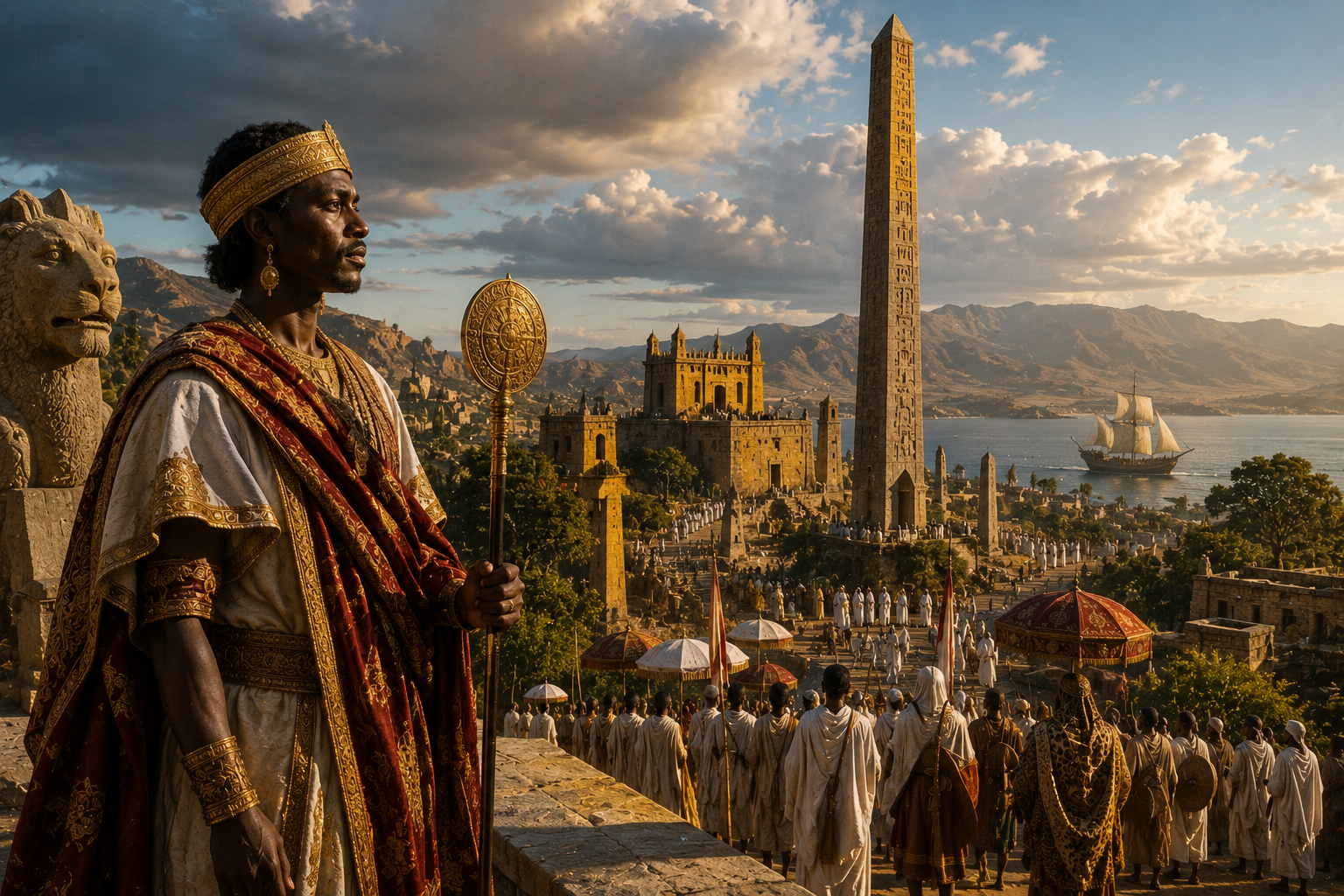
The Kingdom of Aksum: Africa’s Forgotten Superpower. Sometime in the third century, a Persian prophet named Mani sat down to explain the shape of the world to his followers.
There were, he said, four great kingdoms. Rome. Persia. China.
And Aksum.
Mani was not writing propaganda for anybody. He was a religious teacher in Mesopotamia describing the powers of his age as he understood them, and one of the four he named sits almost entirely outside the standard curriculum of world history.
Highland Empire, Red Sea Money
Aksum occupied the highlands of what is now northern Ethiopia and Eritrea, and its power was a straightforward consequence of where it sat.
The kingdom controlled Adulis, a port on the Red Sea, and the Red Sea was the hinge between two of the ancient world’s great commercial systems. Goods from India, Arabia and the African interior came up through Aksumite hands to reach Rome. Ivory, gold, frankincense, tortoiseshell, spices and enslaved people all moved through that corridor.
Being a chokepoint makes you rich. Staying rich requires being able to feed yourself, and here the highlands did the second half of the work. Reliable rainfall and fertile volcanic soil meant Aksum was not dependent on a single river the way Egypt was on the Nile.
Trade income plus food security is a formula for durability, and Aksum was durable for roughly six hundred years.
The Stones They Could Not Quite Raise
Drive north through Tigray today and you come to a field of granite towers.
The Aksumite stelae were cut from single blocks and raised as markers over royal tombs. They are carved to imitate multi-storey buildings, with rows of what look like the projecting ends of wooden roof beams, and false doors at the base complete with carved locks.
| Stele | Height | Where it stands |
| The Great Stele | around 33 metres | Broken, lying where it fell |
| Obelisk of Axum | around 24 metres | Taken to Rome in 1937, returned in 2005 |
| King Ezana’s Stele | around 21 metres | Still upright |
The Great Stele is the largest single stone any human society is known to have attempted to raise. It never stood. The most widely held reading is that it collapsed during erection, possibly killing people, and it has lain in pieces ever since.
There is something almost unbearably human about that. A kingdom at the height of its confidence tried to build the biggest thing anyone had ever built, and it fell over, and they left it.
The King Who Changed the Coins
Around the 330s, the Aksumite king Ezana converted to Christianity.
Ethiopian tradition credits a young Syrian named Frumentius, shipwrecked as a boy on the Red Sea coast, raised at the Aksumite court, and eventually consecrated as the first bishop of Aksum.
You can watch the conversion happen in the currency. Aksumite coins carry a disc and crescent, and then they carry a cross. It is among the earliest appearances of the cross on any state’s money anywhere.
The coinage itself is worth pausing on. Aksum minted in gold, silver and bronze from around the late third century, making it one of very few ancient African states to issue its own currency. Minting is not decoration. It is a claim that your word is good enough to guarantee value, and that your administration can enforce that claim across a territory.
Aksumite coins carried legends in both Greek and Ge’ez, which tells you precisely who the kingdom thought it was talking to. Greek for the Mediterranean. Ge’ez for home.
That script has outlived the kingdom by fourteen centuries. Ge’ez remains the liturgical language of the Ethiopian Orthodox Church, and modern Amharic and Tigrinya both descend from it. Very few ancient writing systems are still in use. This is one.
An Outsider’s Description
We have one reasonably early external account of the place. The Periplus of the Erythraean Sea, a Greek merchant’s handbook to Red Sea and Indian Ocean trade written in the first century CE, describes Adulis as a port of substantial business and names the ruler inland as Zoskales, calling him a man familiar with Greek letters.
That is not a chronicle. It is a working guide for traders, which makes it more useful. Somebody with cargo to move thought this kingdom mattered enough to describe.
There is also an Aksumite voice in the record. The Ezana Stone, still standing near the town, carries an inscription in three scripts: Ge’ez, Sabaean and Greek. A kingdom that publishes in three languages is a kingdom that expects three audiences to read it.
Losing Relevance
At its height Aksum projected force across the water. In the sixth century, Aksumite armies intervened in southern Arabia and briefly held territory in what is now Yemen.
Then the map changed underneath it.
- The rise of Islam in the seventh century redirected Red Sea commerce away from Aksumite control.
- Adulis declined as a port, and the kingdom’s income declined with it.
- Centuries of intensive cultivation appear to have exhausted the highland soils.
- Political weight shifted southward, away from Aksum itself.
None of this was a conquest. There is no siege, no sack, no final battle to point at. The capital simply stopped being where things happened, and people left.
What is remarkable is how much survived the kingdom. The Ethiopian state that emerged from Aksum kept the script, kept the church, kept the royal traditions and the claim of descent from Solomon. Ethiopia would remain one of only two African countries never brought fully under colonial rule.
Aksum’s territory also produced something else that outlasted it: a tradition of rock-hewn church architecture that would reach its extraordinary conclusion centuries later at Lalibela, where eleven churches were cut downward into solid rock rather than built up from it.
Aksum today is a modest town carrying an enormous past. The Church of Our Lady Mary of Zion stands there, and Ethiopian Orthodox tradition holds that the Ark of the Covenant is kept in a chapel on its grounds, attended by a single guardian monk who never leaves. Nobody else is permitted to see it. The claim cannot be verified and the tradition is not going to change to accommodate that.
The Reason You Have Not Heard of It
Aksum is missing from most people’s education not because it was minor but because of who wrote the syllabus.
The historical tradition that shaped Western schooling looked north to Europe and east to Persia, India and China. It did not look south with the same attention, and a kingdom that traded with Rome, converted before most of Europe, minted its own gold and raised the largest monoliths ever attempted fell into the gap.
Mani had it right in the third century. It took the rest of us a while.
Frequently asked questions
Where was the Kingdom of Aksum?
In the highlands of present-day northern Ethiopia and Eritrea, with its main port at Adulis on the Red Sea.
When did Aksum exist?
It was a major power from roughly the first century CE to the seventh, peaking in the third and fourth centuries.
Why did Aksum decline?
Chiefly because the rise of Islam redirected Red Sea trade away from its ports, compounded by soil exhaustion and a southward shift of political power.
How tall are the stelae?
The Great Stele stands around 33 metres and lies broken. King Ezana’s stele, roughly 21 metres, is still upright.
Was Aksum genuinely ranked with Rome?
The third-century Persian prophet Mani listed it alongside Rome, Persia and China as one of the four great kingdoms of the world.
Is the Ark of the Covenant really at Aksum?
Ethiopian Orthodox tradition holds that it is. Access is not permitted, so the claim cannot be independently assessed.
Sources consulted