An Egyptian believed a person was made of parts.
There was the body. There was the ka, a life force that stayed with the body and needed feeding. And there was the ba, the mobile part of a person, usually shown as a bird with a human head, which could leave the tomb and travel.
Every night the ba had to come back and find the body it belonged to.
If it could not recognise what it found, the person was finished. Not dead in the ordinary way. Erased, with no continued existence anywhere at all.
Everything in this article follows from that single fear.
The Sand Did It First
The earliest Egyptian mummies were nobody’s plan.
Around 3500 BCE the dead were buried in shallow pits cut straight into desert sand. The sand was hot, dry and absorbent. It pulled the water out of a body faster than decay could start.
Egyptians who reopened old graves would have found their ancestors intact. Recognisable. Present.
Then burial practices improved and everything went wrong. Bodies placed in coffins, inside built tombs, cut off from the sand, rotted the way bodies normally rot.
Artificial mummification was invented to solve a problem that better funerals had created.
Seventy Days
The process reached its most refined form during the New Kingdom, roughly 1550 to 1070 BCE. Herodotus described it in the fifth century BCE, and modern examination of mummies has confirmed much of his account.
- Washing. The body was cleaned, often with palm wine and water from the Nile.
- The brain. A hooked instrument went in through the nostril. The brain was broken up and drained out. Egyptians thought it unimportant and threw it away.
- The organs. An incision was made in the left flank. Lungs, liver, stomach and intestines came out, were dried separately and stored.
- The heart stayed. It held intelligence, memory and moral character. It would be needed later.
- Natron. The body was packed and covered in natron, a salt gathered from dry lake beds, and left for about forty days.
- Restoration. The dried body was stuffed with linen, sawdust and resin to bring back a lifelike shape.
- Wrapping. Layers of linen bandages applied over several days, with protective amulets set between them.
- The Opening of the Mouth. A final ceremony on the wrapped body, meant to restore the senses for use after death.
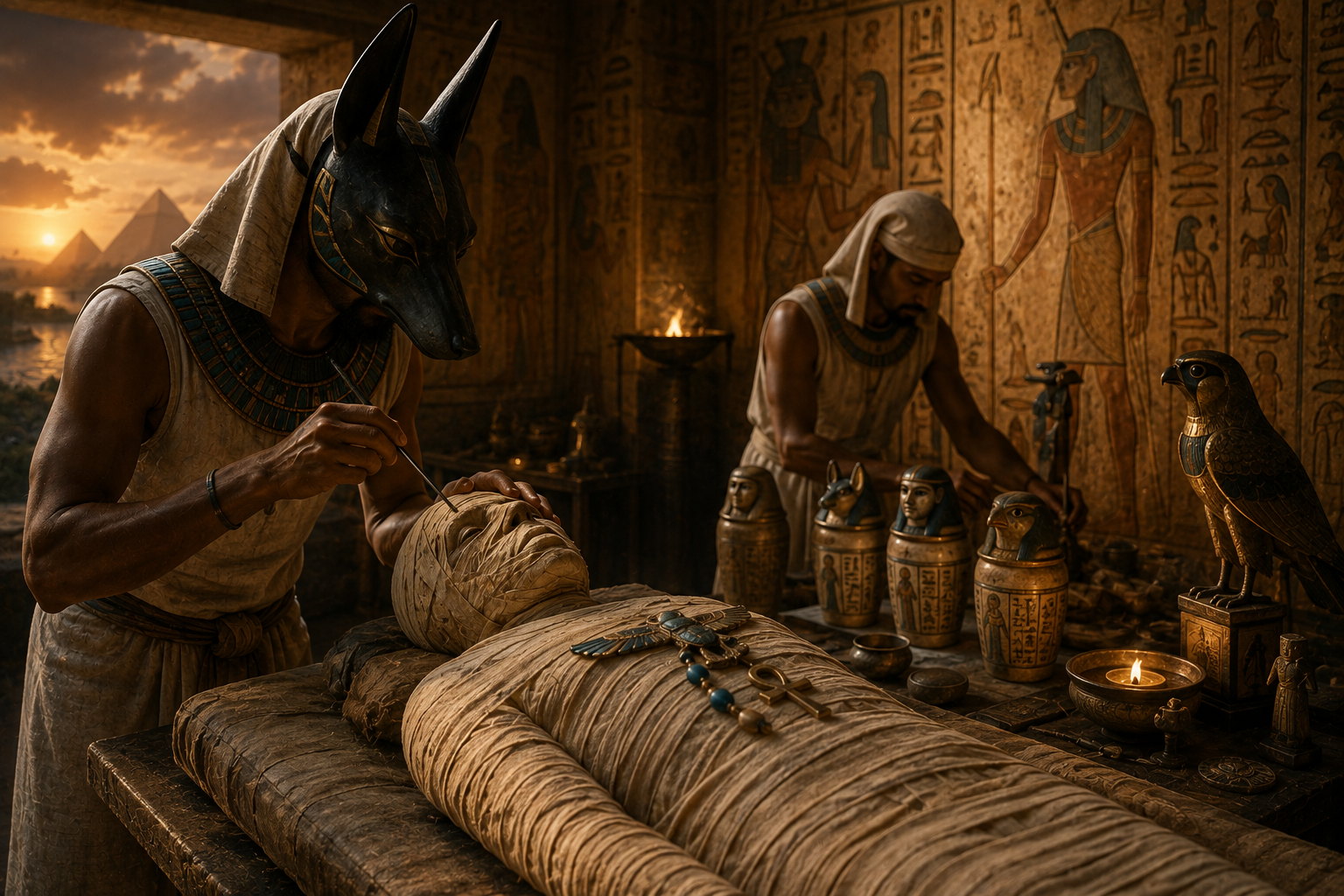
The four organs went into containers now called canopic jars.
| Guardian | Head | Organ |
| Imsety | Human | Liver |
| Hapy | Baboon | Lungs |
| Duamutef | Jackal | Stomach |
| Qebehsenuef | Falcon | Intestines |
Who Did the Work
Embalming was a trade, and it had its own workshops.
The work took place in a structure called the wabet, the pure place, usually a temporary building near the tomb or the river. Several specialists were involved. One read the ritual texts. One handled the bandaging, wearing a jackal mask to represent Anubis.
And one made the incision.
Diodorus Siculus, writing in the first century BCE, recorded a strange detail about that role. The man who cut into the body was ritually cursed and driven off with stones by the other workers, who then continued as normal.
The cut was necessary. It was also a violation of the body, and somebody had to carry the blame for it. So the trade built a ceremony to move that blame onto one man and then release it.
The Weighing
Preservation was only half the work. The other half happened after death, and it explains the decision about the heart.
Egyptian funerary texts, collected under the modern label the Book of the Dead, describe the dead arriving in the hall of Osiris. The heart goes on a scale. On the other side sits a single ostrich feather, standing for Ma’at, the principle of truth and order.
A heart weighed down by wrongdoing tips the scale. The creature waiting beside it, Ammit, part crocodile and part lion and part hippopotamus, eats it.
This is not punishment. There is no hell in the Egyptian system. Being eaten by Ammit simply means ceasing to exist.
So the brain went in the bin and the heart stayed in the chest. Without a heart there is nothing to weigh. Without a weighing there is no verdict, and no continued existence to be granted.
Three Price Points
Herodotus recorded that embalmers offered tiers, and the difference shows up in surviving bodies.
The most expensive treatment meant full organ removal, high-grade natron, resins imported from the Levant, fine linen and elaborate amulets. Royalty and senior officials could afford it.
The middle option skipped the abdominal incision entirely. Cedar oil was injected instead, left to dissolve the organs, then drained out.
The cheapest was a purge, a natron drying and minimal wrapping. A great many surviving mummies are ordinary Egyptians who got this.
Animals were mummified in staggering numbers as offerings to particular gods. Ibises for Thoth. Cats for Bastet. Crocodiles for Sobek. Falcons for Horus. Dedicated animal cemeteries have produced them in the millions.
What the Bodies Told Us Later
Modern examination has turned mummies into a medical archive nobody intended to leave.
CT scanning and DNA work on royal mummies have found arterial disease, arthritis, dental abscesses and parasitic infection. Tutankhamun appears to have had a club foot and malaria. Ramesses II had severe dental problems and hardened arteries.
Most of this evidence was destroyed during the unwrapping era. Almost everything learned recently has come from scanning bodies without opening them, which is a reversal of method that happens to be much closer to what the Egyptians wanted.
What Happened to Them
Mummification declined under Roman rule as burial fashions changed. The spread of Christianity from the second century CE removed the theology that required it. By roughly the fourth century the practice had stopped, after some three and a half thousand years.
What followed is grimmer than anything the embalmers did.
From the medieval period into the early modern, ground mummy was sold across Europe as medicine, prescribed for bruises, epilepsy and internal bleeding. Demand was high enough to sustain a trade. In the nineteenth century, mummies were unwrapped at private parties in London and Paris as entertainment, with guests invited to watch.
Uncounted thousands were destroyed for both.
Howard Carter’s opening of Tutankhamun’s tomb in 1922 changed attitudes considerably. Partly through the spectacle, partly because Carter documented the excavation with a care that made casual destruction look like exactly what it was.
What They Were Doing
Seventy days of skilled labour. Expensive imported materials. A specialist’s full professional attention.
All of it went into a single proposition. That this person is coming back, and when they do, they need to be able to find themselves.
The Egyptians were not preoccupied with death. They were making arrangements for somebody they expected to see again.
Frequently asked questions
How long did mummification take?
About seventy days in total, roughly forty of which were spent drying the body in natron salt.
Why remove the brain but keep the heart?
The heart held intelligence, memory and character, and it was needed for the weighing ceremony. The brain was thought unimportant.
What is natron?
A naturally occurring salt, mainly sodium carbonate and bicarbonate, collected from dry lake beds and used to draw water out of the body.
What are canopic jars?
Four containers holding the liver, lungs, stomach and intestines, each protected by one of the Four Sons of Horus.
Were only pharaohs mummified?
No. Herodotus recorded three price tiers, and many surviving mummies are ordinary Egyptians given simpler treatments.
What was the weighing of the heart?
A judgement in which the heart was weighed against the feather of Ma’at. A heart heavy with wrongdoing was eaten by Ammit, ending the person entirely.
Were animals mummified too?
Yes, in enormous numbers, as offerings to specific gods. Animal cemeteries have yielded millions.
When did the practice stop?
It declined under Roman rule and largely ended by around the fourth century CE as Christianity spread through Egypt.
Sources consulted