
Updated 8 October 2026: corrected claims about the Archimedes stories. See Corrections.
A Roman soldier walked into a courtyard in Syracuse in 212 BCE and found an old man drawing diagrams in sand. The old man, according to the story, told him to stand back and not disturb the figures. The soldier killed him.
It is the most famous death in the history of mathematics. The death itself is reported fairly early, by Livy under Augustus, but the famous last words appear only in writers more than two centuries later, and they do not agree on what he said.
Archimedes is a genuine case where the achievements are extraordinary and independently verifiable, and the anecdotes attached to him are almost all late, unsourced and probably invented. Sorting one from the other is a good exercise in how ancient reputations actually get built.
What is not in doubt
His own writings survive, in Greek, and they are the reason he matters.
He established the relationship between the volume of a sphere and the cylinder that encloses it, a result he considered his best work and asked to have marked on his tomb. He calculated a value for pi by bounding a circle between inscribed and circumscribed polygons of ninety-six sides, arriving at a range that is correct. He founded hydrostatics as a field in a treatise called On Floating Bodies. He developed a method of exhaustion that gets remarkably close to integral calculus, roughly eighteen centuries early.
There is also the Archimedes Palimpsest, a tenth-century copy of his works that was scraped clean in the thirteenth century and overwritten with a prayer book. Recovered and imaged with multispectral techniques from 1998 onward, it revealed a lost treatise called The Method, in which he explains how he actually found his results using mechanical reasoning before proving them formally. It is the closest thing we have to an ancient mathematician showing his working.
Now the stories
| Story | Source and distance | Assessment |
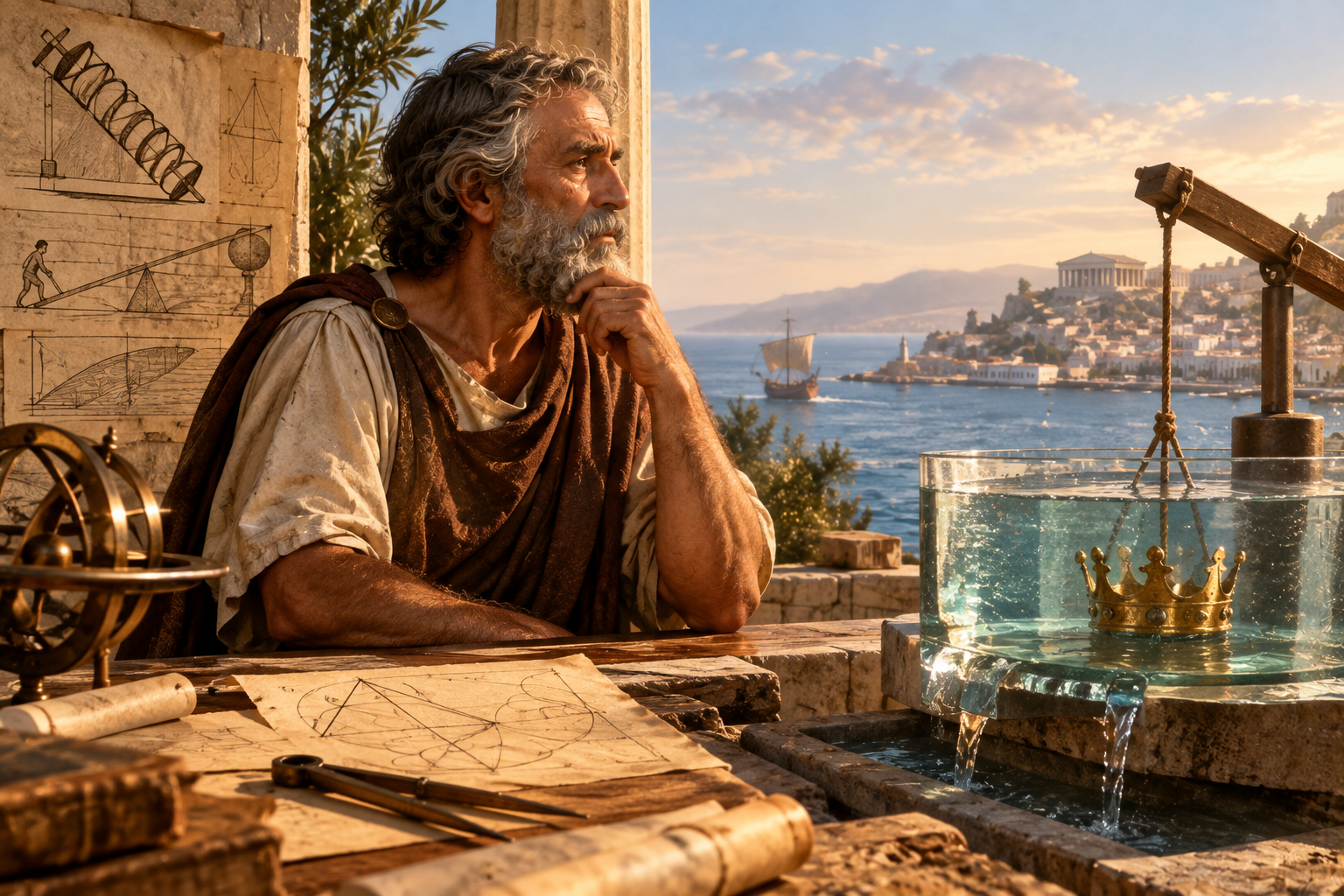
| Eureka, leaping from the bath after solving the crown problem | Vitruvius, writing roughly 180 years later | The physics as Vitruvius describes it, using overflow volume, would be far too crude to detect the fraud. Archimedes’ own On Floating Bodies contains a buoyancy method that would work. The insight is plausible, the bath is decoration |
| Give me a place to stand and I will move the earth | Attributed by Pappus and others, centuries later | No source close to him. The principle of the lever is genuinely his, set out in On the Equilibrium of Planes. The line is a summary that became a quotation |
| Burning mirrors used to set Roman ships alight | Not in Polybius, Livy or Plutarch. First appears with Lucian, and is elaborated by Byzantine writers a thousand years later | Almost certainly invention. The nearest sources describe cranes and catapults, not mirrors. Modern attempts to reproduce the effect require unrealistic conditions |
| Do not disturb my circles | Plutarch and Valerius Maximus, both well over two hundred years later, and they give different last words | The death at Syracuse is credible and reported early. The specific line is a later flourish and the versions disagree |
The pattern is consistent, and it is a pattern worth recognising because it applies to a great many ancient figures. The technical achievements are documented in the man’s own surviving texts. The memorable anecdotes appear centuries afterwards, become more vivid with each retelling, and get attached to him because he is the person such stories belong to.
The siege, which is well attested
What Polybius says, and he is close in time and had access to people who were there, is that Archimedes turned Syracuse into a machine that made the city very difficult to take.
He describes cranes on the walls that could reach out over an approaching ship, grip the prow, lift it and drop it. He describes catapults calibrated for different ranges, so that a fleet moving in was under fire at every distance. He describes the Roman assault stalling entirely and Marcellus resorting to blockade.
Polybius notes, drily, that the Romans became so unnerved that if they saw so much as a rope or a piece of timber appear above the wall, they assumed a device was coming and withdrew.
That is the real Archimedes story: not a death ray, but an engineer who understood that a well-placed lever and accurate ranging could hold off a professional army for two years.
Why the invented version stuck
Because a bath and a shout are easier to carry than a proof about the volume of a sphere.
There is also a Roman appetite in these anecdotes. The Greek genius killed by a Roman soldier who did not know who he was is a story about Rome’s relationship with Greek culture, told by Romans, and it does a particular kind of work.
Marcellus, the Roman commander, is said to have ordered that Archimedes be spared and to have been distressed at his death. Cicero, more than a century later, wrote that he located the neglected tomb outside Syracuse and identified it by the sphere and cylinder carved on it, which if true is the single most touching detail in the whole business.
Frequently asked questions
Did Archimedes really shout Eureka in the bath? The story comes from Vitruvius nearly two centuries later, and the method he describes would not have been precise enough to detect the fraud. Archimedes’ own work contains a buoyancy technique that would.
Did Archimedes build a death ray? No source close to the siege mentions burning mirrors. The claim appears much later and modern reconstructions require conditions a battle would not provide.
What did Archimedes actually discover? Among other results, the ratio between a sphere and its enclosing cylinder, accurate bounds for pi, the principle of the lever, and the foundations of hydrostatics.
How did Archimedes die? He was killed by a Roman soldier during the capture of Syracuse in 212 BCE. The famous last words appear only in much later sources and differ between them.
What is the Archimedes Palimpsest? A medieval copy of his works that was erased and reused as a prayer book. Modern imaging recovered the text, including The Method, a treatise otherwise lost.
Was Archimedes a mathematician or an engineer? Both, though his own writings show he valued the mathematics more highly. Polybius attests to his siege machinery in detail, while the theoretical works survive in his own words, through later Greek copies.
Sources
Primary: the works of Archimedes themselves, most accessibly in T. L. Heath, The Works of Archimedes (1897, reprinted), including On the Sphere and Cylinder, Measurement of a Circle and On Floating Bodies. Polybius, Histories, book 8, for the siege machinery, and he is the closest source in time. Plutarch, Life of Marcellus. Vitruvius, On Architecture, book 9, preface, for the crown story. Cicero, Tusculan Disputations, book 5, for the tomb.
Modern scholarship: Reviel Netz and William Noel, The Archimedes Codex (2007), on the palimpsest and what The Method contains. Chris Rorres has assembled a well-known and carefully sourced collection of the Archimedes material online, which is useful for checking which anecdote comes from where.