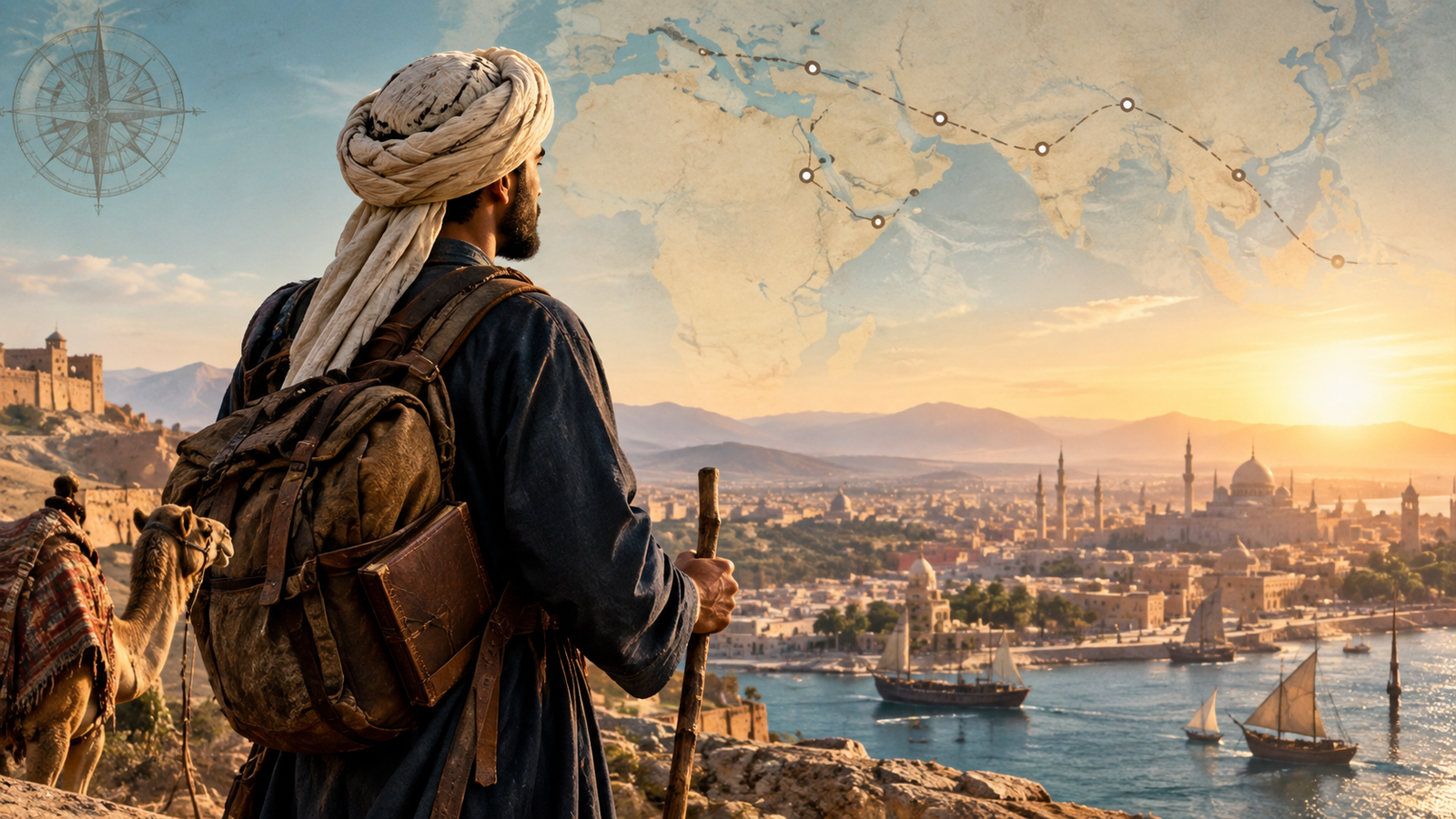
In 1325 a twenty-one-year-old law student left Tangier on his own for Mecca. He wrote later that he set out alone, with no travelling companion and no caravan to join, and that leaving his parents distressed them both.
He came home in 1354. In between he had covered something in the region of seventy-five thousand miles, which is roughly three times the circumference of the earth, and considerably more than Marco Polo.
He had also, along the way, served as a judge in Delhi, been appointed ambassador to China, been robbed, shipwrecked, married and divorced repeatedly, survived a mass execution he was scheduled for, and been given a full state salary by a sultan whose habits terrified him. The city later held two pillars carrying the edicts of Ashoka, moved there by Firuz Shah Tughlaq.
The shape of the journey
He went east through North Africa, married for the first time in Tunisia, and reached Mecca in 1326. That should have been the end of it. Instead he kept going.
Persia and Iraq came next, then a return to Mecca for several years of study. Then East Africa: down the Red Sea to Aden, then along the Swahili coast to Mogadishu, Mombasa and Kilwa, which he describes as one of the finest cities he had seen.
Then Anatolia, then north across the Black Sea into the territory of the Golden Horde. He attached himself to the retinue of a khan’s wife travelling to Constantinople and so entered the Byzantine capital in the company of a Mongol princess, which is a sentence that requires no embellishment.
Then Central Asia, Afghanistan, and over the Hindu Kush into India.
Delhi, and the sultan
He arrived in Delhi around 1334 and stayed roughly eight years, appointed qadi, judge, by Muhammad bin Tughlaq, on the strength of his legal training and, by his own admission, his ability to present himself well.
His account of Tughlaq is one of the most valuable passages in the whole book because he is describing a ruler he served under, saw daily, and was frightened of. He records extraordinary generosity and extraordinary violence from the same man in successive paragraphs, and he does not attempt to reconcile them.
He describes the token currency experiment, in which Tughlaq issued brass and copper coins at the value of silver, and the resulting collapse when the coins were forged at scale. He describes the forced relocation of Delhi’s population to Daulatabad. And he describes, without softening it, that association with the sultan was dangerous, and that men he knew were executed.
He himself came under suspicion after visiting a sheikh who was subsequently killed. He was placed under guard, expected the worst, and was then abruptly rehabilitated and given a diplomatic appointment to China.
The embassy was a disaster. The party was attacked by rebels, he was separated and robbed, the ships carrying the gifts were wrecked at Calicut, and he decided that returning to Delhi to explain the loss of the sultan’s treasure was not survivable. So he did not return. He went to the Maldives instead, where he became a judge again and attempted, with limited success, to enforce a stricter dress code on a population that had its own ideas.
He reached China eventually, though this is the portion of the book most doubted, and returned west in time for the plague, which he encountered in Damascus in 1348.
The book, and how it was made
He did not write the Rihla himself. On his return, the sultan of Morocco assigned him a scholar, Ibn Juzayy, to take down the account and put it into literary form.
This matters for reliability in two directions. Ibn Battuta was recalling decades of travel largely from memory, having lost his notes in the Indian Ocean. And Ibn Juzayy was a professional writer working in an established genre, who acknowledges in the text that he has incorporated material from earlier travel writing.
Some passages have been shown to be lifted from earlier authors, particularly the description of Damascus and parts of the Palestine material. Some claimed journeys are chronologically impossible as stated. The China section contains errors suggesting he did not see everything he describes.
None of this makes the work worthless. It makes it a memoir rather than a logbook. Where he describes places he clearly spent time, and above all where he describes people, the detail is specific, unflattering and often self-incriminating in ways an invention would not be.
Why he is worth reading
Marco Polo describes what things looked like. Ibn Battuta describes how they felt to be inside.
He complains about food. He notes what the women of each region wear and how much freedom they have, sometimes approvingly and sometimes with visible disapproval. He records his own embarrassments. He is honest that he liked being important and that he spent money faster than he received it.
He also travelled a world that was, briefly, connected in a way it had not been before and would not be again for centuries. The Mongol peace held the overland routes open. Islamic legal and scholarly networks stretched from Spain to Sumatra, and a qadi from Tangier could find employment in Delhi or Malé because the qualifications transferred.
Then the plague arrived and the Mongol structure fragmented, and the network he had used closed. He got there in the window.
Frequently asked questions
Who was Ibn Battuta? A Moroccan legal scholar from Tangier who travelled across Africa, Asia and Europe between 1325 and 1354, producing an account known as the Rihla.
How far did Ibn Battuta travel? Estimates put his total distance at around seventy-five thousand miles, considerably further than Marco Polo, across roughly forty modern countries.
Is the Rihla reliable? Partly. It was dictated from memory after his notes were lost, written up by a professional author, and some passages are borrowed from earlier travel writing. Sections where he clearly spent time are far more dependable.
Did Ibn Battuta really reach China? He describes reaching Quanzhou and other Chinese cities, but this is the most doubted portion of the account, containing errors and compressions that suggest limited or second-hand experience.
What did he do in India? He served for around eight years as a judge in Delhi under Sultan Muhammad bin Tughlaq, and was later appointed ambassador to China, a mission that collapsed after shipwreck and robbery.
Why is Ibn Battuta less famous than Marco Polo? The Rihla circulated in the Arabic-speaking world but was not translated into European languages until the nineteenth century, by which time the Polo narrative was long established in the West.
Sources
Primary: the Rihla. The standard English edition is The Travels of Ibn Battuta, trans. H. A. R. Gibb and, for the final volume, C. F. Beckingham, published by the Hakluyt Society in five volumes between 1958 and 2000. Tim Mackintosh-Smith’s abridgement (2002) is the practical choice for a general reader.
Modern scholarship: Ross E. Dunn, The Adventures of Ibn Battuta (1986, revised 2012), which is the standard scholarly treatment and is careful about which passages can be trusted. David Waines, The Odyssey of Ibn Battuta (2010). On the borrowed passages and chronological problems, see the discussion in Dunn’s introduction and in Stephen Janicsek’s earlier work on the itinerary.