Temüjin was about nine years old when his father was poisoned and his family was abandoned on the steppe.
The clan took the herds and left. His mother kept the children alive on roots, wild onions and fish, which was not how the family of a minor chieftain was supposed to eat. He was later captured by a rival clan and held in a wooden collar before escaping.
By 1206 he had unified the Mongol tribes and been proclaimed Genghis Khan. He was around forty-four, and he had not yet fought a single campaign outside Mongolia.
Why the Steppe Was Fragmented
The world Temüjin was born into consumed its own energy. Mongol clans raided each other for horses, women and grazing, alliances shifted constantly, and blood feuds ran for generations.
Nobody could unify it because the loyalties ran to clan and kin, and any confederation dissolved as soon as its founder died.
Solving that problem is Genghis Khan’s actual achievement. The conquests follow from it.
The Reforms
This is the part most accounts skip, and it explains everything else.
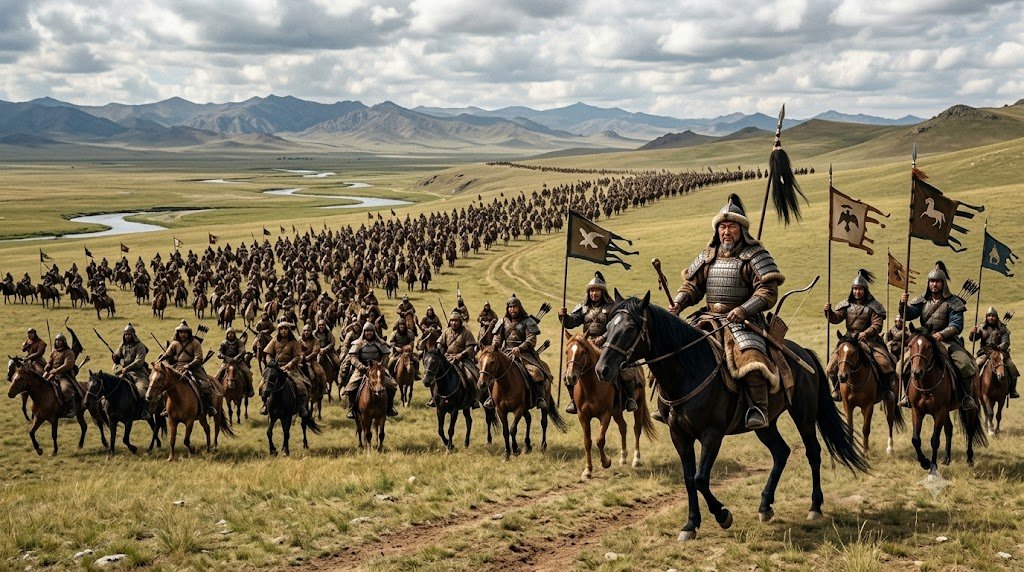
Decimal military organisation. The army was structured in units of 10, 100, 1,000 and 10,000, and men from different tribes were mixed deliberately within each unit.
Broken tribal loyalty. Because units were mixed, a soldier’s loyalty ran to his commander and to the khan rather than to his clan. That one change ended the cycle of fragmentation that had held the steppe back for centuries.
Promotion by merit. Commanders rose on competence. Subutai, among the most effective generals in recorded history, was the son of a blacksmith.
The Yassa. A written legal code applying to everyone, including the khan’s own family.
A written script. Genghis adopted the Uyghur alphabet for the Mongol language, which gave the empire administrative records.
Religious tolerance. Clergy of every faith were exempt from taxation. This was policy rather than sentiment, and it made conquered populations far easier to govern.
The Yam. A relay system of way stations with fresh horses, allowing messages to cross the empire at extraordinary speed.
An army that can be commanded at distance, resupplied on schedule and reinforced by promotion is a different instrument from a raiding party.
The Conquests
Western Xia fell first, from 1209. The Jin dynasty in northern China followed from 1211, in a long war that took Zhongdu, later Beijing, in 1215.
The Khwarazmian campaign of 1219 to 1221 began as a diplomatic incident. Genghis sent a trade caravan and envoys west; the governor of Otrar had them killed. The response destroyed one of the wealthiest civilisations in the Islamic world, and several great cities never recovered. The Moroccan traveller Ibn Battuta later crossed several of the successor states.
That single incident shaped how every subsequent city responded to a Mongol embassy.
The Rus principalities and eastern Europe were invaded from 1237. Kiev fell in 1240. Baghdad fell in 1258, ending the Abbasid Caliphate. Southern Song China held out until 1279, when Kublai Khan completed the conquest and ruled as a Chinese emperor.
At its height the empire covered roughly 24 million square kilometres, the largest contiguous land empire in history.
How the Army Fought
The tactics matched the organisation.
Mongol armies moved on horseback with remounts, several per rider, which meant they could cover distances that other armies could not credit. Composite bows, drawn from the saddle, gave them range and volume of fire.
The characteristic manoeuvre was the feigned retreat. A unit would break and run, sometimes for days, drawing pursuers away from support and into prepared ground. Armies that had won the first engagement discovered this too late.
They also used terror deliberately, and openly. A city that resisted and fell could be destroyed entirely, and the news travelled ahead of the army to the next city, which frequently surrendered.
That was not rage. It was policy, and it reduced the number of sieges they had to fight.
The Limits
It did have them.
At Ain Jalut in 1260, the Egyptian Mamluks defeated a Mongol force and halted the westward advance permanently.
Two attempted invasions of Japan, in 1274 and 1281, were broken by storms the Japanese called kamikaze, divine winds.
And the withdrawal from Europe in 1242 was not a defeat at all. Ögedei, the reigning khan, had died, and the commanders returned east to take part in choosing a successor.
Central Europe was saved by a succession procedure.
What the Empire Did
Once conquest stopped, something unexpected happened. The routes across Asia became safer than they had been in centuries, a period historians call the Pax Mongolica.
Merchants, missionaries and diplomats crossed the continent. Marco Polo left Venice in 1271 and returned in 1295. Persian astronomers worked in China. Chinese medical knowledge reached Persia. Paper money, printing and gunpowder all moved west along Mongol-secured roads.
The plague moved too. The Black Death that reached Europe in 1347 travelled routes the Mongols had made passable.
Dissolving by Absorption
The unified state lasted barely two generations. A disputed succession in 1260 produced open civil war between Kublai and his brother Ariq Böke, and what followed were four increasingly independent realms.
The Yuan dynasty in China and Mongolia, under Kublai. The Ilkhanate in Persia, which converted to Islam. The Chagatai Khanate in Central Asia. The Golden Horde in the Russian steppe, which became Turkic-speaking and Muslim.
They fought each other. The Golden Horde under Berke, a Muslim, allied with the Mamluks of Egypt against his own cousin Hulagu after the sack of Baghdad.
Within two generations, Mongol khans were at war with Mongol khans over religion.
The empire did not fall. It was absorbed by the places it had conquered, which is an unusual way for an empire to end, and it left behind a connected Eurasia whose consequences, good and catastrophic, shaped the following century.
Frequently asked questions
When was the Mongol Empire founded?
In 1206, when Temüjin was proclaimed Genghis Khan at a kurultai, an assembly of Mongol chiefs.
How big was it?
At its greatest extent roughly 24 million square kilometres, making it the largest contiguous land empire in history.
Why were the Mongols so successful?
Organisation more than cavalry. Decimal units with mixed tribal composition, promotion by merit, a written law code, a relay postal system and religious tolerance all contributed.
Why did the Mongols leave Europe in 1242?
The reigning khan Ögedei had died and the commanders returned east to help choose a successor.
Who stopped the Mongol advance?
The Egyptian Mamluks defeated a Mongol force at Ain Jalut in 1260, halting expansion into the Middle East.
What was the Pax Mongolica?
A period when Mongol control made travel across Eurasia unusually safe, allowing merchants, ideas, technologies and eventually plague to move long distances.
Sources consulted: The Secret History of the Mongols, Igor de Rachewiltz translation; Timothy May, The Mongol Art of War (2007); UNESCO Silk Roads Programme.