
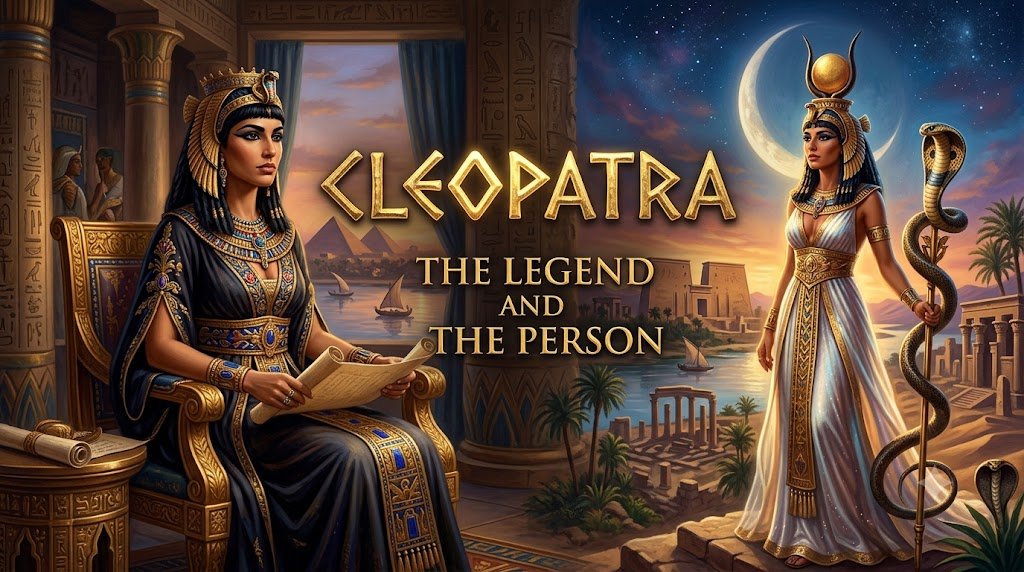
Updated 9 October 2026: corrected a table claim about Plutarch and the marks on Cleopatra’s body. See Corrections.
She spoke somewhere between seven and nine languages and was reportedly the first ruler of her dynasty to bother learning Egyptian. She wrote, or was credited with writing, a technical treatise on weights and measures. She ran a country through a famine and a currency crisis. She held power for twenty-one years in the most dangerous political environment in the Mediterranean.
The best-known fact about her is that she was beautiful, and the one ancient writer who discusses it in any detail, Plutarch, says specifically that her looks alone were not remarkable.
Cleopatra VII has been through more rewriting than almost any figure in ancient history, and the rewriting started while she was still alive, because her enemy in Rome was very good at it.
The propaganda came first
Octavian needed a war and could not have the one he actually wanted. Rome had just come through a century of civil war, and declaring war on Mark Antony, a Roman consul with a substantial following, meant another one.
So he declared war on Cleopatra instead. Antony became a man unmanned by a foreign queen, which made the coming fight a defence of Rome against Egypt rather than Romans against Romans.
The material produced in that campaign is where the durable image comes from: the seductress, the drinker, the manipulator of better men. Horace, Propertius and Virgil all wrote under the settlement Octavian built, and Roman writers afterwards inherited the frame. Plutarch, our fullest source, wrote well over a century later and worked from that inheritance, though he is more careful than most.
Then Plutarch says something that survived despite fitting nobody’s agenda: that her beauty was not in itself incomparable, and that what actually held people was her presence, her conversation and the sound of her voice.
Legend against record
| The legend | The record |
| An Egyptian queen | Macedonian Greek by ancestry, from the Ptolemaic line founded by one of Alexander’s generals. Her family had ruled Egypt for about 250 years |
| Famous for her beauty | Plutarch explicitly says her looks alone were not remarkable and credits her charm, intellect and voice. Her coin portraits show a strong nose and prominent chin |
| Seduced Caesar rolled inside a carpet | Plutarch describes a bed sack or bedding bag, smuggled past guards. The carpet is a later embellishment |
| A decorative figure beside powerful Romans | Sole or senior ruler of Egypt for twenty-one years, controlling grain, papyrus and the Alexandrian treasury, which is why Roman leaders needed her |
| Died by asp bite to the breast | Plutarch reports the snake story as one version among several, notes that no snake was found and that only faint, indistinct marks were reported on her arm, and records an alternative involving poison hidden in a comb |
| Bathed in donkey milk, dissolved a pearl in vinegar | Pliny tells the pearl story as an anecdote about extravagance. It is a moral tale, not a report |
What she was actually doing
The reign was a permanent crisis in resource management. The Nile flood failed repeatedly in the 40s BCE. Cleopatra devalued the coinage, and a surviving papyrus from 33 BCE grants a tax exemption to a Roman associate of Antony, with a single word at the bottom that may be in her own hand, meaning approximately let it be done.
That papyrus is the closest we get to touching her. One word, on a tax document.
Her foreign policy was the only one available to a country in her position. Egypt was rich and militarily outmatched. Rome was going to have Egypt one way or another. Aligning with a specific Roman, backing him, and making Egypt indispensable to him was not romance, it was the survival strategy of a state with money and no army. She did it twice, with Caesar and then with Antony. It worked for twenty years and then it failed, and the failure has been read backwards as the whole story.
The end
Antony died first, after Actium and the collapse at Alexandria. Cleopatra survived him by days, long enough to negotiate and to understand that Octavian intended to display her in a triumph.
Plutarch, writing at a distance, gives the snake version and then undercuts it. No one saw a snake. No snake was found. The marks on the body were doubtful. He offers a rival account in which the poison was concealed in a hollow comb.
Modern historians generally consider a fast-acting poison more likely than a cobra, whose bite is neither quick nor tidy. The asp survived because it was the better image, and because a queen who chooses an Egyptian royal symbol as the instrument of her death makes a much more satisfying ending than a woman with a vial.
Her son by Caesar, Caesarion, was killed on Octavian’s orders. Her three children by Antony were taken to Rome and raised by Antony’s Roman wife, Octavia, which is one of the least expected details in the whole affair. Her daughter, Cleopatra Selene, later became queen of Mauretania and named her own son Ptolemy.
Frequently asked questions
Was Cleopatra Egyptian? She was born in Egypt and ruled it, but her ancestry was Macedonian Greek, from the Ptolemaic dynasty founded after Alexander’s death. She was reportedly the first of her line to learn the Egyptian language.
Was Cleopatra beautiful? Plutarch, our fullest ancient source, says her appearance alone was not extraordinary and attributes her effect on people to her intelligence, charm and voice. Her coin portraits are not flattering.
Did Cleopatra die from a snake bite? It is one of several versions Plutarch reports, and he notes that no snake was found and the marks on her body were unclear. A concealed poison is generally considered more likely.
How long did Cleopatra rule Egypt? About twenty-one years, from 51 BCE to 30 BCE, initially as co-ruler with her brothers and later as sole ruler.
Why did Rome go to war with her? Octavian needed to fight Mark Antony without declaring civil war, so he declared war on Cleopatra and framed the conflict as Rome against a foreign queen.
What happened to her children? Caesarion, her son by Julius Caesar, was executed. Her three children by Antony were taken to Rome and brought up by Octavia. Her daughter later ruled Mauretania as queen.
Sources
Primary: Plutarch, Life of Antony, especially sections 25 to 29 for the description of her manner and 84 to 86 for her death. Cassius Dio, Roman History, books 50 and 51. Pliny the Elder, Natural History, book 9, for the pearl anecdote. The Berlin papyrus of 33 BCE carrying the tax exemption and the single subscript word.
Modern scholarship: Duane W. Roller, Cleopatra: A Biography (2010), which is the most careful recent treatment and is scrupulous about separating evidence from tradition. Prudence J. Jones, Cleopatra: A Sourcebook (2006), which gathers the ancient testimony. Diana E. E. Kleiner, Cleopatra and Rome (2005), on the coin portraiture and visual record.