For most of the 20th century, archaeologists thought they understood the sequence.
Agriculture came first. Surplus food enabled permanent settlement. Settlement enabled specialization, which enabled monumental construction. Then, finally, civilization. Religion. Art. All of that followed from farming, in the proper order, because that was the only way any of it made sense.
Then someone dug up a hill in southeastern Turkey and the sequence collapsed.
What Was Under the Hill
In 1994, German archaeologist Klaus Schmidt visited a site near the city of Sanliurfa that an earlier survey had dismissed as uninteresting. Schmidt looked at the ground differently. He recognized the shape of things beneath the surface. He began to excavate. What he found was not supposed to be there.
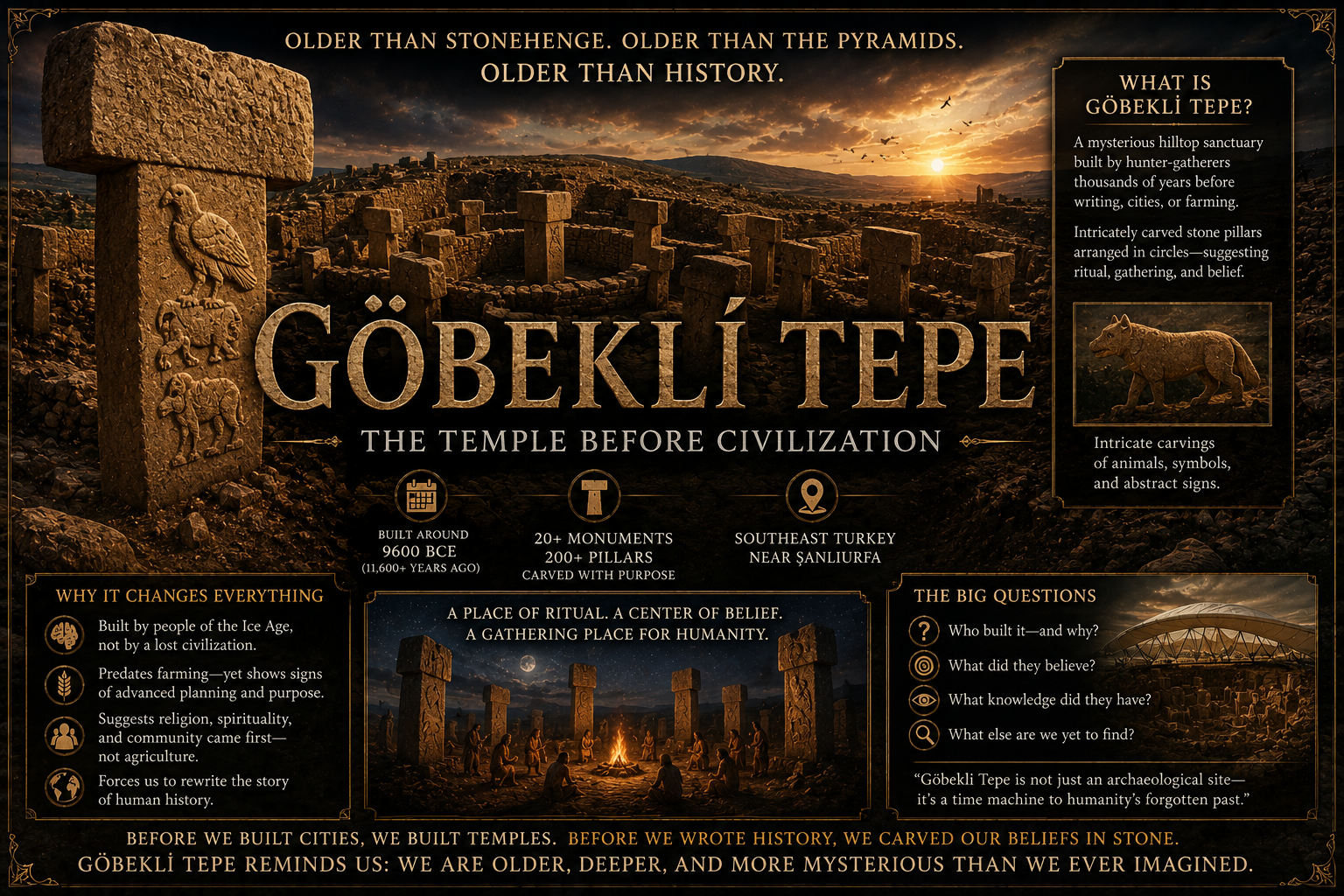
Circular enclosures, multiple of them, built from massive T-shaped limestone pillars some weighing up to twenty tons and standing more than five meters tall. The pillars were not rough-hewn. They were carved, in detail that suggested something beyond simple utilitarian labor. Foxes. Vultures. Lions. Scorpions. Ducks. Spiders. A complete
vocabulary of the animal world rendered with genuine artistic intention, in stone, by hands that had no metal tools, no writing, no cities, and apparently no agriculture.
Some of the pillars had abstracted human arms carved into their sides, as if the stone columns themselves were not architectural features but standing beings of some kind, witnesses or participants in whatever happened here.
Dating came back at somewhere between 11,500 and 12,000 years old. Predating Stonehenge by seven thousand years. Predating the Egyptian pyramids by eight thousand.
The Logistics Problem
Move one of those pillars. In your mind, just try it. Twenty tons of limestone, quarried from bedrock half a kilometer away, transported uphill without wheels, without draft animals, without any of the mechanical advantages that later civilizations would develop specifically because they needed to move heavy things.
The construction of Göbekli Tepe required hundreds, possibly thousands of people working in organized shifts over extended periods of time. Multiple enclosures were built across what appears to have been a sustained, multigenerational project. This is not casual labor. This is the kind of coordinated effort that requires planning, leadership, shared purpose, and, critically, something to feed all those people while they work.
They were hunter-gatherers. There was no surplus. There were no storage silos and no granaries within range of the site. The textbook said this was impossible.
The Reversal That Changed Everything
Klaus Schmidt spent years wrestling with the implication before finally stating it clearly. What if religion came first? What if the need to maintain a sacred site, to gather a community regularly for ritual purposes, created the logistical pressure that eventually drove people toward agriculture?
You need to feed the builders. Feeding a large, semi-permanent workforce requires more reliable food production than hunting and gathering alone can sustain. The problem of the temple creates the incentive for the farm.
This is not established fact. It is a hypothesis, and it is contested, and the archaeological community has not reached consensus. But it has been taken seriously by enough serious people that it has genuinely complicated one of archaeology’s most foundational assumptions. The possibility that religion, not agriculture, was the first engine of human civilization is now a legitimate scholarly position rather than a fringe idea
Why They Buried It
Around 10,000 years ago, someone filled Göbekli Tepe in.
Not gradually, not through the accumulation of sediment over time, but deliberately, methodically, with rubble and soil and stone until the entire complex was sealed beneath what looked from the outside like an ordinary hill. The enclosures were hidden. The pillars were buried. The hilltop became featureless.
Nobody knows why. There is no evidence of catastrophe, no fire layer, no sudden disruption. The filling appears organized and intentional. Some researchers describe it as ritual decommissioning, a sacred site ceremonially closed when its purpose was complete or when the community that sustained it moved on. What that purpose was, and what completion looked like, we cannot currently say.
What we know is that the burial preserved the carvings with extraordinary completeness. The hill held its secret for ten thousand years. And less than five percent of the site has been excavated.
Frequently Asked Questions
How old is Göbekli Tepe?
Approximately 11,500 to 12,000 years old, dating to roughly 9600 to 7300 BCE. It is the oldest known temple complex in the world, predating any other comparable monumental structure by thousands of years.
Who built Göbekli Tepe?
Hunter-gatherers living in the region of what is now southeastern Turkey. Their specific cultural identity cannot be determined from current evidence, but they were the ancestors of the people who later developed agriculture in the Fertile Crescent.
Why was Göbekli Tepe deliberately buried?
This is one of the genuinely open questions. The burial was methodical and appears intentional. The leading hypothesis among researchers is ritual decommissioning, but no definitive explanation has been established.
What do the carvings depict?
Animals, primarily: foxes, vultures, scorpions, lions, ducks, snakes, and spiders. Some pillars also feature abstracted human arms. The specific meaning of the imagery is not understood.
How does Göbekli Tepe change our understanding of history?
It suggests that organized religion and monumental construction preceded agriculture, potentially inverting the foundational assumption that farming came first and everything else followed. This has significant implications for how we understand the origins of civilization itself.
A Final Thought
Twelve thousand years ago, people who had no cities and no farms and no metal moved twenty-ton stones up a hill and carved foxes into them with precision and intention. Then they buried the whole thing, carefully, like a secret worth keeping. The hill kept it for ten thousand years. We have barely begun to look at what is still down there. Every answer the site produces seems to generate two more questions, which is perhaps the most human quality the place has. The people who built it were asking questions too. We just do not yet know what they were.