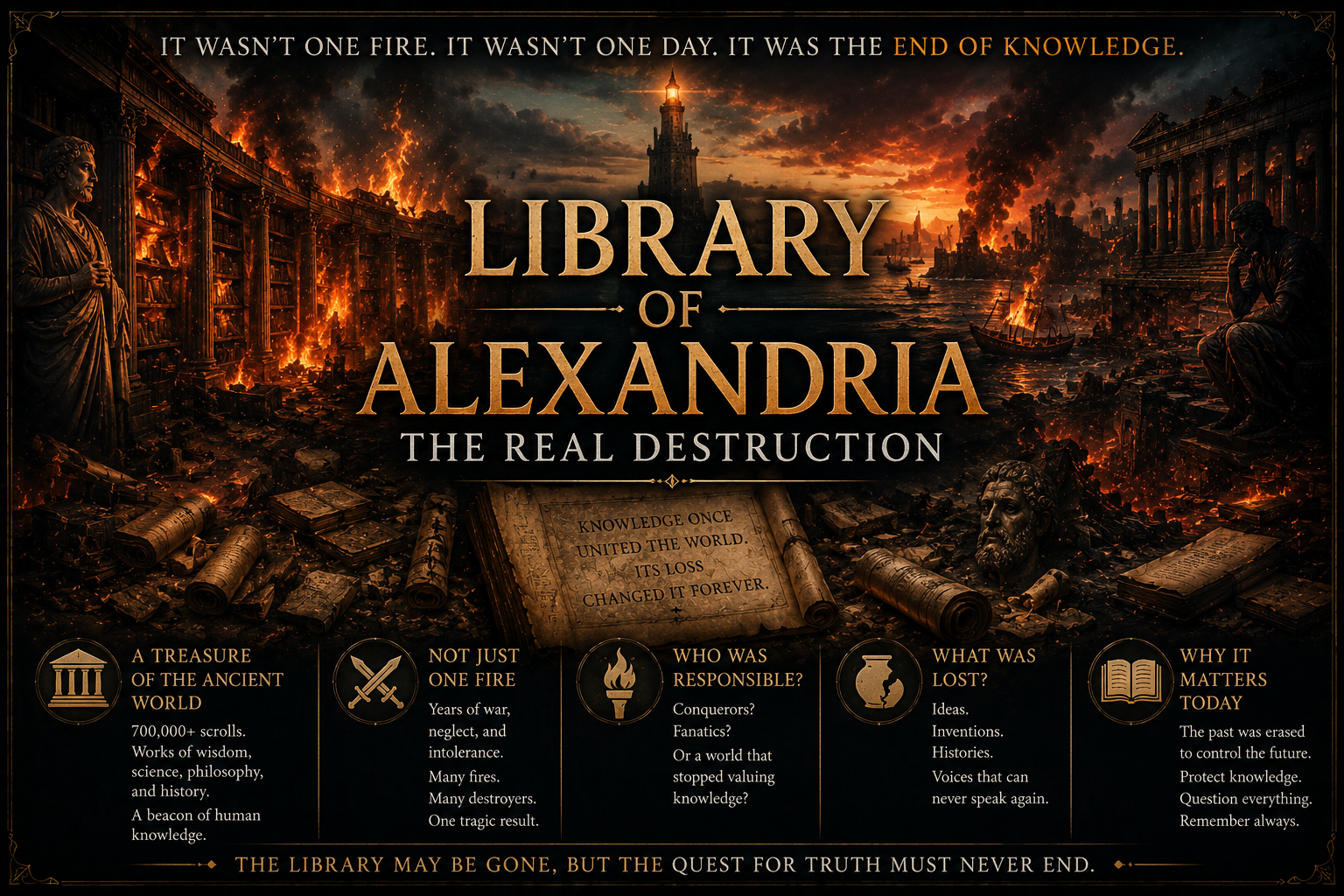
Everyone knows the story. Julius Caesar. One catastrophic night. The greatest repository of human knowledge in the ancient world in flames, centuries of scholarship turning to ash while the harbor burned and history stood by helpless. It is one of those losses that lodges in the imagination like a splinter, irreducible and permanent. All that
knowledge. Gone, in a night.
The problem is that is not quite what happened.
What the Library Was
Before we can mourn what was lost, it helps to understand what was actually there. The Royal Library of Alexandria was not, in the modern sense, simply a building full of shelves. It was a research institution. A living intellectual community funded by the Ptolemaic dynasty at extraordinary expense, where scholars were not merely permitted to
study but were paid to live there and work, supported in the way that court composers and court painters would later be supported by Renaissance princes. It was a museum in the older meaning of that word: a house of the Muses, a place dedicated to the life of the mind as a serious public enterprise.
Euclid wrote his Elements there, or at minimum produced the work in that intellectual atmosphere. Eratosthenes, working as the library’s third chief librarian, calculated the circumference of the earth using the angle of shadows in two different cities and got an answer that was, by modern measurement, remarkably close. Callimachus built the first systematic library catalogue in human history, 120 volumes cataloguing the collection by genre and author.
The books themselves were gathered by methods that would today be considered aggressive at best. Ships entering the harbor at Alexandria had their scrolls confiscated, copied, and the copies returned while the originals went into the library. Ptolemy III borrowed the official Athenian copies of the great tragedies for copying purposes and simply kept them, sending back duplicates, and paying the deposit he had promised toforfeit cheerfully.
They wanted everything. They got most of it.
What Caesar Actually Did
In 48 BCE, Julius Caesar arrived in Alexandria in pursuit of Pompey and found himself almost immediately tangled in the civil conflict between the young Ptolemy XIII and his sister Cleopatra. He set fire to ships in the harbor to prevent them falling into enemy hands.
Ancient sources, including Plutarch and Strabo, mention books being destroyed in the fire that spread from the harbor. This is where the narrative of the library’s burning originates. But read those same sources carefully and something important emerges: what burned was almost certainly a warehouse district near the waterfront, likely containing books that had been inventoried for export. The library itself, situated in the royal quarter some distance inland, appears to have survived this event largely intact.
The clearest evidence is Strabo himself. He visited Alexandria roughly two decades after Caesar’s fire and used the library’s resources extensively. His writings show no awareness of a catastrophic loss. A scholar working from the collection of a burned library tends to notice.
The Slower Truth
The real story of the Library of Alexandria’s end is not dramatic. That is precisely why
it never became a famous story.
After the Ptolemies, Rome administered Egypt and Roman emperors had their own cultural priorities, which did not necessarily include maintaining someone else’s monument to Greek intellectual life. Funding became irregular. The position of chief librarian, once one of the most prestigious posts in the Mediterranean world, declined in visibility and importance. Without institutional continuity, the scholars who had made the library a living thing began to drift elsewhere.
There were specific destructive events along the way. The district containing much of the library complex was damaged during the Roman emperor Aurelian’s violent suppression of a revolt in the 270s CE. The Serapeum, a temple complex that housed a secondary library collection, was destroyed in 391 CE during the Christian suppression of pagan religious sites.
The Arab conquest of 641 CE produced a famous story about Caliph Omar ordering the books burned as redundant since the Quran was sufficient, but most historians consider this tale a later fabrication designed to shift blame.
What Was Actually Lost
The real loss is measurable not in flames but in absences. Aristotle’s dialogues, which ancient sources tell us were elegant and publicly accessible in a way his surviving lecture notes are not. The complete works of Menander, the comic playwright, of whom only fragments exist. The original astronomical observations of Hipparchus. Dozens of plays by Sophocles and Euripides that later catalogues reference and we have never read.
We know these things existed because other ancient writers cited them. We know we do not have them. That is all we know. No fire explains all of it. Neglect and time and the slow cessation of copying explain more.
The Lesson That Is Harder to Accept
The burning library is a better story than gradual institutional collapse. It has a villain, a moment, a clear arc of cause and effect. What it cannot account for is the truth that knowledge tends to disappear not through spectacular catastrophe but through the slow withdrawal of people who no longer think it matters enough to maintain.
Libraries are not usually destroyed by fire. They are abandoned by the living.
Frequently Asked Questions
Did Julius Caesar burn the Library of Alexandria?
Caesar’s harbor fire in 48 BCE likely destroyed warehouse space containing books near the waterfront. Whether the library itself was significantly damaged is disputed, and most modern historians believe it survived this event substantially intact.
What happened to the Library’s scrolls?
The collection was lost gradually across several centuries through political instability, shifting patronage, specific acts of destruction, and the simple cessation of copying and maintenance programs.
How many scrolls did the Library hold?
Ancient estimates range from 400,000 to 700,000 scrolls, figures that are difficult to evaluate. Modern historians tend to believe these numbers were exaggerated, though the collection was undeniably vast.
Is there a modern Library of Alexandria?
Yes. The Bibliotheca Alexandrina opened in 2002 near the ancient site and operates as a major contemporary research and cultural institution.
Who destroyed the Library of Alexandria?
No single person or event bears full responsibility. The decline was a process spanning centuries, involving neglect, political change, specific acts of violence, and the gradual failure of the institutional will to preserve something extraordinary.
A Final Thought
The Library did not burn in a night. It faded over centuries, the way all things sustained by human attention and conviction fade when that attention finally turns away. Scholars left when the money did. Scrolls deteriorated when no one kept the conditions right for their survival. Texts were never copied when the copying program quietly ended.
The fire is the story we tell because fire has a clear shape and a clear ending. The truth is harder and longer and less satisfying. Knowledge disappears the same way everything else disappears: slowly, then completely, one unnoticed absence at a time.