Most apocalypse stories end.
Ragnarok restarts, and everything interesting about it follows from that.
Where the Story Comes From
Almost everything known about Ragnarok comes from two Icelandic sources, and both carry the same caveat.
The Poetic Edda is a collection of older anonymous poems. The Völuspá, the prophecy of the seeress, is the most important of them. The Prose Edda was written around 1220 by Snorri Sturluson, an Icelandic chieftain, poet and politician.
Iceland converted to Christianity around the year 1000.
So Snorri was a Christian writing about pagan belief two centuries after his country stopped practising it, partly to preserve the poetic vocabulary his craft depended on. How much of what we have reflects genuine Norse belief, and how much reflects a medieval Christian’s reconstruction, is a real and unresolved argument.
The Signs
The sequence is unusually detailed for a myth of this kind.
- Moral collapse. An age of brothers killing brothers, broken oaths, general savagery.
- The Fimbulwinter. Three consecutive winters with no summer between them.
- The sun and moon devoured. The wolves Sköll and Hati finally catch the lights they have chased across the sky.
- The chains break. Fenrir the wolf gets free. Loki escapes his binding.
- Yggdrasil shudders. The world tree trembles and the mountains fall.
- Heimdall sounds the Gjallarhorn. The alarm that musters the gods.
- Naglfar sails. A ship built from the untrimmed nails of the dead carries the forces of destruction.
Who Dies
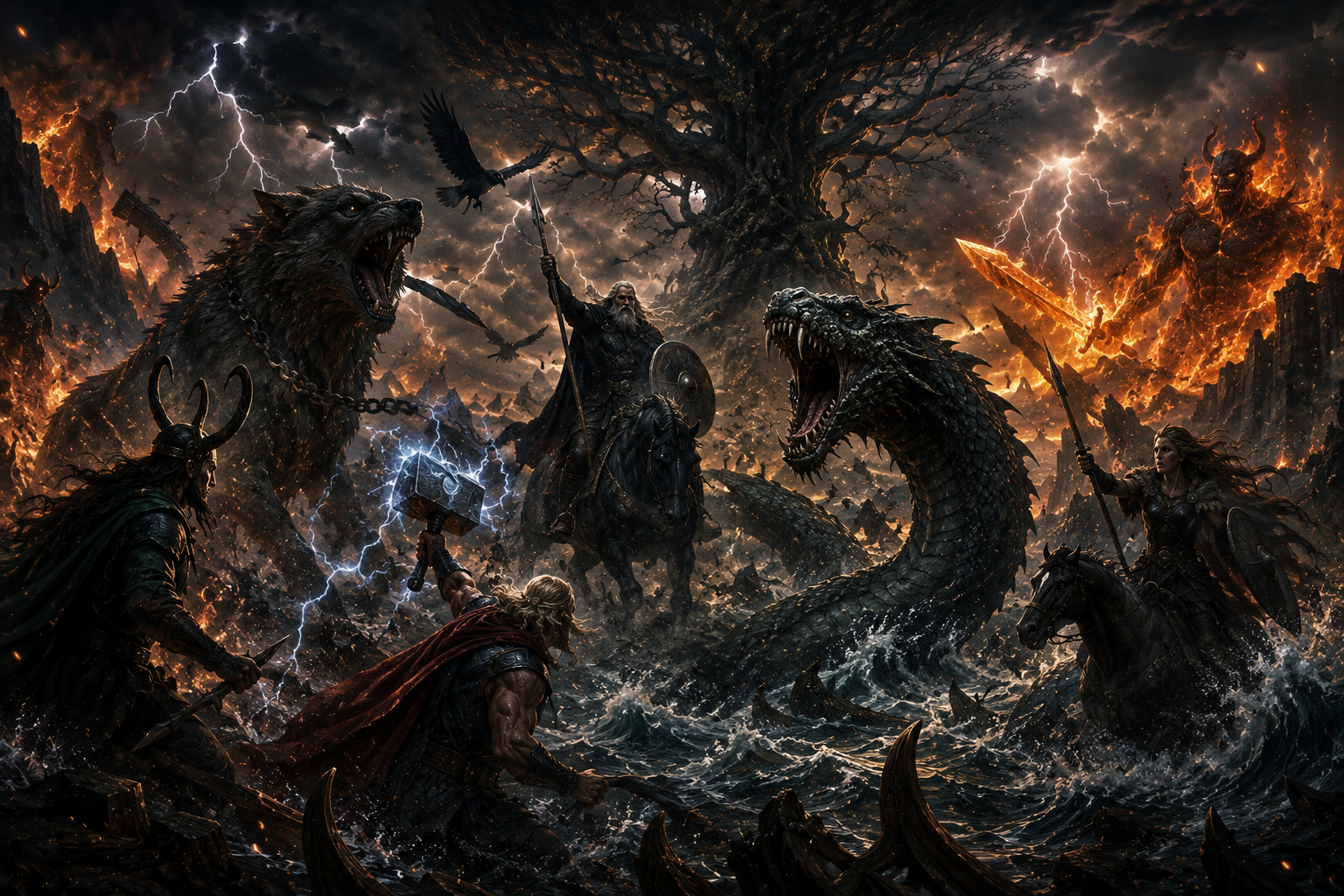
The battle is fought on the plain of Vígríðr, and Norse myth is oddly specific about who kills whom.
Odin is swallowed by Fenrir. His son Vídarr kills the wolf afterwards.
Thor kills Jörmungandr, the world serpent, then walks nine paces and dies of its venom.
Freyr falls to the fire giant Surtr, having given away his sword generations earlier to win a wife.
Heimdall and Loki kill each other. Týr and the hound Garmr do the same.
Then Surtr sweeps fire across the world, and the land goes down under the sea.
The Freyr detail is worth pausing on. He traded his weapon for a marriage long before any of this, and at the end of the world he fights without it and dies. The Norse were not sentimental about consequences.
The Part Everybody Forgets
The Völuspá does not stop at the fire. The seeress keeps talking.
The earth rises again from the sea, green and fertile. Grain grows in fields nobody sowed. A handful of gods survive: Vídarr, Váli, and Thor’s sons Móði and Magni, who inherit their father’s hammer.
Baldr, murdered before Ragnarok through Loki’s scheming, returns from the dead.
The surviving gods find the old golden game pieces lying in the grass, where somebody had left them before any of it went wrong. It is a small image and it does an enormous amount of work.
Two humans, Líf and Lífthrasir, ride out the destruction hidden in a wood and repopulate the world.
This is not a story about everything ending. It is a story about a corrupted world being cleared away, and Norse cosmology treats that as necessary rather than tragic.
Preparing for It
One detail explains why a warrior culture built a mythology around a battle its gods would lose.
Odin spends the myths preparing. He hangs himself on Yggdrasil for nine nights to win the runes. He gives an eye for a drink from Mimir’s well. He collects the slain, half to Freyja and half to his own hall, and the einherjar feast and fight in Valhalla every day.
All of it is preparation for Ragnarok. And none of it works. Odin still dies, swallowed by the wolf he knew would kill him.
A bleak logic runs through this, and it fits the society that produced it. A warrior in tenth-century Scandinavia knew roughly how his story ended. The mythology did not offer him escape. It offered him company.
Stones That Show the Overlap
Physical evidence for Ragnarok survives in stone, and it complicates the Christian-influence question in a useful way.
The Gosforth Cross in Cumbria, carved in the tenth century, is a Christian monument. Its shaft carries scenes that most art historians read as Ragnarok: a bound figure generally taken for Loki, and a figure driving a spear into a monstrous mouth, set alongside a crucifixion. The identifications are probable rather than certain, since the carvings carry no inscriptions.
Thorwald’s Cross on the Isle of Man shows a figure with a spear and a bird, a wolf at his foot, next to Christian imagery.
These are not confused craftsmen. They are communities that had recently converted, placing their old cosmology beside the new one, apparently seeing a parallel between a world that ends and is renewed and a resurrection.
Which is exactly why the rebirth section is hard to assess. It fits pagan cyclical thinking. It also fits what a Christian audience wanted to hear.
The Seeress Who Tells It
The Völuspá is structured as a report, and who is reporting matters.
Odin has summoned a völva, a seeress, and she speaks the poem. She addresses him directly, describes what she has seen, and at several points needles him about what he already knows and what he gave up to learn it.
The whole account of the end of the world is therefore framed as something Odin went looking for. He is not warned. He asked.
The poem ends with the seeress sinking back down. She has said what she came to say, and the god now knows precisely how he dies.
What Wagner Changed
The German phrase Götterdämmerung, twilight of the gods, comes from Richard Wagner’s opera cycle completed in 1874, and it has shaped how the myth is understood ever since.
The Old Norse word is ragnarök, meaning fate or doom of the powers. A variant, ragnarökkr, does mean twilight of the gods, and Snorri may have used it. Whether that was a genuine alternative or a scribal slip is debated.
Wagner’s version is heavy with romantic pessimism and the grandeur of ending. The Icelandic sources are stranger, more procedural, and considerably more hopeful.
Modern films and games have generally inherited Wagner rather than the Völuspá.
Going Anyway
Ragnarok gets used as shorthand for total catastrophe, which gets it almost exactly backwards.
The gods know it is coming. They know the sequence. They know which enemy will kill each of them, and in several cases they have known for a very long time.
They go anyway, and they go knowing.
That is the ethical core of the myth, and it explains why a warrior culture found it worth preserving. Ragnarok is not about avoiding the end. It is about conducting yourself well in full knowledge that the end arrives regardless, and trusting that something grows afterwards.
Frequently asked questions
What is Ragnarok?
The Norse account of the world’s destruction in a final battle between the gods and their enemies, followed by the world’s rebirth from the sea.
Which gods die?
Odin, Thor, Freyr, Heimdall, Loki and Týr all fall. Vídarr, Váli, Móði and Magni survive, and Baldr returns from the dead.
Does the world end permanently?
No. The earth rises again, green and fertile, and two humans named Líf and Lífthrasir survive to repopulate it.
Where does the story come from?
Mainly from the Poetic Edda, especially the Völuspá, and from Snorri Sturluson’s Prose Edda, written around 1220.
What is the Fimbulwinter?
Three consecutive winters with no summer between them, one of the signs that Ragnarok is approaching.
How does Thor die?
He kills Jörmungandr, the world serpent, then walks nine paces and dies from its venom.
Is Ragnarok the same as Götterdämmerung?
Not exactly. Götterdämmerung is Wagner’s operatic title from 1874, and his reading is considerably gloomier than the Icelandic sources.
Sources consulted