In 138 BCE, a Han official named Zhang Qian rode west out of China with about a hundred men and a diplomatic mission that was going to fail badly.
The emperor Wu wanted allies against the Xiongnu, the steppe confederation that had been raiding the northern frontier for generations. Zhang Qian was to find a people called the Yuezhi, who had their own grievance against the Xiongnu, and propose a joint war.
He was captured almost immediately.
Ten Years in the Wrong Place
The Xiongnu held him for roughly a decade. He married among them and had a son. Han sources note, with what reads like genuine admiration, that he kept the imperial staff of authority with him the entire time.
Eventually he escaped and, rather than turning for home, continued west to complete the mission.
He found the Yuezhi. They had resettled in fertile country in Bactria, they were comfortable, and they had no interest whatsoever in marching back east to fight anybody. Zhang Qian was refused, was captured again on the return journey, escaped again, and reached Chang’an around 125 BCE with two survivors of the original expedition.
The alliance was a dead loss.
What he brought back instead was a report. Kingdoms the Han court had not known existed. Cities. Markets. Agriculture. And, in the Ferghana Valley, horses so superior to anything in China that the court would eventually go to war to acquire them.
The Han had thought of the west as empty. It was not empty. It was full of people who wanted to trade.
Nobody Called It the Silk Road
The name arrived in 1877, when the German geographer Ferdinand von Richthofen coined Seidenstrasse to describe the routes in a work of geography. It stuck, and it has been quietly misleading people ever since.
There was no road. There was a shifting braid of caravan tracks, mountain passes, oasis stops and sea lanes, and no single authority maintained any of it.
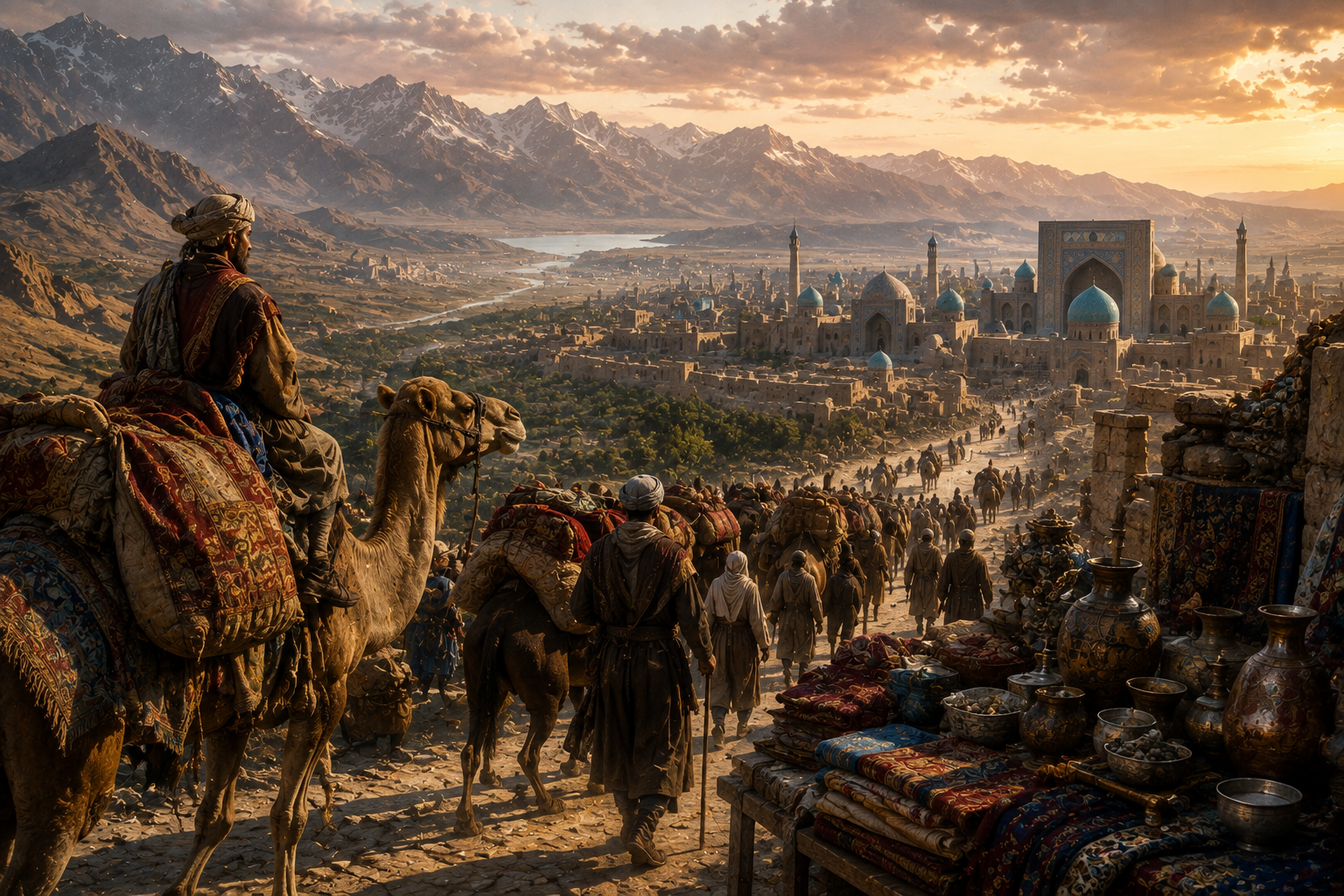
Nor did anyone travel the whole thing. The system worked by relay. A bolt of silk leaving Chang’an might pass through a dozen sets of hands before reaching Antioch, and the merchants in the middle, especially the Sogdians of Central Asia, grew wealthy on transactions at both ends of journeys they never made.
What actually moved:
- West out of China: silk, paper, lacquerware, ceramics, tea, and eventually the techniques of printing and gunpowder
- East toward China: horses, glassware, wool, gold, silver, gemstones, grapes and alfalfa
- North from India: cotton, spices, ivory, and Buddhist scripture
- From the steppe and mountains: jade, furs, and the middlemen who made the whole arrangement function
Cities Built Out of Passing Through
A relay network needs places to stop, and those places got rich.
Samarkand sat where several branches converged and could afford astronomers. Dunhuang was the last substantial settlement before the desert crossing, which is why it accumulated a religious complex whose cave temples still hold thousands of manuscripts and centuries of mural painting. Kashgar, Merv, Bukhara and Chang’an all grew on the same logic.
The cosmopolitanism of these places is easy to underestimate from a distance. A market street in eighth-century Chang’an could hold Sogdian traders, Persian musicians, Indian monks and Korean students, and the Tang court employed foreigners at senior levels.
Running alongside all of this, and for a long time neglected by historians, was the sea. Ships moved between Chinese ports, Southeast Asia, India, the Persian Gulf and the Red Sea, carrying bulk cargo more cheaply than any camel. Current scholarship increasingly treats the maritime and overland systems as one network rather than two.
The Cargo That Mattered Most Was Not Cargo
Silk made merchants rich. Ideas rearranged civilisations.
Buddhism travelled north out of India and east into China with monks who moved alongside merchant caravans, arriving around the first century CE and permanently altering Chinese religion, art and philosophy. The painted caves at Dunhuang exist because that transmission passed through them.
Paper went the other way. Chinese papermaking spread into the Islamic world during the eighth century, reached Baghdad, and eventually arrived in Europe, where it replaced parchment and made the printed book economically thinkable several centuries later.
Astronomy, medicine, mathematics and metallurgy moved in both directions and were absorbed, argued with, and improved. Religions travelled that most people have now forgotten were ever there: Manichaeism, Nestorian Christianity, Zoroastrianism, each leaving inscriptions and communities along routes where they are no longer practised.
A Letter That Never Arrived
In 1907, in the ruins of a watchtower west of Dunhuang, the archaeologist Aurel Stein found a bundle of letters written in Sogdian, sealed and undelivered. They date to around 313 CE, and they had been sitting in the sand for sixteen hundred years because the postal arrangement failed.
Most are commercial. One is not.
A woman named Miwnay writes to her mother. She has been stranded in Dunhuang, abandoned by her husband, a merchant named Nanai-dhat, and left without money or means to get home. She has been reduced to depending on charity from the local priest. The letter to her husband, in the same bundle, is furious in a way that needs no translation across seventeen centuries.
This is what the Silk Road looked like from inside. Not a romance of camels and silk bales, but a system that carried people enormous distances from anyone who could help them, and occasionally left them there.
And Then the Plague
The network that carried paper and the Buddha also carried Yersinia pestis.
The Black Death that reached Europe in 1347 came west along these routes from Central Asia, moving with caravans and then with grain ships. Recent genetic work has traced its origins to the Tian Shan region and identified a surge of plague activity there in the 1330s.
This is not an argument against connection. It is a reminder of what connection is. A world integrated enough to move silk from Chang’an to Rome is a world integrated enough to move a bacterium along the same line, at the same speed, using the same infrastructure.
The Silk Road was never a moral project. It was a set of roads, and roads do not choose their traffic.
The Peak and the Fade
The routes were at their safest under the Mongols. For roughly a century in the thirteenth and fourteenth, a single political authority ran from Korea to eastern Europe, and travel became more secure than it had been in living memory. Marco Polo left Venice in 1271 and did not return until 1295, which was possible largely because of that. The traveller Ibn Battuta crossed much of this world in the fourteenth century.
The decline came from four directions at once.
The Mongol Empire fragmented and the corridor lost its single authority. The Black Death emptied cities along the route. Shipbuilding improved to the point where sea freight beat overland on price and risk. And European powers began sailing to Asia directly, cutting out every middleman between Venice and Guangzhou.
By the sixteenth century the continental system had broken back down into regional roads.
Zhang Qian never knew any of this. He died around 113 BCE, having failed at the task he was given and succeeded at something nobody had asked him to do.
Frequently asked questions
When was the Silk Road active?
From roughly 130 BCE, following Zhang Qian’s westward journey, until it declined as a continental system by around the sixteenth century.
Was it actually a road?
No. It was a shifting network of overland routes and sea lanes with many branches, and almost nobody travelled its full length.
What was traded besides silk?
Paper, ceramics, tea, spices, horses, glassware, gold, jade, cotton and gunpowder, along with religious texts and technical knowledge.
Who named it?
Ferdinand von Richthofen, a German geographer, in 1877. Nobody who used the routes called them that.
How did Buddhism reach China?
Monks travelled with merchant caravans from India through Central Asia, arriving around the first century CE and leaving major sites such as the Dunhuang caves.
Did the Black Death travel these routes?
Yes. The plague that reached Europe in 1347 moved west from Central Asia along the same trade network.
Sources consulted