For most of her adult life, a German mathematician named Maria Reiche walked the Nazca plateau with a broom.
She swept the lines. Two thousand years of desert dust settles even in a place that gets almost no weather, and Reiche cleared it by hand, measured what she found, mapped it, and slept in a small room at the edge of the pampa. She arrived in Peru in the 1930s, began surveying in the 1940s, and did not stop until she physically could not continue. She died in 1998 and is buried nearby.
Peru owes her the site. Before she started campaigning, vehicles drove across the geoglyphs freely, and the Pan-American Highway had already been cut straight through one of them.
What she spent fifty years measuring is still not fully explained. But the part everyone finds mysterious is the part we actually understand.
Drawings You Cannot See
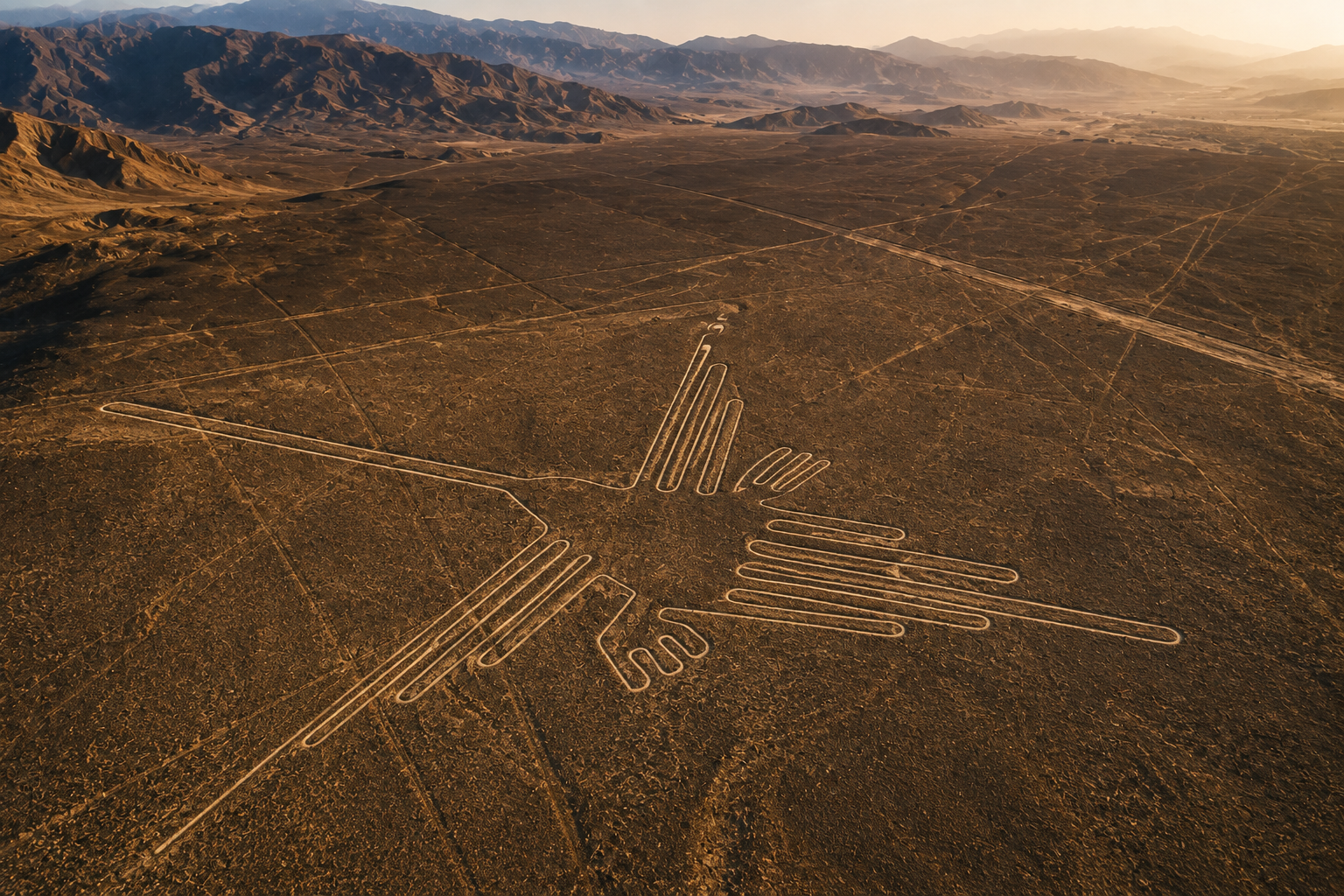
Stand on the Nazca plateau and there is very little to look at. Pale ground, some low ridges, a scattering of dark stones pushed into rough lines. You can walk across a hummingbird two hundred metres wide and register nothing but desert.
Get above it and the plateau resolves into figures.
The current count runs to more than 800 straight lines, around 300 geometric shapes, and roughly 70 animal and plant figures. They were made between about 500 BCE and 500 CE by the Nazca culture and, for some of the earlier work, the Paracas before them.
The largest figures stretch to around 370 metres. Some straight lines run for kilometres, holding their direction across uneven ground with an accuracy that is genuinely hard to achieve.
Why They Are Still Here
The Nazca Desert is one of the driest places on the planet. Rainfall is measured in millimetres per year, and there are stretches where it does not rain at all for years at a time.
There is also an unusual thermal effect. A layer of warm air sits over the darkened surface stones and cushions the plateau against the wind that would otherwise strip it.
Take those two conditions away and the lines would have been gone within a few generations. They survive because of an accident of climate, not because of anything their makers did.
The Method Is Not a Mystery
Here is how you draw a spider three hundred metres across.
The desert floor is covered with reddish-brown pebbles, darkened over centuries by iron oxide. Beneath them lies pale yellow-grey ground. Remove the pebbles along a path, heap them at the edges, and you have a line with high contrast that will hold its shape for two millennia. It is closer to sweeping than to carving.
The scaling problem is more interesting, and it has been solved experimentally. Researchers have reproduced Nazca-sized figures using nothing but wooden stakes, cord and simple measurement:
- Draw the design small on the ground.
- Establish reference points and a grid across it.
- Scale up proportionally using stakes and cord.
- For long straight lines, sight between fixed posts, which stays accurate over very long distances.
Remnants of wooden stakes have been found at the ends of some lines. The evidence fits.
None of this requires flight, and it is worth saying that the assumption it does says more about us than about the Nazca. What it requires is planning, string, and a community willing to put in the labour.
The Figures Themselves
There is a hummingbird with a long straight beak. A monkey with a spiralling tail. A spider. A condor with a wingspan well over a hundred metres. A killer whale. A tree, a pair of hands, a flower.
On a hillside there is a standing humanoid figure with large round eyes, waving. Tour guides call it the Astronaut. It is almost certainly a deity or a shaman, and it is grouped with figures that appear on Nazca pottery.
The Town Down the Valley
The lines did not exist in isolation. About 25 kilometres away lies Cahuachi, a large complex of adobe mounds and plazas that served as the Nazca culture’s principal ceremonial centre.
Excavation there, led over many seasons by the Italian archaeologist Giuseppe Orefici, found something unexpected. Cahuachi has very little domestic refuse. People did not live there in large numbers. They came, performed, deposited offerings, and left.
The plateau also holds puquios, spiral-mouthed underground aqueducts cut into the ground to draw water from subterranean sources. Some still work. Whether they date to the Nazca period or later is argued about, but they demonstrate the same preoccupation the geoglyphs may express: a society organising enormous effort around the problem of water.
What Nobody Has Settled
The purpose is where the genuine debate lives, and the honest position is that several answers may all be partly right across a thousand years of use.
| Theory | The claim | Where it stands |
| Astronomical calendar | Lines mark solstices and star risings | A few alignments hold; most fail statistical testing |
| Water and fertility ritual | Lines relate to underground water and rain ceremony | Many point toward water sources; the region is desperately arid |
| Ceremonial pathways | The figures were walked in procession | Supported by pottery fragments concentrated along the lines |
| Social markers | Different figures belong to different kin groups | Distinct construction styles across the plateau |
Paul Kosok, who studied the site from the 1940s, called the plateau the largest astronomy book in the world. Later statistical work knocked most of that reading down. Point enough lines in enough directions across a desert and some will align with something.
The water theory, associated with the anthropologist Johan Reinhard, has gained ground because it fits the place. In a landscape where survival hinged entirely on scarce and unpredictable water, ritual organised around water is not a stretch. It is the obvious thing for that society to have been anxious about.
Still Finding Them
The plateau became a UNESCO World Heritage Site in 1994. It has been studied for the better part of a century.
And researchers using drone survey and AI-assisted image analysis have identified dozens of previously unrecorded figures in recent years, many of them smaller and older than the famous biomorphs, some visible from the surrounding hillsides rather than only from the air.
That last detail matters more than it sounds. It suggests the whole site was not built for a viewer in the sky. Parts of it were built for people standing on the ground, in the right place, at the right moment.
What Is Actually Strange About Nazca
Not the engineering. We know how they did it.
The strange part is the commitment. A society under real environmental pressure, in one of the driest inhabited places on earth, spent a thousand years drawing figures across a plateau that no individual could see whole, and kept doing it, generation after generation, as their culture changed around them.
Maria Reiche spent fifty years measuring the result and never claimed to know why.
There are worse positions to end up in.
Frequently asked questions
Who made the Nazca Lines?
The Nazca culture of southern Peru, along with the earlier Paracas, between roughly 500 BCE and 500 CE.
How were they made?
By removing dark, iron-oxide-coated surface pebbles to reveal the pale ground beneath and heaping the stones along the edges.
Can you see them from the ground?
Mostly not. Some smaller figures are visible from surrounding hillsides, but the large biomorphs only resolve from the air or from viewing platforms.
What were they for?
Not settled. Water and fertility ritual is currently the strongest theory, with processional use and limited astronomical alignment also supported.
Were they built by aliens?
No. The figures match the artistic style on securely dated Nazca pottery and textiles, and the construction method has been reproduced with tools available at the time.
Are new figures still being found?
Yes. Drone and AI-assisted surveys have identified dozens of previously unrecorded figures in recent years.
Sources consulted